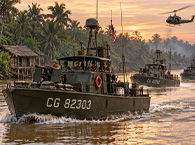
| By Tom Edward How many of you knew the Coast Guard participated in the Vietnam War? Read the attached article to learn more about their role. On April 29, 1965 President Lyndon B. Johnson established a ‘Memorandum of the President’. That document initiated the process of the United States Coast Guard working in conjunction with the United States Navy to prevent communist troops from accessing South Vietnam. The day the Memorandum was signed, Coast Guard Squadron One (RONONE) was established. It consisted of 47 officers and 198 enlisted men. They had  received their training in Coronado, California. Less than a week after the establishment of RONONE, six 82-foot U.S.C.G. cutters were in shipyards for the necessary modifications. Following the yardwork, they were transferred to the Philippines and subsequently rendezvoused with the escort ship USS Snohomish County (LST-1126). 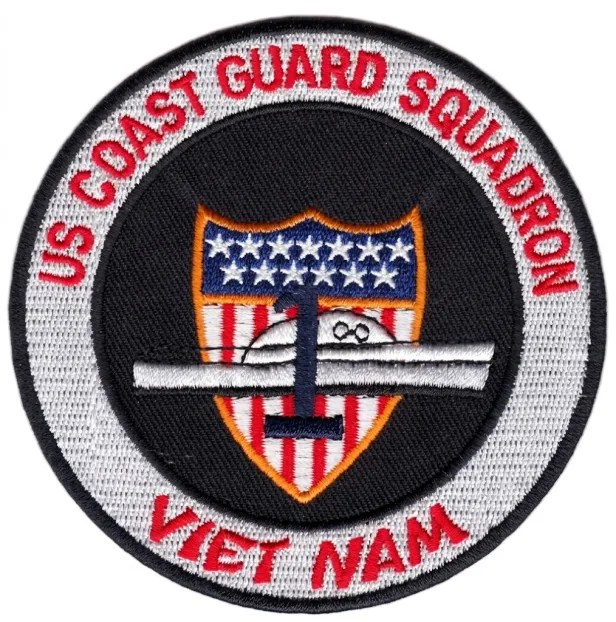 The escort enabled the required refueling given the distance from the Philippines to Vietnam. After 5 days underway, the crews rested at the South Vietnam base located at Con Son Island in the Gulf of Thailand. The following day, 3 cutters were on patrol and the other 3 were relocated to their new home port in An Thoi, a fishing village on the southern tip of Phu Quoc Island, the largest in Vietnam. It is in the Gulf of Thailand. As a USS Krishna crew member, I was stationed there for about 8 months as a Swift Boat maintenance and repair electrician. U.S.C.G. cutters arrived in An Thoi and Da Nang in July 1965. Operation Market Time then transferred from Task Force 71, a Seventh Fleet organization, to Task Force 15, a Military Assistance Command Vietnam organization. The initial squadron eventually consisted of 26 cutters of the ‘Point’ class; shallow-water 82-foot patrol boats tasked with patrolling the South Vietnam coastal waters. During their time in Vietnam, the cutters boarded and searched approximately 250,000 junks and sampans. They also conducted 6,000 gunfire support missions that caused significant damage to enemy structures. During the course of the war, 56 cutters operated in Vietnam. Ultimately, 30 were transferred to South Vietnam. Working with United States Navy patrol boats, the U.S.C.G. cutters significantly helped limit communist infiltration of coastal waters and inland canals. Those successful operations left the enemy with one option; use the Ho Chi Minh trail as the only supply route for forces in the south. In April 1966 a Cambodian patrol in the Gulf of Thailand fired on the cutter Point Comfort. April also saw the Point Partridge capture a Viet Cong Colonel of Engineers and Coast Guard and Navy personnel coordinated to extinguish a fire in An Thoi that had destroyed a number of housing units. In 1966, the Military Assistance Command Vietnam approved having Coast Guard buoy tenders to implement and service aids to navigation (ATON) in South Vietnam. A buoy tender quickly arrived on site to set petroleum buoys designed to provide fuel for American craft. A total of 5 buoy tenders served in Vietnam channels. They also maintained lighthouses along South Vietnam’s coast. Buoy tender crew members trained Vietnamese sailors in ATON maintenance requirements. The Coast Guard constructed and provided the personnel to operate Long Range Aids to Navigation (LORN) stations. Those facilities allowed sailors and pilots to determine their locations. Operation ‘Tight Reign’ established LORAN sites at Con Son Island and Tan My, Vietnam, and Lampang, Sattahip, and Udorn, Thailand.  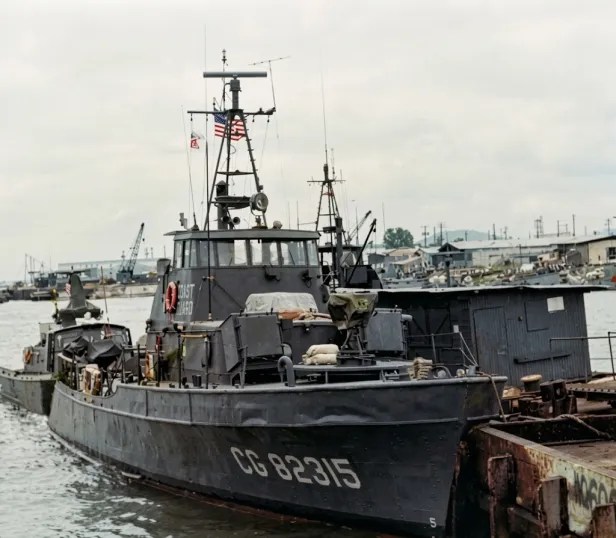 Early in 1967 the Navy requested 5 high-endurance Coast Guard cutters to coordinate with the Navy’s Coastal Surveillance Forces. In May 1967, the cutter Barataria fired the first RONTHREE gunfire of the war. During the following February, cutters Winona and Androscoggin fired on enemy trawlers, destroying them with the support of Coast Guard and Navy patrol boats. During that combat, the cutter Minnetonka drove off another trawler. With the number of craft involved, it was among the largest naval force engagements of the war. The Point Orient led an attack on July, 15, 1967 on an enemy trawler. The trawler sustained disabling damage, was run aground and ultimately captured. Offshore patrol craft utilized by the Coast Guard were constructed to sustain adverse weather conditions. That was not the case for their Navy counterparts; the 50-foot Patrol Craft Fast, also known as Swift Boats, did not share the 82-foot Coast Guard cutter patrol craft design. On Leap Day 1968, 4 trawlers engaged cutters and Swift Boats south of Da Nang. The U.S. destroyed 3 of the trawlers, and the fourth retreated as it headed north. The first trawler initially tried to penetrate the Da Nang barrier and came under fire from the 255-foot high-endurance cutter Androscoggin. The enemy fire was quickly returned. Point Welcome closed in as Point Grey and Patrol Craft Fast used machine gun fire. The trawler fired back and was eventually beached. On March 1 shortly after 2:30 AM, the trawler self-destructed. January 1969 saw the initial transition of Coast Guard cutters to Vietnamese control. Two Vietnamese Lieutenants reported onboard 2 of the cutters. The following month, 17 Vietnamese Navy Ensigns and 2 more Lieutenants were reported as part of the transition. Vietnamese sailors replaced their U.S. counterparts. In ceremonies held in Saigon on May 16, 1969 the cutters Point Garnet and Point League were transferred to the Vietnamese Navy. They were renamed Le Phuc Dui and Le Van Nga. Simultaneously, Coast Guard cutters continued their operations. The Point Banks successfully rescued 9 friendly forces that had been trapped by the Viet Cong. The Point Cypress and Point White worked to prevent a Swift Boat from sinking. The Point White also refloated 2 Swift Boats that had gone aground in Ha Tien. Along with their numerous ongoing activities, as the number of pages on the 1969 calendar diminished, the primary goal of the Coast Guard remained the ongoing turnover as a part of what had become known as Vietnamization. On August 15, 1970, the final 2 cutters, the Point Marone and the Point Cypress were transferred to the Vietnamese. That day, Coast Guard Squadron One and Coast Guard Division Thirteen were disestablished. On January 31, 1971, Coast Guard Squadron Three was disestablished. In early February 1973, the Coast Guard Port and Waterways Detail in Vietnam was disestablished, ending that chapter of Coast Guard history in the Vietnam War.  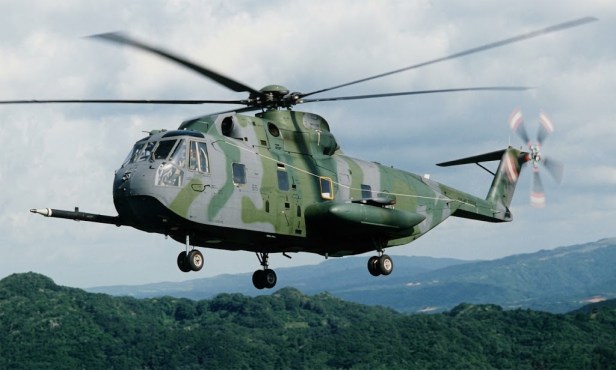 The name ‘Coast Guard’, understandably, generates images of a variety of ships and boats. There were, however, Coast Guardsmen who flew in Vietnam. On April 3, 1968, U.S.C.G. pilots began coordinating Search and Rescue operations with the Air Force. Among the helicopters, the Sikorsky-built HH-3E, better known as the Jolly Green Giant, had 11 Coast Guard aviators. Prior to being stationed in Vietnam, their months of training involved survival techniques and the operation of a Jolly. In country they became members of flight crews frequently with Air Force copilots and engineers. The Douglas Aircraft built A-1 Skyraiders, designed during World War II for the Navy were the last tail-wheeled Navy plane. They frequently served as firepower support aircraft for the helicopters. The United States Air Force A-1’s were pained camouflage, their Navy counterparts were gray and white. The initial group of Coast Guard pilots had orders that established the Coast Guard – Air Force Aviator Exchange Program.  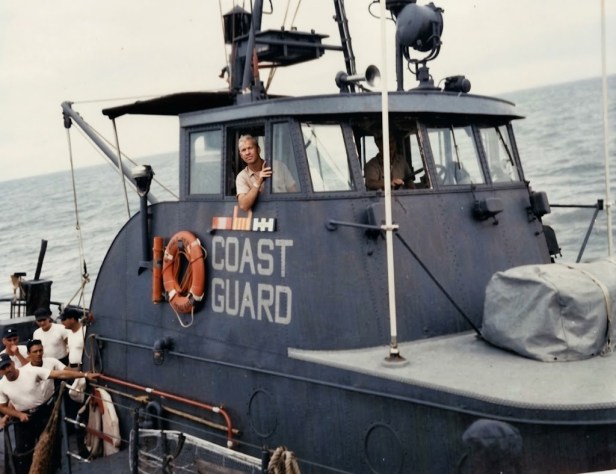 Among the most noteworthy Coast Guard-related air rescue missions began on July 1, 1968, when an F-105 Thunderbird was hit with enemy fire over the Vietnamese peninsula. The pilot, Lt. Col. Jack Modica descended too quickly as he was attempting to reach the gulf and ejected into a jungle canyon. Coast Guard Lt. Cmdr. Lonnie Mixon was the HH-3E pilot during the first rescue mission. The incoming fire he took damaged the fuel tank, electrical systems and hydraulic lines. Despite that damage, he made a second rescue attempt. Anti-aircraft fire forced him to terminate that pursuit. Mixon spent the night in the jungle. He was awarded a Silver Star for his efforts. The second day was unimaginably worse. An A-1 Skyraider was shot down, and the rescue helicopter suffered heavy damage, including an unexploded rocket inside that had penetrated the fuel tank. After multiple unsuccessful attempts, the Air Force ultimately contacted Jolly 21 pilot United States Coast Guard Lt. Lance Eagan and asked him to fly behind a B-52 for a bomber strike. Lt. Eagan and his Air Force flight crew were quickly wheels up. After yet another extensive enemy engagement, Lt. Modica was delivered to a hospital and the crew was later decorated for the courage they had shown. The Jolly, after taking intense enemy fire during the final minutes of the rescue was heavily damaged. The fuselage had taken 40 large caliber hits, 4 of the 5 rotor blades were damaged and the fuel tank had been hit 9 times. The Jolly Green Giant was too damaged to fly and was returned to Da Nang by a heavy-lift CH-54 B Skycrane helicopter. A month prior to that rescue, Coast Guard pilot Lt. Jack Rittichier was shot down while on a rescue flight. He was awarded the Silver Star, the Distinguished Flying Cross and the Purple Heart. The Coast Guard’s support of combat air rescues continued for another 4 years, ending in 1972. The awards they earned included 4 Silver Star Medals, 15 Distinguished Flying Crosses and 86 Air Medals. ***** To continue reading this article which includes more recent United States Coast Guard/Vietnam news, click on the following link: armydocuments.togetherweserved.com/newsletter/161/newsletter.html#article13 Thank you for taking the time to read this. If you have a question or comment about this article, scroll down to the comment section below to leave your response. If you’re interested in learning more about the Vietnam War and its Warriors, subscribe to this blog to receive notifications by email or your feed reader whenever a new story, picture, video, or update is posted on this website. The subscription button is located at the top right of this page. I’ve also created a poll to help identify my website audience. Before leaving, please click HERE and choose the one item that best describes you. Thank you in advance! |
Coast Guard Operations in Vietnam