
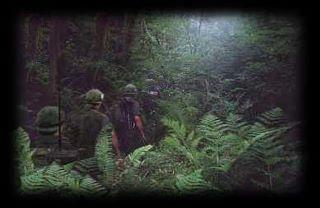
Night is always the most frightening part of the day, especially for a young soldier during war. Read below for one viewpoint.
By SepiaGlyphs ·
The true terror of a night ambush wasn’t the firefight. It was the blinding darkness that followed, as deafened soldiers sat in utter silence, listening for an enemy crawling toward them. Young minds in total darkness tend to imagine a lot, and none of it was good. A minute seemed like an hour, and dawn would never come.
These missions stripped away every technological advantage the U.S. military relied upon, leaving a handful of men completely dependent on their own senses in pitch-black sensory deprivation. During daytime operations, American forces had the advantage of air support, artillery, and visibility. But once the sun set beneath the dense jungle canopy, the environment became a wall of absolute darkness. Starlight rarely penetrated the foliage, meaning soldiers could not see their own hands in front of their faces. The night belonged to the Viet Cong (VC) and North Vietnamese Army (NVA), who were intimately familiar with the terrain and used the darkness to move supplies and stage attacks.
An ambush team—often just a squad of four to twelve men—would quietly slip away from their main unit just before dusk to avoid observation. They would navigate to a suspected enemy trail and set up a “kill zone.” The foundation of this defense was the M18A1 Claymore, a directional anti-personnel mine that fires 700 steel balls in a 60-degree arc when triggered. They also used trip flares, which were usually placed a short distance in front of the Claymores, as early-warning devices.
Australian soldiers check the sighting on an M18A1 Claymore mine during a patrol in Vietnam in 1971. Source: Wikimedia Commons.
Once the explosives were armed and the men were in position, the true psychological toll began. They enforced absolute silence and strict discipline. No talking, no smoking, and no movement. Soldiers lay in the wet jungle for hours, suffering from cramping muscles, monsoon rain, and relentless mosquito bites, unable to swat them away for fear of making a noise.
In the pitch black, imagination became an enemy. Every snapping twig, rustling leaf, or shift in the wind sounded like an approaching patrol. The tension of waiting for an enemy force that might heavily outnumber the ambush team stretched nerves to the breaking point.
If the enemy did enter the kill zone, the squad leader would detonate the Claymores to initiate the ambush. This was immediately followed by the “mad minute”—sixty seconds of overwhelming, coordinated fire from every weapon in the squad to devastate the target area before the enemy could react.
The sudden burst of muzzle flashes and explosions completely destroyed the soldiers’ night vision, plunging them back into an even deeper, deafening darkness. The ambush team then had to wait in absolute silence until dawn, agonizing over whether survivors were crawling through the brush to flank them or a larger enemy element was preparing a counterattack.
ADMIN: The alternative was to call for illumination from the base and conduct a visual recon. Then, pack up and move to a new location. Listening posts were usually more stressful, as the two soldiers were usually outgunned when the enemy was present.
This article originally appeared on Quora.
#####
Thank you for taking the time to read this. Should you have a question or comment about this article, then scroll down to the comment section below to leave your response.
If you want to learn more about the Vietnam War and its Warriors, then subscribe to this blog and get notified by email or your feed reader every time a new story, picture, video and changes occur on this website – the button is located at the top right of this page.
I’ve also created a poll to help identify my website audience – before leaving, can you please click HERE and choose the one item that best describes you. Thank you in advance!


Night is always the most frightening part of the day, especially for a young soldier during war. Read below for one viewpoint. https://cherrieswriter.com/2026/11/01/what-made-the-night-ambush-missions-in-vietnam-so-terrifying-and-intense/
LikeLike