
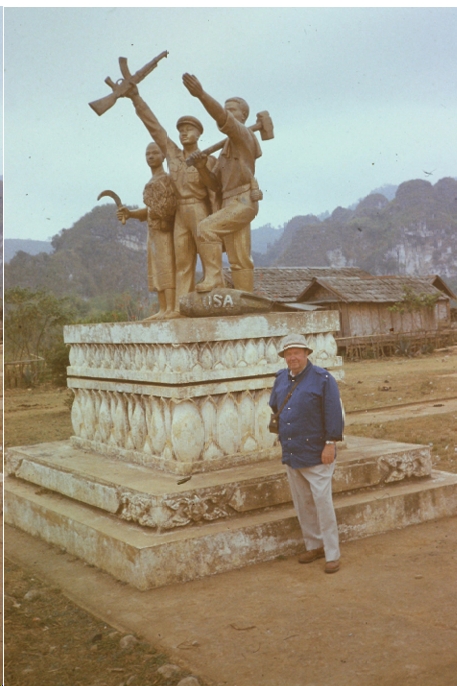
U.S. Army Col. (retired) and former POW Lawrence R. Bailey, Jr., in Sam Neua, Laos, (Photo by Ron Martz)
By Ron Martz
On the morning of March 23, 1961, U.S. Army Major Lawrence R. Bailey, Jr. was faced with what seemed at that moment a rather insignificant choice. That choice, however, would determine whether he would become the first American prisoner of war in Southeast Asia or a name on the first line of the Vietnam Veterans Memorial Wall.
Bailey was little more than six months into his assignment as assistant Army attaché at the U.S. embassy in Vientiane, Laos. His primary job was flying the American ambassador in Laos and other high-ranking officials around the country so they could monitor what was then a messy civil war that few Americans knew, or cared, was being fought.
Laos was designated a neutral country under the terms of the Geneva Convention following the French defeat in Vietnam in 1954. But by the time Bailey arrived in Laos in December 1960, it was anything but neutral. Three factions were fighting for control of the government, and at times it was difficult to know who was fighting who.
One faction, the Pathet Lao, was backed by North Vietnam. The Royal Lao Army was receiving some support from the U.S. A third faction, referred to as the Neutralists, had broken away from the Royal Lao Army and was under the command of a 26-year-old paratroop captain named Kong Le. The Neutralists claimed they wanted no foreign interference in the country but were aided by the Soviet Union and eventually sided with the Pathet Lao.
The fateful decision Bailey made that spring morning involved what type of parachute to wear while flying as a passenger on what he anticipated being a non-combat milk run from Vientiane to Saigon in South Vietnam in an unarmed C-47.
Bailey was an experienced pilot and had served in the Army Air Corps in two wars after learning to fly in his hometown of Waycross, Georgia. He flew B-29 bombing missions over Japan during World War II and was a one-man air-borne artillery spotter in the Korean War, flying a Cessna O-1 Bird Dog over enemy lines.
Bailey had always worn a parachute while flying his missions and opted to wear a bulky backpack chute, the only one on board, on the flight to Saigon. The six crew members and one other passenger were relieved. They wore only a harness to which a canopy stowed in a chest pack could easily be attached in case of emergency, and thus they were able to move around freely while in the air.
Unknown to Bailey until after he was on board the aircraft, it was code-named Rose Bowl and was on a reconnaissance mission to photograph Pathet Lao and Neutralist positions in central Laos.
Little more than 30 minutes into the flight, as Rose Bowl flew over the Plain of Jars, Bailey heard two loud bangs and the aircraft shuddered. He looked out the right-side windows and saw the number two engine engulfed in flames. As a pilot, he instantly realized the plane would not fly much longer. He knew once the fire burned through the spar, the right wing would fold up and break off, and the plane would roll over on its back before spinning into the ground.
“We’re on fire! We’ve got to jump!” Bailey shouted at the others.
The crew scrambled for their parachute canopies stacked against the forward bulkhead. The cargo bay door had been opened, and Bailey jumped out. Just as he did, the right wing came off, and the plane began spinning.
Something hit Bailey hard on his left side as he fell away from the plane into clean air. After several tugs on the D-ring, the parachute popped open, and he landed safely, despite not being able to use his arm to steer with the left riser.
He landed in a grassy field, his left arm badly broken, with no sign of civilization nearby. Beyond a low hill to the east, he saw smoke from the downed C-47 but could not tell if anyone else had exited the aircraft safely. He later learned the seven others were trapped inside when the plane began to cartwheel and died in the crash.
Bailey lay in that field for several hours before Neutralist troops found him and took him prisoner. He was taken to the village of Sam Neua in northeastern Laos and, for the next 17 months, was held in solitary confinement in an unlit cell.
Bailey’s status as the first known POW in Southeast Asia has been verified by the Defense Intelligence Agency’s (DIA’s) master list of Americans captured and missing in that war. The DIA used a seven-digit numbering system (sometimes reduced to four digits) to identify cases.
The first case, Reference Number, or REFNO 0001, is that of Richard Fecteau and John T. Downey. Both were CIA agents captured in China during the Korean War and held for more than 20 years. REFNO 0002 is Charles Duffy, a State Department employee in Laos who went hunting in January 1961 and was never heard from again.
Bailey is REFNO 0003, specifically REFNO 0003-1-01. The others on the plane are listed as REFNO 0004-1-01 through REFNO 0004-1-07. The names of those seven – Staff Sgt. Alfons Bankowski, Staff Sgt. Frederick Garside, 1st Lt. Ralph W. Magee, 2nd Lt. Glenn Matteson, Staff Sgt. Leslie Sampson, Warrant Officer Edgar Weitkamp, and 1st Lt. Oscar Weston, are on the first two lines of the first panel of the Vietnam Veterans Memorial Wall.
Although Bailey had no formal training on how to survive in captivity, especially in solitary confinement in an unlit cell, he devised mind games to entertain himself. He designed the house he would live in when he got out. He secretly fashioned a dime-sized peephole in the tin that covered the cell’s lone window so he could see what was going on outside. He studied the voices, movements, and habits of the guards that constantly monitored him. He came up with several escape plans but was unable to implement any because of how closely he was guarded. He paced daily to keep up what little strength he had. And he prayed, not
for himself but for his family and those who had died in the crash.
Bailey was released in August 1962 following a ceasefire agreement among the three warring factions. He was surprised to learn that while he had been in captivity, other Americans had been taken prisoner, too. They included a U.S. Army Special Forces soldier, a news reporter for NBC, and several Air America employees.
He lost a considerable amount of weight while a prisoner because of a diet that consisted primarily of rice and water with only an occasional piece of meat or some vegetables. After his release, he was flown to Walter Reed Army Hospital in Washington, D.C., for treatment and rehabilitation. In August 1962, while still in the hospital, Bailey received a visit from then-President John F. Kennedy, who personally awarded him the Bronze Star Medal, the first since the Korean War.
Bailey remained in the Army and retired as a full colonel before moving to Marietta, Georgia, a suburb of Atlanta, where he became active in local politics. In 1991, he learned that the remains of four of the men who had died in the crash of Rose Bowl—Garside, Magee, Matteson, and Sampson—had been found and were being brought home for burial. The other three—Bankowski, Weitkamp, and Weston—have never been accounted for.
It was then that Bailey decided to return to Laos to find the house in Sam Neua where he had been held captive. He thought by revisiting the site that had been such a significant part of his life and had helped shape who he had become, it would chase away some of the ghosts that haunted him for years.
Bailey and two friends, with the assistance of a Lao guide, spent two days in Sam Neua looking for the place where he had been a prisoner. They wandered throughout the small town but were unable to find anything that resembled the house or the cell. It may have been destroyed during the war when the area was bombed frequently. Or, after 31 years, it may have been renovated and was now unrecognizable.
Despite the disappointment, he considered the return to Sam Neua worthwhile. His prison cell may not have been there physically; it was still there with him emotionally.
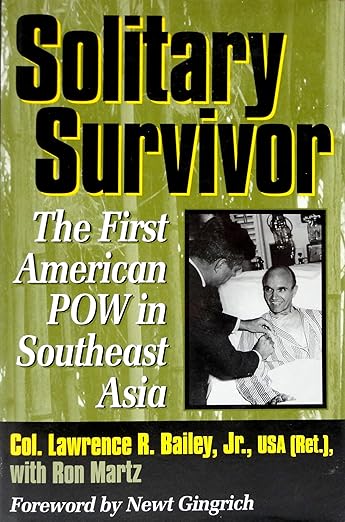
As he wrote in his memoir, Solitary Survivor: The First American POW in Southeast Asia: “The cell is gone, but it will stay with me. Whenever I close my eyes and think of the war, I will see it there, cold and dark and ill-defined, rising out of the blackness. And time will stop and hold me there, if just for an instant, a prisoner once more, a prisoner forever.”
Bailey died on May 19, 2015, and is buried at Arlington National Cemetery. ■
Ron Martz is a Marine Corps veteran (1965-68) and a journalist with 40 years’ experience in the newspaper business as a reporter and editor, primarily covering military affairs and international security issues. He is the co-author of six books on military history, including Col. Bailey’s memoir.
Article courtesy of MWSA Spring 2026 magazine – Dispatches.
*****
Thank you for taking the time to read this. Should you have a question or comment about this article, then scroll down to the comment section below to leave your response.
If you want to learn more about the Vietnam War and its Warriors, then subscribe to this blog and get notified by email or your feed reader every time a new story, picture, video and changes occur on this website – the button is located at the top right of this page.
I’ve also created a poll to help identify my website audience – before leaving, can you please click HERE and choose the one item that best describes you. Thank you in advance!


I knew “Bob” Bailey, who was a close friend of my late father. My late father accompanied Bailey on his trip back to Laos in the mid 1990s, where they found verbal and physical evidence of US POWs who were never released. I trained with many Royal Lao Army Officers who were great soldiers and true friends of the USA. The true story of US involvement in Laos has never been fully told.
LikeLike
America’s involvement in Laos was the first time wher Americans engaged in actual combat in Southeast Asia. Known as Operation White Star, ( Formerly Hotfoot), teams of US Army Special Forces were sent to Laos beginning in 1959.
I personally know of it due to an odd chain of events. After being honorably discharged from the Marine Corps, I went to art school in San Francisco. One of my first instructors happened to be himself a Special Forces vet who had been in Laos in 1961, and we immediately became fast friends.
He told me that he and a number of other Special Forces members had been selected because of their fluency in speaking French, which was at that time still spoken widely in SE Asia. They were given cover identities before their arrival, usually as business consultants, government aid workers, and even big game hunters. However, upon arriving at Vientiane airport, they all received a warm welcome from Radio Hanoi.
My friend was stationed in the panhandle of Laos, working with the Khaa tribes. As a cover they wore French Uniforms and carried foreign weapons. The Special Forces Teams had been specifically ordered to act as trainers, and were forbidden from participating in combat operations. However, the reality on the ground forced them to go out with their teams and engage the Pathet Lao and the NVA.
One thing I did get from him was the cold blooded loathing he had for the CIA Officers he had to work with. He and his team called them those “F*****g Suits”. As time passed, the CIA began sending them out on operations that were deliberately provocative. In the end he was wounded by a mortar shell and medevacked to a hospital in Japan and was later given a medical discharge.
Over time he figured was that the CIA was violating protocols so as to create an incident involving Americans being killed that would force President Kennedy’s hand and coerce him into sending combat troops to SE Asia.
In a final insult, upon his discharge my friend had recurring issues with migrating shrapnel, but to his fury found he did not qualify for VA benefits because his missions were highly classified. He also could not wear any of his decorations for the same reason. To say he was a bitter man would be an understatement.
Fortunately he found himself a good woman to whom he has been married to for over forty years. So there was a happy ending for him.
LikeLike
I feel they a bunch of bastards the the cia did not want to
exposed of those they used to have them there.
LikeLike