
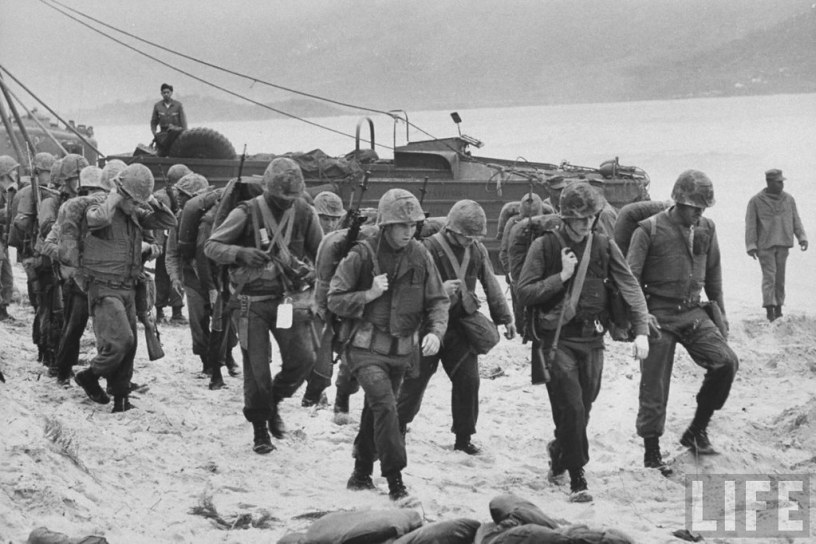
At the beginning of 1965, the US-backed government in South Vietnam was suffering from power struggles among its leadership and troops were deserting its army. Communist forces from North Vietnam were taking advantage, advancing down the Ho Chi Minh trail and gaining control in the countryside. Viet Cong guerrillas had attacked a US compound in the Central Highlands in February. Now, they were approaching Da Nang. General William Westmoreland requested two battalions of US marines to provide support, and at this crucial turning point, President Lyndon B Johnson agreed.
Blog Post by James M. Lindsay
By March 2, 1965 an aerial bombing campaign of North Vietnam began, known as Operation Rolling Thunder, these air strikes were used to soften Viet Cong forces and North Vietnamese forces for the 550,000 U.S. troops that would be deployed by the peak of the war in 1968.
This year marks the fifty-ninth anniversary of the arrival of the first American combat troops in Vietnam. On March 8, 1965, 3,500 Marines of the 9th Marine Expeditionary Brigade arrived in Da Nang to protect the U.S. airbase there from Viet Cong attacks. Despite advance warning they were about to be deployed, many of the Marines were surprised when their deployment orders came down on Sunday, March 7. Based at Okinawa at the time, more than a few of them had been, in the words of Philip Caputo, the author of the acclaimed A Rumor of War and one of those 3,500 marines, “enjoying a weekend of I and I—intercourse and intoxication.” Less than twenty-four hours later they were in a combat zone.

These marines were sent on a mission to establish a U.S. Air Force base and to free up South Vietnamese troops from combat. Prepared with full combat gear and equipped with explosives, M-14 rifles and M60 light machine guns, the 9th Marine Expeditionary Brigade under the command of Brig. General Frederick J. Karch deployed from the U.S.S. Henrico, Union, and Vancouver at 8:15 A.M..
The first marines to land was the Battalion Landing Team 3-9 meeting no opposition but instead were greeted by the local population and even some U.S. soldiers who have been stationed there before the war started. And within two hours of the landing, Landing Team 1-3 of the battalion began landing at Da Nang Air Base.
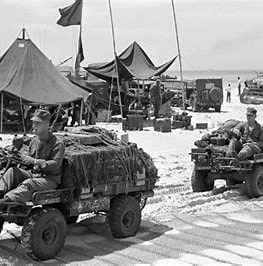
The arrival at Da Nang was uneventful. One of the planes was slightly damaged by anti-aircraft fire. But none of the marines were hurt. The 3rd Battalion, 9th Marines had an unusual introduction to Vietnam. As Caputo tells it:
Their entrance into the war zone had been the stuff of which comic operas are made. Like the marines in World War II newsreels, they had charged up the beach and were met, not by machine guns and shells, but by the mayor of Danang and a crowd of schoolgirls. The mayor made a brief welcoming speech and the girls placed flowered wreaths around the marines’ necks. Garlanded like ancient heroes, they then marched off to seize Hill 327, which turned out to be occupied only by rock apes—gorillas instead of guerrillas, as the joke went—who did not contest the intrusion of their upright and heavily armed cousins.

The arrival of the 9th Marine Expeditionary Brigade provides as good a marker as any for the beginning of the Americanization of the Vietnam War. But it hardly marks the beginning of U.S. military involvement in the country. That had been going on for a decade. The United States took responsibility for training the South Vietnamese army after the Geneva Accords were signed in 1954. An initial 352 U.S. military advisers grew to 3,200 by the end of 1961, 9,000 by the end of 1962, and some 23,000 by early 1965. Along the way, the dividing line between training South Vietnamese soldiers and leading them in battle had eroded. The first military advisers killed in action died in 1959. By the time Lt. Caputo and his comrades landed at Da Nang, more than 400 U.S. servicemen had fallen.
Not all U.S. officials favored the decision to dispatch the 9th Marine Expeditionary Brigade. Maxwell Taylor, the U.S. ambassador to Vietnam at the time and a former chairman of the Joint Chiefs of Staff, expressed grave reservations. He predicted that the demand for more combat troops would become irresistible and the United States would rush headlong into the same trap that had doomed the French. Events proved him right.
The marines who landed in Da Nang amidst garlands and speeches probably didn’t realize that the very nature of the war in Vietnam was changing. Caputo recalls a commanding officer telling his men at a pre-departure briefing: “We’re going there to provide security and that’s all. We’re not going in to fight, but to free the ARVNs [South Vietnamese soldiers] to fight. It’s their war.]”
But it no longer was South Vietnam’s war. By the end of 1965, 185,000 U.S. troops were in Vietnam.
Various versions of this article appeared on the following websites:
https://www.cfr.org/blog/twe-remembers-first-us-combat-troops-arrive-vietnam
https://coldwarthroughthedecades.weebly.com/vietnam-war–first-american-troops-arrive.html
https://www.theguardian.com/world/2015/feb/28/vietnam-war-da-nang-50-year-anniversary-flourishing
*****
Thank you for taking the time to read this. Should you have a question or comment about this article, then scroll down to the comment section below to leave your response.
If you want to learn more about the Vietnam War and its Warriors, then subscribe to this blog and get notified by email or your feed reader every time a new story, picture, video and changes occur on this website – the button is located at the top right of this page.
I’ve also created a poll to help identify my website audience – before leaving, can you please click HERE and choose the one item that best describes you. Thank you in advance!


its just amazing the lies and misconception that the U. S. government put on the very people that were sent to protect and die for. After the drft ended and the war was over, I have learned to NEVER trust the government. if they say its raining, go outside and check for yourself.
LikeLike
Thank you for the History lesson. I was at Camp Eagle (101 st) from Oct 1968 till Dec 1969. I was a Helicopter accident Investigator. Did many.
LikeLike
03/08/65, and soon after, I got my feet wet.
HM3 E 2/9 3 MarDiv
Maccs
LikeLike
and our so call leaders civilian and military have still learned nothing
LikeLiked by 1 person
Makes you wonder if President Kennedy really wanted to pull all of our advisors out of Vietnam by ’65…yes South Vietnam would have certainly fallen…just ten years early.
LikeLike
My neighbor was a U.S. Navy Sailor at these Marine “Landings”. He swears that the Sailors of his unit got Liberty in Da Nang on the night before.
LikeLike
Hmmmm warm beer and b-girls…sounds like a blast.
LikeLike
”First combat troops” tickles me whenever I read it. First US Army helicopter units were flying throughout Vietnam starting in mid-1962, their personnel carrying passports. Try telling those guys that what they did was not combat.
LikeLike
I believe Robert McNamara and Lyndon Johnson are rotting in hell !
LikeLike
1st Cavalry Division (AirMobile), First full Division to Vietnam Based at AnKhe
LikeLike
I was there in April of 66 and charle wasn’t giving up nothing!
LikeLike
It’s sad that we did not learn from the French, nor take the advice and experience of the Australians and New Zealanders in guerrilla warfare in Southeast Asia.
LikeLiked by 1 person
it’s too bad that we went there!
LikeLike
Our government kept pushing that domino effect narrative…if South Vietnam falls…so will Cambodia, Laos and Thailand.
LikeLike
🇺🇲🇺🇲🇺🇲
LikeLike