
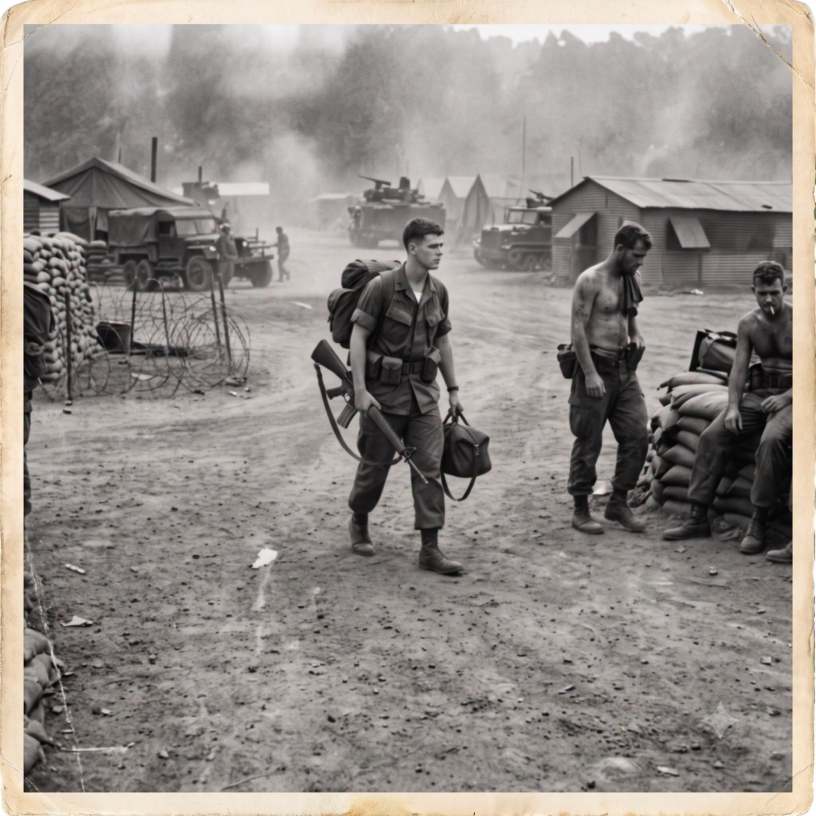
I served a 12-month tour with the Army in Vietnam, and can fully relate to everything this Marine said. What say you all?
By An Unnamed Marine
Most Marines Arrived In Vietnam Alone. Each Facing At Least 13 Months. If They Survived That Time, They Simply Packed Up And Left…, Leaving Just As They Had Arrived…, Alone!
During the Vietnam War, the U.S. military abandoned the long-standing tradition of deploying and returning entire cohesive combat units, instituting a flawed “individual replacement system.” For the first time in American military history, service members—including Marines bound to a grueling 13-month tour—were dropped into combat as isolated substitutes and pulled out the moment their personal calendars expired. This revolving-door policy severed the essential bonds of unit brotherhood, turning a collective military effort into a deeply personal, solitary struggle for survival.
In the following account, an unnamed Marine reflects on the profound psychological toll of being forced to fight—and return from—a war completely alone.
I remember the day. I got off that transport plane feeling completely alone. In every war before ours, Marines trained together, shipped out together, and fought beside the guys who knew their names and had their backs from day one. Not in Vietnam. I arrived alone, not part of a unit; I was just a number filling a slot on a replacement sheet. When I reached my new assigned unit, I was processed in and given a cot. A few asked my name. To the guys that had been there, I was just the new replacement. I was seen as a liability—an untrained kid whose rookie mistakes might get them killed, or worse, someone they’d get attached to right before he caught a bullet. I learned real fast that MY thirteen-month clock started the moment MY boots hit the dirt, and I was going to have to survive every single second of my time in this war based on a date that belonged to ME alone.
That individual rotation system used in Vietnam stripped away the one thing that keeps a Marine sane: real, unbreakable brotherhood. Because everyone’s calendar was on a different schedule, our squad was in constant, chaotic flux. Guys were killed, wounded, or rotated out on their own personal departure dates, replaced by new faces I couldn’t bring myself to look in the eye. You stop making friends when friendship just means guaranteed grief.
Soon enough, I built my own emotional walls. I stopped caring about the overall mission, or about the command. The war ceased to be a shared fight for a cause and turned into a cold, selfish, solitary math problem—me against thirteen months. Every day was just a tick mark on a private calendar, an exhausting, paranoid grind where you couldn’t afford to trust anyone completely because nobody was staying. They were just coming and going. Some went home, some were wounded, some died.
When my 395 days were finally up, there was no victory parade, no troop transport ship carrying our company home together to decompress and make sense of what we’d done. They just pulled me out of the dirt, handed me my papers, and put me on a commercial flight by myself. One day I was ducking fire in the jungle; thirty-six hours later, I was sitting in an airport diner back home. The military just dropped me back into the “World.” Where I was surrounded by civilians who often did not support the war and frequently had a contempt for the men that fought in it. There were no brothers beside me to split the weight, no one to look at and say, we made it.
Decades later, the Vietnam War remains part of me—because when you are forced to fight a war all by yourself, you carry the ghost of it alone for the rest of your life.
*****
Thank you for taking the time to read this. If you have a question or comment about this article, scroll down to the comment section below to leave your response.
If you’re interested in learning more about the Vietnam War and its Warriors, subscribe to this blog to receive notifications by email or your feed reader whenever a new story, picture, video, or update is posted on this website. The subscription button is located at the top right of this page.
I’ve also created a poll to help identify my website audience. Before leaving, please click HERE and choose the one item that best describes you. Thank you in advance!

 CherriesWriter - Vietnam War website
The unnamed Marine wrote: “That individual rotation system used in Vietnam stripped away the one thing that keeps a Marine sane: real, unbreakable brotherhood. Because everyone’s calendar was on a different schedule, our squad was in constant, chaotic flux. Guys were killed, wounded, or rotated out on their own personal departure dates, replaced by new faces I couldn’t bring myself to look in the eye. You stop making friends when friendship just means guaranteed grief.“
I know what he’s talking about but I think his statment about the rotation system strippin away brotherhood is too extreme. I was in the jungle for a year with the army. We learned early on to protect ourselves emotionally but the bonds were there, and when we came home the grief for those fellow soldiers we’d lost hit home hard and stayed with us.
I’d also like to add in that we had another cause for grief. When we left the field many of the guys who’d shared our hardships and losses were left behind. All of us had a role in the squad, platoon, and company and we knew we’d be missed. We didn’t know if the hole we’d left got someone killed, but we knew it was there. Guaranteeing our survival by leaving was part of the deal but it was painful, especially since many of us never knew whether the men we’d left behind had survived.
Ed Mann, 1st Air Cav 69-70.
LikeLike
Spot on point of view. I arrived at my advisor unit only to be greeted by two NCO’s I never served with and a Major who was my immediate boss that I ended up never meeting. No transition. No mutual training. Just thrown in to start combat operations; wounded in Laos several moths later and medevaced to a hospital ship. My wife asks if I have any contact with those in my old unit. NO – I barely remember their names. We were all just a replacement number.
LikeLike
that is what happen to me. one week i was killing people and with in two weeks i was home driving as if nothing had happen. i was sitting inmy car with a “new” girl friend and talking about something i don’t remember now. as she was talking to me i sat there looking at her and thinking she doesn’t know i was killing people two week ago .
LikeLike
Excellent read. I wonder whether the experience of serving in a combat infantry unit differed from that in a rear unit.
LikeLike
So true! And the loneliness never goes away. First tour I deployed with my unit. Second tour, under the individual replacement system. Very different experiences.
LikeLike
Spot on. I was Army so my tour was 12 months. Even as part of a so-called “elite” unit (5th Special Forces Group, I-Corps 1969-70) we were all just piece parts.
LikeLike
Well said!
LikeLike