
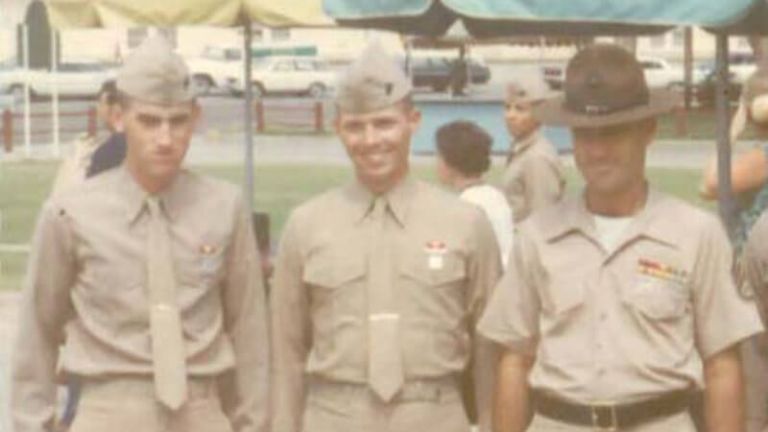
From left to right: Michael Archer, Tom Mahoney, and their senior drill instructor at Boot Camp Graduation, Marine Corps Recruit Depot, San Diego, California, August 1967. (Michael Archer)
Was it battle fatigue or a letter from his girlfriend that caused him to “zone out?” How far would you go to locate the remains of your best friend? Your thoughts…
By Michael Archer
On July 6, 1968, the day U.S. forces officially abandoned Khe Sanh, twenty-year-old Lance Corporal Thomas P. Mahoney III, by all accounts the most well-liked, confident, and optimistic member of his company, inexplicably walked away from his unit’s defensive position and was shot by North Vietnamese soldiers hiding nearby. His fellow Marines fought tenaciously to recover his body, even resisting a direct order from their regimental commander to permanently vacate their position. Only when darkness fell did they ruefully leave their friend behind.
Tom and I had been close high school friends in Berkeley, California, amid the growing civil unrest and protests against American involvement in Vietnam. Despite this, we joined the Marines in 1967 to test ourselves, a goal, we quickly learned, was a romanticized notion of combat heroics.
I arrived at Khe Sanh first, serving as a radio operator with the 26th Marine Regiment. After enduring three months of constant enemy shelling, and regular ground attacks against our positions, our decimated regiment was ordered out. The 1st Battalion, 1st Marines, took our place. Tom was part of that Battalion.
A few weeks before Tom’s perplexing walk into oblivion on Hill 881, our political and military leaders realized what a costly mistake they had made in ordering us to defend that remote combat base. A place where thousands had already suffered and died for no purpose. Tom’s bitterness and frustration grew as his unit fought several vicious battles, all the while knowing they were merely buying time for a final, calculated retreat.
I survived the war and returned home to face not only Tom’s heartbroken family (his father and namesake had died during the Korean War) but disdain from my former schoolmates for having fought in Vietnam.
Tom’s mother showed me a letter he’d received in Vietnam days before his death. It had been among his personal effects. The letter was from his girlfriend, the daughter of a wealthy industrialist who was profiting handsomely from the war. She was breaking up with Tom in the harshest terms; the letter was filled with antiwar epithets like “baby killer.” I immediately recognized that in his already disconsolate frame of mind, the letter may have helped trigger his end. Tom’s family never recovered from his loss.
From the moment I learned of Tom’s death, I began searching for information and details of what actually unfolded. That search turned into a decades-long quest to find out what had happened and, perhaps, find redemption from my guilt and remorse at having survived that terrible place instead of him. Along the way, I made a series of often implausible connections that steered me back to Vietnam and Khe Sanh.
In the 1990s, after diplomatic relations with Vietnam warmed, the US government gained access to a great deal of information about those missing in action. Despite all this, I was frustrated with the poor methodology being employed by the U.S. Joint POW/MIA Accountability Command (JPAC) in their efforts to locate Tom’s remains. My research from military reports had provided the precise map coordinates of where Tom was last seen, yet JPAC ignored my pleas and continued to look for Tom’s remains nearly a half mile from where he fell.
In 2006, Robert “Doc” Topmiller, a friend of mine during the 1968 siege, contacted me after 35 years. Now a university professor and one of the country’s leading authorities on the history and culture of Vietnam, Doc has traveled extensively throughout Vietnam. Also frustrated by JPAC’s inexcusable and ineffective efforts, Doc suggested we do things the “Vietnamese way,” which included meeting with a psychic, or “soul caller.” Though skeptical, I agreed to return with Doc to Vietnam in 2007.
Doc suffered from severe PTSD from the daily horror he’d experienced as a 19-year-old corpsman trying to save the lives of young Marines mangled from the constant artillery fire at Khe Sanh. In 2008, several months after we returned from Vietnam, Doc died from a self-inflicted gunshot wound – yet another casualty of that war so long ago. Because of Doc’s contacts in Vietnam, I had become friends with several former adversaries from the Khe Sanh battlefield.

Upon arriving at the spot where Tom Mahoney was killed on Hill 881, Michael, seated, is overcome with emotion, December 2007. (Michael Archer)
By 2010, I had located a dozen survivors from Tom’s platoon. After the war, most had worked through the difficult transition and become successful in a variety of professional fields. Some, however, were too psychologically scarred to readapt and struggled with drugs, alcohol, and mental health issues. Yet, the two things they all had in common were a clear personal recollection of the day Tom died and incessant remorse and guilt at not having brought him back.
In the weeks following his death, many of his platoon mates were told that a Marine reconnaissance team had secretly returned and retrieved the body. As such, they were shocked when I told them that his remains had never made it home, adding further mystery to his disappearance.
In August 2014, the JPAC brought a former reconnaissance Marine to Hill 881 to locate Tom’s body. The Marine claimed to have accidentally come across and buried Tom’s body a few weeks after his death. But the excavation found the grave to be empty. This would not be the only time that hope for a conclusion to our search ended in disappointment. It was after this 2014 dig that JPAC sought my assistance in pinpointing the correct location.
I had benefited from newly translated Vietnamese military histories, including one containing an astonishingly graphic description of the look on Tom’s face at the moment he was gunned down.
As the NVA History of the 246th Regiment graphically describes:
At 1400 the following day [July 6, 1968], we saw an American walking outside the outpost entrance. His face was red, and his eyes were blue like a mean animal. He was looking toward Mr. Luong’s team. The sounds of AK weapons roared immediately, and the American fell. Mr. Luong and Mr. [Tran Ngoc] Long jumped out of their positions and dragged the American’s body down. They placed the body in front of them to create an ambush for the other Americans coming out of their bunkers.
The report listed three others present in the squad, including Nguyen Tien Thanh, whom I eventually located in a village near Hanoi. In getting to know Thanh, I was astonished to learn he had been a practicing Catholic during the war, discriminated against for promotion by his unit’s Marxist political officers, and derided by many of his fellow soldiers. To prove his loyalty, Thanh volunteered for the most dangerous assignments, including one in July 1968 that took him to the last trail Tom walked.
In June 2016, JPAC escorted Tom Mahoney’s former platoon commander, Frank Ahearn, and his former squad leader, Tom Northrop, back to Hill 881 South to locate where they had last seen him. The two men were confident about the location they found, but as of May 2023, no action has been taken to excavate.
My search for Tom’s physical remains continues, and, as the toll of shattered lives fades into the past, what remains is the revelation that despite the cruelty of war, many who had suffered through that developed a profound appreciation of human dignity and compassion and carried with them an unremitting sense of loyalty to a missing young Marine who had briefly touched their lives. While on the Hill where Tom died, I left a plaque that I had made.

On December 22, 2007, Michael placed this plaque at the location where Tom’s body was last seen. (Michael Archer)
Michael Archer is an author, lecturer, and Vietnam Veteran who served as a radio operator during the 1968 siege of the U.S. Marine base at Khe Sanh. In his 2024 memoir The Long Goodbye (Hellgate Press), the third of his Khe Sanh trilogy, he chronicles his decades-long search for answers to his fellow Marine’s disappearance on Hill 881. His other books about Khe Sanh are Patch of Ground: Khe Sanh Remembered and The Gunpowder Prince: How Marine Corp Captain Mizra Muniq Baig Saved Khe Sanh. Michael’s articles and essays have appeared in the Nevada Review, Political History of Nevada—2016, and twice in Naval History magazine. His books are available online at major booksellers.
This article originally appeared on this website: https://veteransbreakfastclub.org/searching-for-lance-corporal-thomas-p-mahoney-iii/
*****
Thank you for taking the time to read this. If you have a question or comment about this article, scroll down to the comment section below to leave your response.
If you’re interested in learning more about the Vietnam War and its Warriors, subscribe to this blog to receive notifications by email or your feed reader whenever a new story, picture, video, or update is posted on this website. The subscription button is located at the top right of this page.
I’ve also created a poll to help identify my website audience. Before leaving, please click HERE and choose the one item that best describes you. Thank you in advance!

 CherriesWriter - Vietnam War website
A very good article. During my time in Vietnam, there was a disconnect between soldiers and civilians, media and military, politicians and military, and politicians with ideology and reality. The greatest failure was in the military becoming blind to conditions on the ground and not adjusting tactics and strategies to compensate. We kept doing the same things with diminishing returns. Body count over shadowed understanding; our true mission was to train and prepare the South Vietnamese to defend themselves. Our failure in this doomed any success.
LikeLike
In late 1969 I traveled to Saigon to the Army Morgue to ensure a friend made his way back without problems. Talked to one of the enlisted who worked there and took the opportunity to ask him how most of his “customers” ended up in his care. (My friend was a victim of a Helo accident.) He said he figured half swallowed their M-16 after receiving a Dear John letter from home. Of course they were all listed as combat casualties.
LikeLiked by 1 person
thank you for everything you have done
LikeLike