
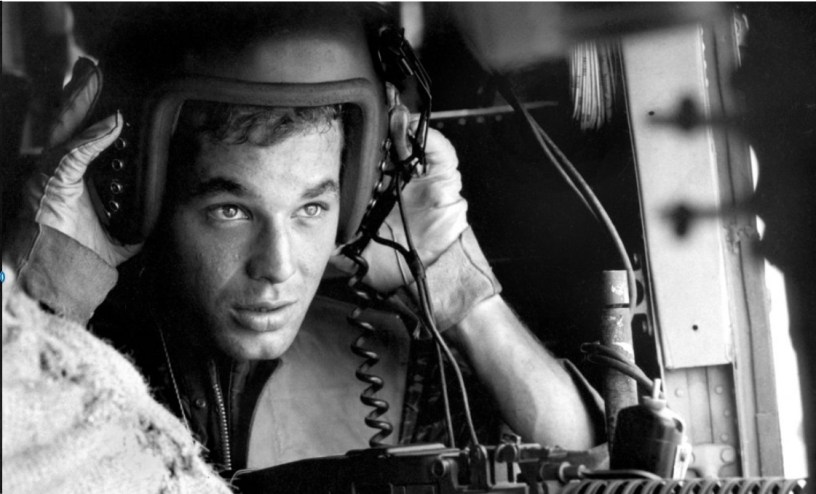
The photo is part of a photo essay by photographer Larry Burrows. The photos and the story were published under the title “One Ride with Yankee Papa 13”. It was published in Life Magazine in April 1965.
Written By: Ben Cosgrove
In the spring of 1965, within weeks of 3,500 American Marines arriving in Vietnam, a 39-year-old Briton named Larry Burrows began work on a feature for LIFE magazine, chronicling the day-to-day experience of U.S. troops on the ground and in the air amid the rapidly widening war. The photographs in this gallery focus on a calamitous March 31, 1965, helicopter mission; Burrows’ “report from Da Nang,” featuring his pictures and his personal account of the harrowing operation, was published two weeks later as a now-famous cover story in the April 16, 1965, issue of LIFE.
Over the decades, of course, LIFE published dozens of photo essays by some of the 20th century’s greatest photographers. Very few of those essays, however, managed to combine raw intensity and technical brilliance to such powerful effect as “One Ride With Yankee Papa 13,” universally regarded as one of the greatest photographic documents to emerge from the war in Vietnam.
Here, LIFE.com presents Burrows’ seminal photo essay in its entirety: all of the photos that appeared in LIFE are here. (Note: In a picture from the article, Burrows mounts a camera to a special rig attached to an M-60 machine gun in helicopter YP13 a.k.a., “Yankee Papa 13.” At the end of this gallery, there are three previously unpublished photographs from Burrows’ 1965 assignment.]
Burrows, LIFE informed its readers, “had been covering the war in Vietnam since 1962 and had flown on scores of helicopter combat missions. On this day, he would be riding in [21-year-old crew chief James] Farley’s machine, and both were wondering whether the mission would be a no-contact milk run or whether, as had been increasingly the case in recent weeks, the Vietcong would be ready and waiting with .30-caliber machine guns. In a very few minutes, Farley and Burrows had their answer.”
The following paragraphs, lifted directly from LIFE, illustrate the vivid, visceral writing that accompanied Burrows’ astonishing images, including Burrows’ own words, transcribed from an audio recording made shortly after the 1965 mission:
“The Vietcong dug in along the tree line, were just waiting for us to come into the landing zone,” Burrows reported. “We were all like sitting ducks and their raking crossfire was murderous. Over the intercom system one pilot radioed Colonel Ewers, who was in the lead ship: ‘Colonel! We’re being hit.’ Back came the reply: ‘We’re all being hit. If your plane is flyable, press on.’
“We did,” Burrows continued, “hurrying back to a pickup point for another load of troops. On our next approach to the landing zone, our pilot, Capt. Peter Vogel, spotted Yankee Papa 3 down on the ground. Its engine was still on and the rotors turning, but the ship was obviously in trouble. “Why don’t they lift off?’ Vogel muttered over the intercom. Then he set down our ship nearby to see what the trouble was.
“Twenty-year-old gunner, Pfc. Wayne Hoilien was pouring machine-gun fire at a second V.C. gun position at the tree line to our left. Bullet holes had ripped both left and right of his seat. The plexiglass had been shot out of the cockpit and one V.C. bullet had nicked our pilot’s neck. Our radio and instruments were out of commission. We climbed and climbed fast the hell out of there. Hoilien was still firing gunbursts at the tree line.”
Not until YP13 pulled away and out of range of enemy fire were Farley and Hoilien able to leave their guns and give medical attention to the two wounded men from YP3. The co-pilot, 1st Lt. James Magel, was in bad shape. When Farley and Hoilien eased off his flak vest, they exposed a major wound just below his armpit. “Magel’s face registered pain,” Burrows reported, “and his lips moved slightly. But if he said anything, it was drowned out by the noise of the copter. He looked pale, and I wondered how long he could hold on. Farley began bandaging Magel’s wound. The wind from the doorway kept whipping the bandages across his face. Then blood started to come from his nose and mouth, and a glazed look came into his eyes. Farley tried mouth-to-mouth resuscitation, but Magel was dead. Nobody said a word.”
In his searing, deeply sympathetic portrait of young men fighting for their lives at the very moment America is ramping up its involvement in Southeast Asia, Larry Burrows’ work anticipates the scope and the dire, lethal arc of the entire war in Vietnam.
Six years after “Yankee Papa 13” ran in LIFE, Burrows was killed, along with three other journalists, Henri Huet, Kent Potter, and Keisaburo Shimamoto, when a helicopter in which they were flying was shot down over Laos in February 1971. He was 44 years old.

Helicopter gunner James C Farley shouts to the rest of the crew as the fatally wounded copilot lies beside him. Larry Burrows Time & Life Pictures/Shutterstock

Vietnam War, LIFE Magazine, Yankee Papa 13. Larry Burrows Time & Life Pictures/Shutterstock

Vietnam War, LIFE Magazine, Yankee Papa 13 Larry Burrows Time & Life Pictures/Shutterstock

Vietnam War, LIFE Magazine, Yankee Papa 13 Larry Burrows Time & Life Pictures/Shutterstock

Vietnam War, LIFE Magazine, Yankee Papa 13 Larry Burrows Time & Life Pictures/Shutterstock
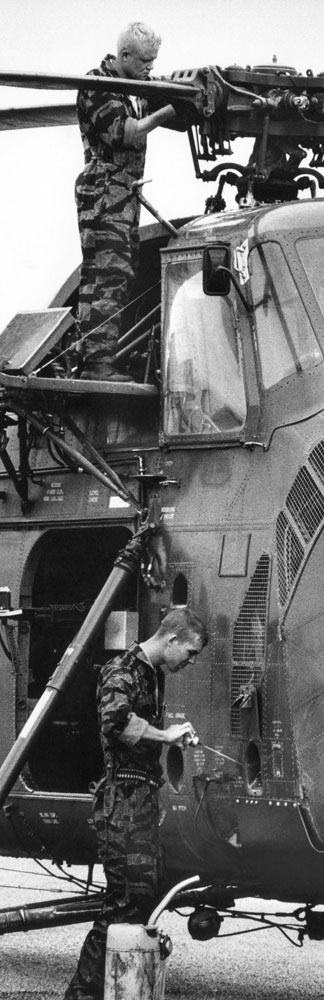
Vietnam War, LIFE Magazine, Yankee Papa 13 Larry Burrows Time & Life Pictures/Shutterstock

Vietnam War, LIFE Magazine, Yankee Papa 13 Larry Burrows Time & Life Pictures/Shutterstock

Vietnam War, LIFE Magazine, Yankee Papa 13 Larry Burrows Time & Life Pictures/Shutterstock

Vietnam War, LIFE Magazine, Yankee Papa 13 Larry Burrows Time & Life Pictures/Shutterstock

Vietnam War, LIFE Magazine, Yankee Papa 13 Larry Burrows Time & Life Pictures/Shutterstock

Vietnam War, LIFE Magazine, Yankee Papa 13 Larry Burrows Time & Life Pictures/Shutterstock

Vietnam War, LIFE Magazine, Yankee Papa 13 Larry Burrows Time & Life Pictures/Shutterstock

Vietnam War, LIFE Magazine, Yankee Papa 13 Larry Burrows Time & Life Pictures/Shutterstock

Vietnam War, LIFE Magazine, Yankee Papa 13 Larry Burrows Time & Life Pictures/Shutterstock

Vietnam War, LIFE Magazine, Yankee Papa 13 Larry Burrows Time & Life Pictures/Shutterstock
The fatally wounded pilot in the photo was not the pilot of the helicopter Farley was assigned to. He’s actually the copilot of another copter, “Yankee Papa 3″. When Farley’s helicopter spotted a downed helicopter and landed near it, Farley and the photographer ran over to the downed helicopter and found the wounded copilot. The photo was taken inside the downed helicopter. Farley and the copilot are the ones in the photo above. Farley also examined the pilot, who was bleeding and not moving. He came to the conclusion that he was dead. In fact, he was alive. The copilot and another marine from YP3 were taken back to Farley’s copter. Two more marines from YP3 made it to Farley’s copter on their own. Later on, another copter landed near YP3 and rescued the wounded pilot, who survived.

Vietnam War, LIFE Magazine, Yankee Papa 13 Larry Burrows Time & Life Pictures/Shutterstock

Vietnam War, LIFE Magazine, Yankee Papa 13 Larry Burrows Time & Life Pictures/Shutterstock

Vietnam War, LIFE Magazine, Yankee Papa 13 Larry Burrows Time & Life Pictures/Shutterstock

Vietnam War, LIFE Magazine, Yankee Papa 13 Larry Burrows Time & Life Pictures/Shutterstock

Vietnam War, LIFE Magazine, Yankee Papa 13 Larry Burrows Time & Life Pictures/Shutterstock

Vietnam War, LIFE Magazine, Yankee Papa 13 Larry Burrows Time & Life Pictures/Shutterstock

Vietnam War, LIFE Magazine, Yankee Papa 13 Larry Burrows Time & Life Pictures/Shutterstock
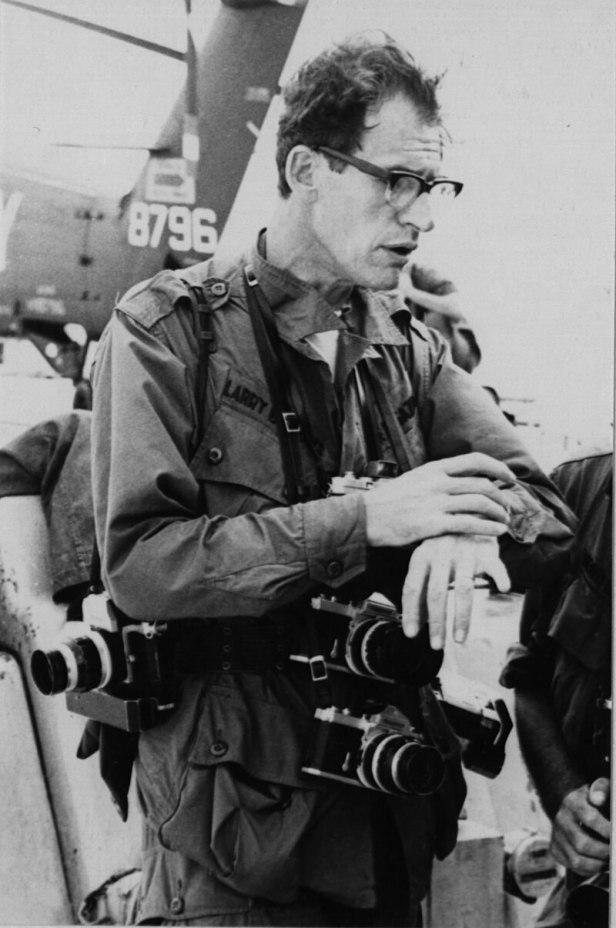
Henry Frank Leslie Burrows (29 May 1926 – 10 February 1971), known as Larry Burrows, was an English photojournalist. He spent 9 years covering the Vietnam War.
Here is the link to the original Life Magazine article:
*****
Thank you for taking the time to read this. Should you have a question or comment about this article, then scroll down to the comment section below to leave your response.
If you want to learn more about the Vietnam War and its Warriors, then subscribe to this blog and get notified by email or your feed reader every time a new story, picture, video and changes occur on this website – the button is located at the top right of this page.
I’ve also created a poll to help identify my website audience – before leaving, can you please click HERE and choose the one item that best describes you. Thank you in advance!

 CherriesWriter - Vietnam War website
As always, words hardly ever can describe the horrors of war like photographs. I have what seems like a million of them in my head, they run on a continuously endless loop. Now at 80 years of age they have not lost their vivid memories, they just have less emotional impact after over 6 years of counselling and group discussions.
I have worked for over 15 years now trying to pay back for the 59 years of life that so many did not get. I was 21 when I got to Vietnam, A young E-5 having been in the army over 4 years then, and two tours as an infantry platoon Sgt.
Thanks for the reposting John, I promised to never forget as long as I live. Hear our story at vvmf.org Echoes of the Vietnam War, my episode is #66 and John’s is a few after that. Salute to those we promised to never forget
LikeLiked by 2 people
A very touching real life account of what it was like for pilots, door gunners, crew chiefs and photographers in Vietnam. Most Americans had no idea of what was going on in Nam during the early years but finally in later years “saw the truth” of its fragility and waste of life as soldiers were sacrificed for reasons never to be realized.
LikeLiked by 1 person
As painful as it was to see, that last picture is a reminder of a reality that many of us understand all too well. Ed
LikeLiked by 1 person