
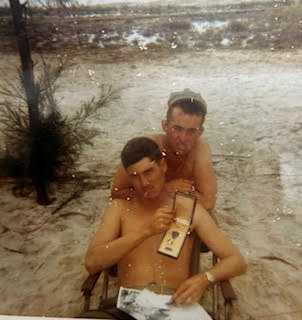
Photo description: Best buds: The author and Lonny Livingston
Two Marines became fast friends on the first day in the military and did everything together. When in Vietnam, they did everything together. At the battle of Con Thien, an injury thought to be fatal separated them for good. Guilt ate at them for the next thirty-five years. Here’s their story:
By Perry Walker
I met Lonny Livingston in June 1966 when I reported to Camp Del Mar for Amphibious Warfare Training. The meeting took place in a large brick building that had a whole side of a parade deck. Across the front portico, rows of windows, fogged and caked with years of dirt and sea salt, sat quietly beneath a line of palm trees.
He entered through the side door and followed the hastily printed signs down the hall and through the open door. Thirty men, all dressed in green fatigues, milled about, shaking hands and balancing coffee cups precariously in the stale, moist air. We waited for the Captain to begin. A Lieutenant, his shirt and trousers starched, nervously stared at his watch, then walked to the podium.
“Take a seat, please.” Men began to shuffle toward the metal chairs, seating themselves. I sat and extended my hand to the Marine sitting beside me. “Perry Walker,” I said.
“Lonny Livingston,” he responded.
The Lieutenant stepped back, and the Captain took the podium. “I don’t want to burn a lot of daylight. You will learn more as I learn more. In short, the division is forming a new regiment. Your new designation will be the First Amtrac Battalion. Some of you might have noticed the Navy ship off our shore. You will be loading and offloading on that ship starting tomorrow. In two weeks, we will load all equipment, beans, ammo, and personnel, and join a convoy. Your next stop: Vietnam.
Any questions?”
He stepped back, and the lieutenant stepped up. “Hit the mess hall for chow, then meet at the ramp at fourteen hundred. Dismissed!”
“You really want to eat at the chow hall?” Lonny asked.
“EM Club?” I responded.
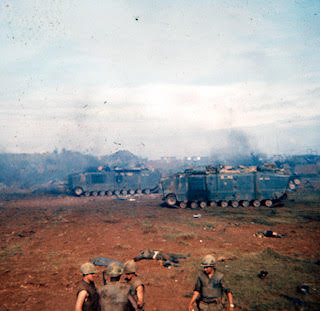
Con Thien – Amphibious vehicles in the background
With that, we left the meeting and walked across the parade deck. The enlisted men’s club was busy, so we sat by a display of paintings depicting Marine accomplishments. In the corner stood an Eagle, Globe, and Anchor in a haze of cigarette smoke. We leaned against the bar and ordered two beers. Then returned to our seats to await the Burgers. We talked for more than an hour. I learned Lonny was from the Tampa Bay area in Florida, and his main interest was the same as any other nineteen-year-old. I queried further and asked why he ended up in the Marine Corps during a war. He paused and looked at me. “I like their uniforms.” That elicited laughter from both of us.
True to the Captain’s word, we loaded everything we could on the USS Tortuga, and with a troop ship at our side, we set sail for the Philippine Islands with a short stop in Pearl Harbor, Hawaii.
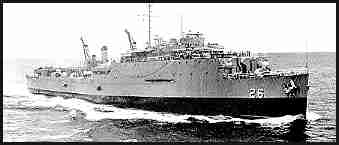
USS Tortuga (LSD-26)
We only had two days at Pearl. Lonny and I made the best of it. We spent one day drinking beer on Waikiki Beach, then the next day drinking more beer on Waikiki Beach.
Late in the afternoon of the second day, we reboarded the ship, and before we awoke the following morning, the ship was rocking and pushing into an easterly wind. The mountains of Hawaii were but a memory.
Occupying our time was an ongoing problem. The sailors were kept busy with their jobs, but the Marines were left to their own devices. Cleaning our equipment became monotonous and routine. We talked during the lulls..I learned Lonny’s home life was focused on his sisters, with him being the odd man out. Joining the Marines was an escape from this, and the brotherhood of the Corps became his new family, one he craved badly. The men around us became like siblings. Lonny was one of those rare people who, when he asked “how do you feel?” he actually waited and watched your eyes for a response. Lonny really cared.
We disembarked our ship in Subic Bay, Luzon Island, and for the next two weeks, we trained and lived in pup tents in the jungle. One of the first things we learned about our environment was to not eat green coconuts. I won’t go into that now.
On the last weekend, we were turned loose on the little town of Olongapo. While we stood in line picking up our “Liberty Passes,” we were warned by the Captain that the USS Enterprise was pulling into port, four thousand sailors strong. Lonny and I, and a few of the guys, made straight for the “jeepnee” waiting near the gate. The Captain’s words were still ringing in our ears: “Behave yourselves!”
Early the next morning, our Lieutenant picked me, Lonny, and a few other men up at the Shore Patrol Office. While signing our release, Lonny leaned forward, and with a purple half moon under his left eye, asked the officer if we could go back to town.
Our new ship, the USS Vancouver, was newer, providing us with better sleeping arrangements and more ventilation. The Vancouver was a flat-bottom boat, so it pitched and rolled much more than the Tortuga. We learned this shortly after leaving the harbor. More men were hanging over the rails chumming the water below. This was a source of amusement to Lonny, who moved down the rail slapping men on the back, and asking, “What’s up?”
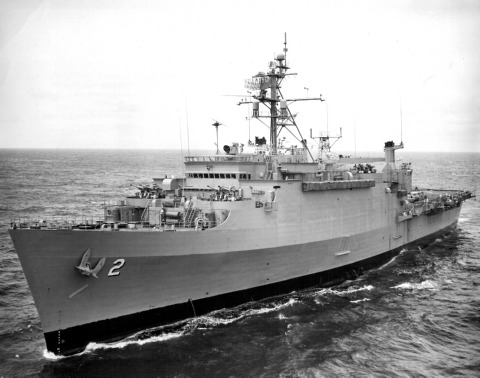
U.S.S. VANCOUVER (LPD-2)
We reached Vietnam on our sixth day out, but before we could make safe harbor, we received word that there was a serious storm bearing straight for us. The decision was made to sail to open sea and ride it out. We were birthed one deck down from the top deck, and the sun beat down mercilessly on the gray metal above. The heat in our area was extreme. So the Navy opened a hatch above us in an attempt to cool our compartment.
That hatch was rectangular, five feet by three feet, weighing in at a good hundred-plus pounds. It was hinged on the short side to the deck and held at a forty-five-degree angle by two stanchions. Around four in the evening, two young sailors entered our area and explained they were there to close the hatch. They requested help with lowering it into place.
Lonny jumped at the idea of getting out of the enclosed space and into the open air above. He volunteered immediately, and I followed. On the way up the ladder, the sailors explained that they would be on the top deck where they would lift the hatch, disconnect the post, and then lower it to Lonny, who was waiting below. The ladder leading up to the sailors above was only two feet wide and six or so feet high. I waited below, looking up at Lonny, hands above his head, waiting to receive the heavy hatch.
While the sailors struggled with the stanchions, it began to rain lightly, and the deck became slippery. The ship seemed restless and rolled gently. As the roll began to increase, the sailors’ foothold on the deck failed, and they lost their grip on the hatch. The single post still viable gave way, and the hatch collapsed downward onto Lonny.
It happened in a blink: the edge of the hatch caught Lonny on the left side above his ear, and drove his head downward onto the vertical edge of the deck. Lonny fell back and tumbled down the stairs into my waiting arms. His head was bleeding profusely from both sides. He looked up at me, his eyes wide in disbelief. As he opened his mouth to say something, his eyes rolled back and closed. Within minutes, a stretcher appeared, and Lonny was transported to sickbay. Sargent Streck instructed me to go to the head and wash the blood off myself, and then report back to him. By the time I got back to our bay, the blood had been cleaned from the deck and ladder. The Lieutenant was leaning against the bulkhead, filling out forms. I waited patiently until he raised his head and asked what had happened. I gave him what I believed to be the details. As he finished and began to walk away, I asked if Lonny was dead. I felt eyes fall on me, and a quiet calm filled the room. “I don’t know,” he said, “I’ll go back to sickbay now.
Lonny was transferred to the much larger troop transport sailing beside us. Unlike us, they had an X-ray machine. Three days later, Lonny was back in our area. Both eyes were black, his head was wrapped like a swami, and he had a new tale to tell. The doctor on the troop ship determined that he had suffered a severe concussion, ten stitches on each side of his head, and a hell of a headache. Lonny never remembered much of that afternoon, other than climbing the ladder, my face staring down at him, and then later waking up in sickbay.
We landed in Vietnam on December 6. We were assigned to a camp in the very early stages of construction. We were kept busy digging bunkers, foxholes, and stretching barbed wire. Lonny’s head healed, and his headaches passed into a bad memory. So he was in the bunker getting dirty with the rest of us. We worked during the day, had C rations for dinner, and after a brief respite, we occupied a foxhole and stared into the blackness of night. We would be four hours on, then Lonny would take over till dawn. Lonny was a constant source of entertainment. He usually finished digging his hole before us, and would sit on its edge, and smoke a cigarette, chattering like a bird in a cage. Occasionally, a sniper would shoot at us, and Lonny, true to his demeanor, would extend his middle finger above the foxhole, then yelled something dirty in response.
I was moved to another platoon, and Lonny and I were finally separated. His tent was now about a hundred feet from the artillery pieces at the edge of the base. On the twenty-sixth of December. Around three in the morning, the artillery group received a fire mission. Their first shell misfired and exploded directly above Lonny’s tent. The whole camp came alive. We were sure we were under fire. Minutes passed before it was clear what had transpired and where help was needed. I ran over to Lonny’s tent and found it shredded with shrapnel holes. The wounded and dead lay among the flotsam of cots, tables, and shards of canvas. A Corpsman was moving from wounded Marine to wounded Marine. I soon found Lonny lying on his back with a red bandage wrapped around his leg. I sat there waiting for him to go into shock, but true to Lonny, he just chatted and asked who else had been hit.
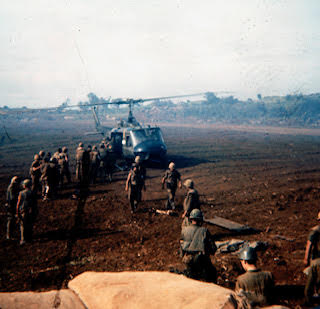
Loading the dead and wounded after the battle, May 1967
Within the hour, helicopters were ferrying the wounded to hospitals. I’m not sure where they took the dead. Lonny spent three days at Battalion Aid and then came back to us. After five more days on light duty, he was back to his old self. Lonny was awarded the Purple Heart for his wound. He was very proud of that.
In May, the whole platoon went on an operation north to the DMZ. We were told it might last a month or more. Soon after the news to “saddle up,” Lonny stuck his head in the tent.
“You going on the operation?”
“Sure am, someone has to babysit you,” I responded.
He chuckled and turned to leave, then stopped and turned toward me. “I hear it’s bad up there.” Then he walked away.
It took a full day to arrive at our point of departure. From the time we started moving westward, just under the Demilitarized Zone, the sniper opened up, and mortar and artillery started falling on us. We would move forward for eight hours, stop, and dig in for the night.
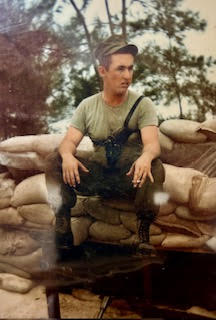
Lonny Livingston
Lonny and I usually kept track of each other, and we would dig our holes within rock-throwing distance. Some nights, either Lonny or I would crawl over to the other‘s hole and just lie there and talk, until someone would whisper: “Shut the &^%$ up”.
After a week or so, it became routine that a chopper would fly into camp, drop ammo, food, and water, and then lift off with at least one or two body bags. Shortly before the chopper would arrive, three men would be chosen to run to the open area where it landed, grab the dropped supplies, and then drag them back to cover. More than he should have, I spotted Lonny doing it. I knew he volunteered, and more than once, I told him to “knock it off.”
After being out for six or so weeks, we arrived at a small hill and dug in on the south side. Our company of Marine infantry dug in on the north side, leaving some Army Green Berets on the hill to our East. At 2:45 am, we were attacked by a very large group of North Vietnamese Soldiers.
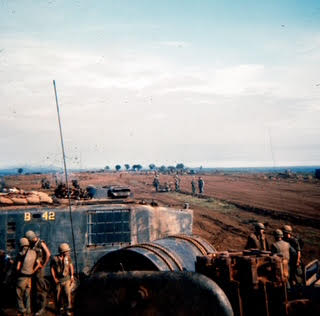
After the battle of Con Thien, May 1967
The battle lasted until daybreak, when they broke off and retreated. While the enemy stragglers stayed behind to cover the main groups’ retreat, we started looking for our wounded and those killed. I spotted Lonny off to my left, helping a Marine lying on the ground. So I started searching the foxholes, working away from him. The shooting was sporadic, and about the time you stood up, you would hear a round buzz by your ear.
By nine o’clock, the fighting had ended, but the cleanup continued. I got word that one of our troops could not be accounted for, so we dropped everything and started searching. I was making my way back towards where I last saw Lonny when a Marine called out that he had found the body of Landon, the missing man. I turned to continue my morbid job when I noticed Bond standing beside a tank. He was wearing a white bandage wrapped around his wrist. He noticed me and pointed to an Amtrak. I turned my palm upward and shook my head. Bond stared at me and called out, “Lonny!”
A Corpsman was affixing a WIA tag to Lonny’s tunic. Looking around, he stated: “We need him on a chopper now.”
I quickly moved to Lonny’s back, pushed him into a sitting position, and then looked for help. A marine was standing next to Bond, a white bandage wrapped around his head.
“Can you help?”
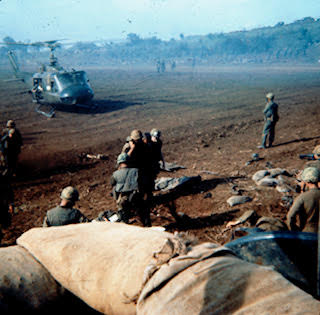
Helicopter evacuating Lonny – their final separation
He said nothing, just moved to Lonny‘s side, and together we lifted Lonny to a standing position. With the bandaged Marine under one arm and me under the other, we exited the Amtrac. Walking as quickly as possible to the cleared area where the choppers brought in more Marines and ammunition. Then, pausing to take on the wounded. We half-carried Lonny to the side door of the green helicopter and set him on the door sill. I jumped in and moved behind Lonny. Grabbing him, I pulled back, and just before I laid him down, I noticed the deck of the chopper was awash with blood. I suddenly felt sick, but before I knew it, the door gunner pushed me out the door. I remember looking down at Lonny, whose eyes were shut. Then the roar of the engine, and the world around me swirled with dust, and he was gone.
35 Years Later
I came home after the war with PTSD. I didn’t know it at the time, but it was like a cancer hidden deep inside of me, waiting, raising its ugly head in the middle of the night, or when my stress level swelled. I was told by many people that I had “changed,” that I was not the person who had left years before.
That hidden world collapsed on me in 1986. The night sweats, the anger, the fear – it all came back. After many anguished nights, my wife read an article about veterans and PTSD. She immediately recognized my cry for help.

With the guidance of a counselor, we identified it as PTSD, or, to be more precise, guilt. I constantly thought about Lonny’s face on the day I put him into that bloody chopper. When I pictured this, my emotions would skyrocket, and my eyes would well with tears. With the help of two friends that Lon and I served with in Vietnam, I obtained Lonny’s phone number in Texas. I remember my emotions were ramped, my hands trembled, and my breath was short and choppy.
A woman’s voice answered. She heard me out, and said nothing, then I heard her ask Lonny if he knew Perry Walker in Vietnam. I heard his footsteps across a linoleum floor, the receiver lifted to his face, then a pause. I heard him take a deep breath, as if all his memories were rushing in.
“Do you hate me?” He said.
I was taken aback. “Lonny, why would I hate you?”
“Because I left you”.
*****
Thank you for taking the time to read this. If you have a question or comment about this article, scroll down to the comment section below to leave your response.
If you want to learn more about the Vietnam War and its Warriors, subscribe to this blog and get notified by email or your feed reader every time a new story, picture, video, or change occurs on this website—the button is located at the top right of this page.
I’ve also created a poll to help identify my website audience. Before leaving, please click HERE and choose the one item that best describes you. Thank you in advance!

 CherriesWriter - Vietnam War website
I’d like to learn more of you and Lonnie after you and he reunited.
George Paul Farris FarrisGP@gmail.com Mbl: (202) 368-6666
LikeLike
Uncle, this was so special to read. I cannot imagine the guilt that you both carried all those years. I am so thankful that we both connected again. God bless you Uncle…. Paul
LikeLiked by 1 person
Thank you for sharing this story. Well written accounts and the end made me cry. True sense of loyalty.
LikeLiked by 1 person
This is Lonny’s wife Diane. Perry, thank you for writing this story about Lonny. He didn’t talk much about his time in Vietnam. The guilt ate at him for 35 years until he reconnected with you and the others he served with. You captured his personality perfectly. His sense of humor and his loyalty to his Marine brothers. Semper Fi.
LikeLiked by 1 person
Great summary of how one feels when leaving your unit still alive. The regret and survivors guilt never goes away. Lost my fire team (19 yo and 23 yo) and feel guilt to this day.
LikeLiked by 1 person
We all changed from time in ‘Nam to time we made it home ! Neither of you have anything to feel ashamed of. Welcome home !
LikeLiked by 1 person
The last line says it all. The loyalty and responsibility we felt for each other was powerful.
LikeLiked by 1 person
What a wonderful story- well written!! I’m sure many of us Vietnam Vets have a similar tale. Mine whas when I met Mike Leon when I first got in-country at Long Binh Post January 1970. We became as close as brothers. We were assigned to the 557th MP Co., and often rode as partners in a two-man town patrol jeep in Bien Hoa, and while on convoy escort, experiencing many shared “adventures” during our tour of duty. After we were done with the war, we kept in touch. He lived in Southern California and I in Northern California. We met up a few times over the years, and corresponded by email or by phone. Sadly, Mike passed away a couple of years ago from cancer caused by Agent Orange. I think of him often.
John Schembra
LikeLiked by 1 person
Great story and well told. Thanks
LikeLiked by 1 person
I’m so happy you’re here with us and this is wonderfully written! I love you grandpa! Great job with this! So touching! Love, Shana.
LikeLiked by 1 person