
During a routine patrol, his squad was caught in an ambush. He was wounded, and the event might have saved his life. Here’s one instance when volunteering in the military paid dividends. Read what happened.
By Lee Campbell
I arrived in Vietnam in early March 1967 and was assigned to the 2nd platoon, Charlie Company, 4th Battalion, 12th Infantry, 199th Light Infantry Brigade. As an RTO, I carried the PRC-25 radio for the squad leader to communicate with the platoon and company RTOs. I called in our coordinates, popped smoke grenades in LZs to guide resupply and dust off choppers to our locations, and called in our coordinates for artillery fire missions.
On July 2, Charlie Company’s Second Platoon was on the last day of a three-day search and destroy patrol near Bien Hoa, South Vietnam. My job was to follow our squad leader, Sgt. Curtis G. McHendry, who we called Sgt. Mac. We had humped pretty much from shortly after daylight to near dark every day, and we were exhausted. As the platoon set up their NDP (Night Defensive Position), my squad started out for a location about 500 yards away to ambush a trail running adjacent to a wooded section.
When we came upon a deep stream, I volunteered to swim across and secure the ropes on the other side. This stream was about fifteen yards across, and swimming with a rope and boots on was much more difficult than I initially thought. I went under a couple of times and struggled across without drowning. The first guy to cross on the ropes brought my radio.
Once everyone crossed the stream, we found ourselves next to a thick wooded area on our right. We followed it for thirty minutes before coming to an open area and stopped for a short break. We set up a small twenty-foot diameter perimeter, with Edward “Piggy” Miller, our M-60 machine gunner, positioned closest to the wooded area and in the twelve o’clock position. “Piggy” was his nickname, but I always called him Miller. He and I were close friends in Vietnam. Two other guys in our squad carried ammo for the M-60 and dropped next to him. The following two positions were set at a clock’s four and eight o’clock positions. Sgt. Mac and I were together in a spot furthest away from the stream and wooded area and more in the circle’s center.
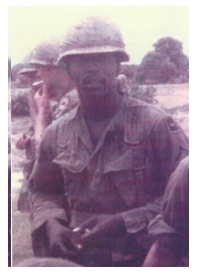
Edward “Piggy” Miller
The old rice paddy we sat in was dry; a border dike was to our rear, about twenty-five yards away. According to our map, we were only about a half mile from the Company CP on the other side of the large wooded area.
Sgt. Mac was an E-6 staff sergeant who was a good squad leader and a nice guy. I liked him. I just turned twenty-two, Sgt. Mac was closer to thirty but appeared older. The other nine guys were all between nineteen and twenty-two. I remember Daniel Toro, who carried the M-79 grenade launcher, Bernie Ford, Tommy Donahue, and Robert McClamroch, all infantrymen. The remaining four guys were all new; I don’t remember their names. We were all trying to get rid of the leeches we picked up while crossing a second shallower and only knee-deep stream en route to this position. Some, like me, attempted to dry out, rest a little, and eat a dinner of C- Rations before it darkened and we moved to our ambush location. My boots lay on the ground while my wrinkled feet dried in the humid air.
Suddenly, we came under intense fire from the wooded area. Sgt. Mac and I were pinned down, bullets impacting all around us. I immediately knocked my radio on its side and slid it between us and the woods so we had something to hide behind. I had my steel pot helmet on, but Sgt. Mac lost his in the scramble to melt into the ground.
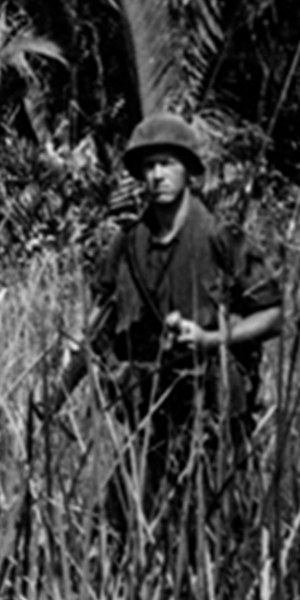
PFC Lee Campbell, RTO
Sgt. Mac immediately took the radio handset to call the Second Platoon Leader, Lt. Gene Krupp, for help but got no response. Then, I tried for several moments but couldn’t reach anybody either. While continuing my efforts, Sgt. Mac was yelling, “Miller, get the machine gun firing.”
There was very little return fire from our squad as everybody remained pinned down for several minutes. The incoming rounds were passing so close to my head that I could smell them burning and heard them crackling as they passed overhead. The sound was like bacon frying in a skillet. I was still calling for help on the radio, and Sgt. Mac was hollering at Miller when an enemy burst hit us both.
Sgt. Mac yelled, “Oh my God, I’m hit, I’m hit.”
I told him I was hit, too!
I was shot through my left elbow. The round went in from the inside and out the back. Sgt. Mac was shot through his right foot. The fire remained intense for some time.
The next thing I remember is hearing the M-60 and the other guys finally returning fire. Several minutes later, and just as suddenly, the enemy fire stopped.
Now that the short skirmish appeared over, I examined my radio and found three direct hits, which explained why we couldn’t reach anybody.
Just then, Daniel Toro crawled over to our position and informed us that Miller was killed in the initial burst. It was Daniel who took over the machine gun and began returning fire. While talking, he assessed our wounds – bandaging my arm and helping Sgt. Mac to remove his boot. Toro’s equipment was hit four times (his steel pot helmet, canteen, the heel of a boot, and gun belt), but he was not wounded.
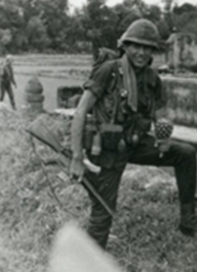
Sgt. Curtis G. McHendry
Just then, the rest of Second Platoon and our new platoon medic, George Hauer, came crashing through the foliage and into the clearing. This was Hauer’s first combat experience. He went straight to Miller and determined that he had died instantly. Hauer had just replaced Second Platoon medic Jim Rothblatt, who was transferred to the mortar platoon and Company CP, where he was promoted to Senior Medic. A helicopter gunship arrived and fired rockets and mini-guns into the suspected enemy positions. When a medevac helicopter touched down, Toro returned and helped me get Sgt. Mac to the chopper, which landed thirty yards away.
The medic on board helped Sgt. Mac onto the chopper. I shared my supplies, M-16, and ammo with the guys and hopped onto the chopper. It took off, leaving my bullet-riddled boots and radio lying in the field.
Sgt. Mac and I were seated side by side on the helicopter, with Miller’s body lying at our feet. His face was contorted as if he were trying to holler out, a single, bloody hole was centered in his forehead, and his stomach was so swollen that he looked nine months pregnant. It was a short chopper ride to the Tan Son Nhut Airbase. We landed at the heliport, where a Jeep ambulance truck was waiting.
The truck had a medic in the back, who helped get Miller’s body inside and then assisted Sgt. Mac as he climbed in. As I started to step up into the back of the ambulance, the medic motioned me away and closed the door. Thinking that he wanted me to walk around and get in the passenger seat, I started around the right side of the ambulance, and it pulled away.
The round that went through my arm must have severed some nerves because I wasn’t hurting all that bad. The underside of my arm was numb from the elbow through my left hand. Anyway, there I was, standing alone on the helipad with no boots on and my bandage loose and streaming almost to the pavement.
By this time, it was getting dusky dark. I looked around, and there was a building maybe twenty-five yards away. A soldier had exited earlier and was now walking toward me. He was an Air Force Major who had watched everything unfold.
He asked, “Son, weren’t you supposed to be in that ambulance?”
I answered, “Yes, sir, I’m shot and need to get to the hospital.” I raised my arm to show him my blood-soaked bandage.
He said I should wait right where I was and hurried back to the building. Less than five minutes later, a green sedan pulled up. The rear window rolled down, and an Air Force Major General peered out. “Get in the car, son; we’re taking you to the hospital,” he said.
I opened the back door and started to climb in, but hesitated when I saw the general sitting there. He told me to get in the front passenger seat.
All I could think of was how dirty my fatigues were; blood was still leaking from my elbow and dripping onto the leather seat. I felt bad that the driver of the spit-shinned limo had to clean it up after I got out.
The general and I chatted nonstop until arriving at the 3rd Field Hospital in Saigon. The emergency entrance was dark, and no one was around. “Wait here; I’ll be right back,” the general growled.
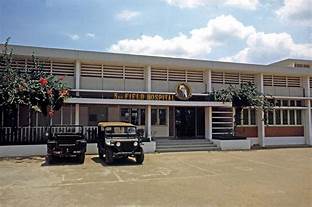
3rd Field Hospital, Saigon
A minute later, the doors swung open, and four medical staff came running out with a wheelchair and stretcher. The general wished me well before I was rushed inside.
They took me to a curtained-off area to examine my arm and scheduled me for surgery. Then, one of the attendants pulled back the side curtain, and Miller lay there on a gurney.
He asked me if I knew him. When I nodded that I did, he wanted to know all about him. I told them everything I knew. They closed the curtain, which was the last time I saw Miller.
I went to the shower room and stood under the hot water for thirty minutes, my first shower in four months. I had the surgery and slept all the next day and night and woke up the following morning with my arm in traction and a Purple Heart pinned to my pillow. The guy beside me said they tried to wake me but couldn’t.
When the nurse came and took the bandage off, I saw the entrance and exit wounds were stuffed full of bloody gauze; each wound was an oval gash about five inches long and three inches wide. They had to leave the incisions “open” to drain and avoid infection. The next day, they told me they were flying me to Camp Drake in Tokyo, Japan, for a few weeks of therapy. I was happy because it meant I was out of “the field” and Vietnam for a few weeks.
I flew in a hospital plane to Tokyo with my arm still in traction. They scheduled me for surgery to close the wounds. The surgeons used thin strands of twisted wire about an inch apart instead of stitches. After a few days, I was doing o.k., but the therapy was seriously unpleasant.
I was bored and volunteered as a clerk in one of the offices when I wasn’t having therapy. That decision led to an opportunity that may have saved my life. I worked there for a few weeks before I got my orders to return to the 199th Infantry Brigade in Vietnam. The sergeant in charge offered me an opportunity to get my MOS changed from 11B Infantry to 71B Clerk. I took him up on his kind offer. I arrived back at the 199th Brigade Main Base at the end of July.
I was assigned to work as a clerk for the Brigade S-1, Major Edward Kelly III. The S-1 office was still in a tent on a wooden platform and part of “Tent City .” I worked there for a few weeks before moving into the new Brigade Headquarters building, a single-story wooden building on a concrete slab. The Brigade HQ building was connected by a wooden covered ramp to the Tactical Operations Command (TOC) building. The TOC building was heavily sandbagged on all sides and on the roof in case of mortar or rocket attacks. A short time later, Major Kelly was reassigned and named the Executive Officer (XO) for 4th/12th. His replacement, Major John Musser, was my boss for the rest of my tour. Ironically, when the sergeant who worked in S-1 rotated out, his replacement was Sgt. Mac, who had just returned from Japan.
In late January 1968, I only had about six weeks left in-country and was finally beginning to believe I would make it home after all. Then TET happened! We dug in and sandbagged three-man defensive positions at each of the four corners of the Brigade HQ building – “our last line of defense.”
The TET Offensive began in the early morning of January 31, 1968. The North Vietnamese Army (NVA) and the Viet Cong (VC) launched a series of well-coordinated attacks on cities, towns, and large military bases all over South Vietnam. Our 199th base camp came under heavy 122mm rocket, mortar, and crew served weapons fire before waves of Viet Cong and NVA from the 274th & 275th main force regiments attacked the camp. After three days of heavy fighting, we counted over nine hundred enemy bodies around the perimeter.
In early March 1968, I returned to the 90th Replacement Battalion for out-processing and went to Bien Hoa Airbase to catch my flight home. There, I joined hundreds of other celebrating soldiers who also survived their tours in Vietnam.
#####
Lee Campbell lives in Johnson City, Tennessee. He retired as a PGA Golf Professional and is a Life Member of the PGA of America. He was diagnosed with Multiple Myeloma August 1, 2023 and later Plasma Cell Leukemia from exposure to the herbicide Agent Orange in Vietnam (57-years later). He is currently in Cycle-11 of a Chemo Treatment Program at the VA here in Johnson City. In the next couple of months he will be going to the Nashville, TN VA Hospital at Vanderbilt for a Stem Cell Transplant.
*****
Thank you for taking the time to read this. If you have a question or comment about this article, scroll down to the comment section below to leave your response.
If you want to learn more about the Vietnam War and its Warriors, then subscribe to this blog and get notified by email or your feed reader every time a new story, picture, video, or change occurs on this website – the button is located at the top right of this page.
I’ve also created a poll to help identify my website audience. Before leaving, please click HERE and choose the one item that best describes you. Thank you in advance!


Very interesting. Thanks for sharing and wish Lee the best with his treatment.
LikeLike
I lost my Uncle Charles in a Helicopter crash at Fire Base Washington due to a star shell that exploded near his medivac Huey as they were attempting to land. It was in November of 1970 and I was just 11. He was my father’s younger brother and my dad was devastated. I went with him to the funeral and saw my dad cry for the first time. To the men and women who served in Vietnam I welcome you home and may God Bless you all and your family’s.
LikeLike
A clear memoir of a bad day. There it is. There it stays.
LikeLike
LikeLike
Welcome home…
LikeLike
LikeLike
Glad to have read your story and that you were able to avoid returning to fighting in Nam. During your time there I was stationed at Yokota AB, Japan where your Medevac airplane landed. From there they loaded you on a bus to Camp Drake for your surgery. I worked on the east side of the runway at Yokota and saw the Medvac planes on the tarmac every day of the week. We didn’t talk about those planes or the people on them as a way on insulating ourselves from the active war. I apologize to you and all others that may read this but I think it was a defensive mechanism that we used.
I am please that you are receiving treatment for your current illness and pray for your full recovery.
LikeLiked by 1 person
Hi John, This was a great story about Lee Campbell’s Vietnam experiences and his new battle with cancer. I noticed that Lee was from Johnson City, Tn. If you recall, I wrote a chapter in my book” The Gunner and the Grunt” about my commanding officer, Major Billy Joe Nave, who was born and raised in Johnson City, Tn. He graduated from East Tennessee University on the ROTC Program and was later killed in Vietnam on 27 June 1966. Lee probably attended the same high school as Billy Joe Nave. Tell Lee I wish him well. Like Lee, many of us old vets are struggling with serious illnesses, most of which is related to our time in Vietnam.
LikeLiked by 1 person
I was in the same unit in Vietnam with John Honaker who knew Bill Nave. I have some information about John if you are interested. My email is leecampbellpga@gmail.com.
Lee Campbell
LikeLike
Thanks for your story and may your medical treatments be successful.
LikeLiked by 1 person
That Ol’ Man Agent Orange raised his ugly head again at the end of this article. For so long the army refused to believe in that ghost. But it finally all came out. People who fought the war then had to fight again…that should not be, not on that scale.
LikeLiked by 1 person
An awesome account of some of our American Hero’s. I’m grateful for each and everyone of them.
LikeLike
An outstanding recollection of time served and brave men. Welcome Home.
LikeLiked by 1 person
God bless you all and welcome home
LikeLiked by 1 person
Thank you for the sacrifices you made, for me and for our country. This should be a mandatory reading for every young person in America. It would enlighten them to a position of thankfulness for the many sacrifices made so they could enjoy the many liberties we have and take for granted. God bless you, and every one of YOU who made similar sacrifices. Carl
LikeLiked by 1 person
Thanks for a well written story that any infrantryman can relate to. As someone who carried the M60 & a PRC 25 on different occasions I can certainly relate to your experience as well as the fire fight coming out of nowhere.God bless and I pray that you recover quickly.
LikeLiked by 1 person
Lee Campbell, Welcome Home Brother.
I just wanted to let you know that I served at 3rd Field Hospital OR in Saigon 1972.
You were there a few years before me. but we did our best to save lives before I was there and after I came back State side. 3rd Field Hospital was an incredible place.
Keep Smilin myfriend
Randall Underwood
LikeLiked by 1 person
A very good read…..
LikeLiked by 1 person
Great article. Written very well with excellent details. Took me back to my time with the 101st in early 1971.
Terry Smith Bristol, Virginia
LikeLiked by 1 person
Excellent, well written -who, what, when, where, and a little why. Three epilogues, out of the field, out of VN, and, hopefully, out of the hospital soon.
tom yelverton – 11B
3/47, 9th infanty division
LikeLiked by 1 person
Thanks you for your story..
Bob 1/12th 1st. Air Cav. 10/68-10/69
LikeLiked by 1 person
It was well written and I was glad the way it ended for the trooper. Not all men who were wounded made it back. I served in 1966-1967 with A co.229th AHB, First Cavalry as a door gunner on a UH1D (Huey) helicopter. My MOS was 11B4P, but I volunteered to be a door gunner.
LikeLiked by 1 person
I pray your treatment’s work. We really brought the war home with us. I was there in 65 & early 66 with the 1st Cav.
LikeLiked by 1 person
Thanks for the story.I pray your medical treatments are successful.
LikeLiked by 1 person
I pray your treatment will silence this terrible disease.
LikeLiked by 1 person
Brought back memories of me in Vietnam,6/31 infantry 9th division, Mekong Delta,69-70
LikeLiked by 1 person