
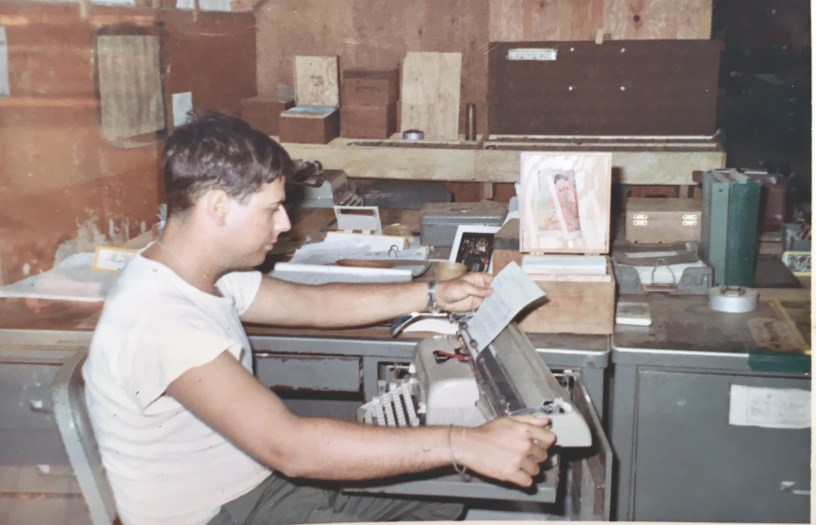
There wasn’t a safe place anywhere in Vietnam during the war, and every person who served there was at risk of injury or death. In this war, 10% of the military actually patrolled through the jungles and rice paddies in search of the enemy. The rest supported their efforts in the field and mostly spent their nights in highly defended camps. Any inefficiency of these units would have caused a major problem for those living outside the wire. Infantry soldiers referred to them as inferior and called them REMFs. Many Vietnam Veterans know of Marc Leepson. This is what he has to say.
By Marc Leepson
On July 10, 1969, I walked out of an administration building at Fort Myer in Arlington, Virginia. I had just finished the paperwork that processed me out of the Army. I was a civilian for the first time in two years. I felt damn good. I also felt very lucky.
On July 11, 1967, the day I was drafted into the Army, I felt a lot of things, but lucky was not one of them. As I slogged through eight weeks of basic training, the drill instructors rarely missed an opportunity to tell us draftees that we would be headed for infantry Advanced Individual Training at the notorious Fort Polk in the swamps of Louisiana, before going straight to Vietnam—where we’d be lucky to survive our first week.
My good luck began after basic training when I received orders for clerk school. It continued after I arrived in Vietnam on Dec. 15, 1967. After four days at the giant Long Binh Replacement Station near Saigon, I got orders to report to the 527th Personnel Service Company in Qui Nhon, a port on the coast of central South Vietnam—a safe area in the rear. After coming home from the war, I wound up with a great assignment: company clerk for an Army unit in Washington, D.C., where I went to college.
Other than thanking my lucky stars that I survived the war, I don’t recall reflecting much about my service in Vietnam that fine July day 50 years ago when I left the Army. I was just happy to be back in civilian life and have my military service in the rearview mirror. I took a temporary full-time job and then started graduate school. Life was good.
But not completely. Like nearly every other Vietnam veteran coming home to a bitterly divided country, I quickly figured out that hardly anyone wanted to hear about the war from those who had served in it. So I did what nearly all of us returning veterans did: I shut up about it and went about my business. I finished graduate school, got married, screwed around for a couple of years and then embarked on a writing career at age 28 in 1974.

It wasn’t until the late ’70s that I felt comfortable talking about the Vietnam War and my role in it. Well, mostly comfortable. Although I had mixed feelings about the war, I felt pride in having served my country. But I also felt that pride diminished by the sense that people who didn’t serve, and even some veterans, let it be known in subtle (and sometimes not-so-subtle) ways that my service as a rear-echelon soldier was inferior to that of “combat veterans.” To this day, I feel demeaned by the assumption that those of us who weren’t in combat units are some sort of second-class veterans. It’s as though there is a two-tier war veteran caste system, with former rear-echelon folks as the untouchables.
When people ask what I did in the Vietnam War, I tell them that I was drafted, then got lucky—that I was a clerk in a personnel company and that only one guy in my unit was killed the year I was there. Most people respond kindly and say, “You served. That’s a good thing.” Or words to that effect. That goes for nearly all of my fellow Vietnam veterans.

But—and it’s a significant “but”—I continue to hear “combat veteran” all the time. I admire and respect every Vietnam veteran who served in the combat arms. My feelings have nothing to do with their sterling service. But using “combat veteran” obliquely demeans the service of all of us clerks, cooks, truck drivers and other rear-echelon types. I realize that most people who use that term don’t intend to minimize or mock the wartime service of hundreds of thousands of other veterans, but that’s exactly what it does.
I was astonished to see British journalist Max Hastings go out of his way in his recent, big history of the war, Vietnam: An Epic Tragedy 1945-1975, to deride the service of anyone who wasn’t humping the boonies in Vietnam. How else to interpret this snarky, condescending sentence in which he sums up all rear echeloners’ war service:
“Maybe two-thirds of the men who came home calling themselves veterans—entitled to wear the medal and talk about their PTSD troubles—had been exposed to no greater risk than a man might incur from ill-judged sex or ‘bad shit’ drugs.”
Ken Burns’ much-ballyhooed 18-hour, 2017 Vietnam War documentary all but dismissed the service of men in noncombat units. The show offered hours and hours of grunts fighting but gave only a few minutes to rear-echelon people.
I understand that infantrymen could have negative feelings about us rear echeloners, but we were doing the jobs the military asked us to. And in Vietnam, contrary to Hastings’ ridiculous generalization, you were in danger no matter where you were. In addition to the GI killed in my unit while I was there—Stephen Allsopp, blown up on guard duty in 1968—three other men from the 527th Personnel Service Company lost their lives in Vietnam during the war. As did thousands of others not in the combat arms.
Although there are no official statistics, the best estimate is that 75 to 90 percent of those who served in Vietnam were in support units. That’s more than 2 million men and women who came home without the label “combat veteran.”
My suggestion to fellow veterans and those who never put on the uniform: Please consider dropping “combat veteran” from your vocabulary and replace it with “war veteran.” Or “Vietnam War veteran.” Or “Iraq War veteran” or “Afghanistan War veteran.”
While you’re at it, I wouldn’t mind a “thank you for your service.”
Marc Leepson is a journalist, historian and the author of nine books, most recently, Ballad of the Green Beret: The Life and Wars of Army Staff Sergeant Barry Sadler. He edited the Webster’s New World Dictionary of the Vietnam War and is arts editor, senior writer and columnist for The VVA Veteran, the magazine published by Vietnam Veterans of America.
This article was published in the October 2019 issue of Vietnam.
By Chuck Barone:
Patton said it best. “Every single man in the army plays a vital role. So don’t ever let up. Don’t ever think that your job is unimportant. What if every truck driver decided that he didn’t like the whine of the shells and turned yellow and jumped headlong into a ditch? That cowardly bastard could say to himself, ‘Hell, they won’t miss me, just one man in thousands.’ What if every man said that? Where in the hell would we be then? No, thank God, Americans don’t say that. Every man does his job. Every man is important. The ordnance men are needed to supply the guns, the quartermaster is needed to bring up the food and clothes for us because where we are going there isn’t a hell of a lot to steal. Every last damn man in the mess hall, even the one who boils the water to keep us from getting the GI shits, has a job to do.”
Thank you for your service, brother! And thank you for this great article.
<><><>
Thank you for taking the time to read this. Should you have a question or comment about this article, then scroll down to the comment section below to leave your response.
If you want to learn more about the Vietnam War and its Warriors, then subscribe to this blog and get notified by email or your feed reader every time a new story, picture, video and changes occur on this website – the button is located at the top right of this page.
I’ve also created a poll to help identify my website audience – before leaving, can you please click HERE and choose the one item that best describes you. Thank you in advance!

 CherriesWriter - Vietnam War website
I was an 11B from 2002-2010 and spent nearly 3 years of it on deployments to OIF. I was very heavily engaged in active combat with the enemy and very much earned my Combat Infantryman Badge as well as the Valor devices attached to some of my ribbons. If you wanted the same respect and recognition as a combat grunt you should have suffered through the same miserable conditions alongside them but you didn’t. It’s just that simple.
I’m proud of what I accomplished during my time in the Army and no one owes me any recognition or gratitude just like no one owes you any either Marc. It’s completely on you to be proud or not of your own service. If you feel like you deserve more recognition then maybe you should have did more to earn it.
LikeLike
I have so many different thoughts about this subject. I suppose was considered a combat vet being in fire fights on the ground (all documented by my commanding officers and some who witnessed them) but I did not have an 11B MOS. I did complete basic of course at Ft. Knox, Ky and was sent to Ft. Polk for advanced infantry training. A strange thing happened two weeks into my training, I was called to the orderly room and ask about my past experience working with the dead. I told them and that I was trained in civilian life and worked and lived in a funeral home. I was then immediately sent to graves registration school in Ft. Lee, Va for Army version of taking care of our deceased hero’s. I then was sent to Ft. brag and then to Vietnam and assigned to a Graves Registration unit in Cantho in the Mekong Delta. I was assigned to the search and recovery of air crash (mainly chopper crash victims) and bring them back to the mortuary or collecting point for first stage of processing. I personally was on the ground under enemy fire and awarded letters in front of the company but never received the medals I was told I would receive but its ok they would just wind up in a shoe box in a closet and forgot about more than likely. I am sad to see that we as vets are now grown men well into our 70’s or even 80’s and still using the words like gooks and putting our fellow vets down. Cool down men no one is trying to steal your glory, but we all were at danger no matter where you were. I remember going to a unit near my airfield and picking up the mail clerk killed in his sleep by a VC rocket and shrapnel went through the building and killed him. I also remember speaking with a combat unit that was back, and they told me that they had been on patrol for weeks and made no contact with the enemy. My point is it was a very mixed war and job assignments met nothing. I spent time in Vietnam as a soldier in combat with a 57F MOS not a 11B and also with the DOD until 1975. Return to visit in 1987 arrested in the Delta and put in a jail cell in a prison camp and accuse of being a spy by a Russian and North Vietnam office and finally acquitted, (FBI) can confirm this if needed and also, I bought into a company in Saigon in 2002 and having been teaching English there for several years. I have spent more than 14 years in Vietnam total and did so by looking at a beautiful country, friendly people, and amazing history of over 5000 years. Men let the anger and joyously go, for no one is trying to steal you glory but they were away from their family once also and never knew from day to day what would happen. I know what I did, and no one can change that. I had a jog that most could not do and that is proven. I had hard combat vets with short time left work in the mortuary and requested to leave due to the nature of the job. We all have our weaknesses and strength in different ways. I learned to speak the language fluent and have traveled all over the country driving my car now and traveled the world also and have learned that we all are human, all make mistakes, all are Gods creation, and all must learn forgiveness if done wrong or felt anger to another. I am sure I will catch allot of back lash for this article but that’s life, I can deal with it. J D O Retired Pilot
LikeLike
Well said, bro!
LikeLike
I have no real problem with his post but only a genuine combat grunt who fought in the jungles can understand what an actual combat vet is. Mark Leeson served honorably and anyone who served in combat has every right to call himself a combat vet and should. It sounds like he is a crybaby.
LikeLike
This guy makes me sick. He had it good. Sure Charlie rocketed our installations. Hell, that’s war. Sure some of his equals got a dirt nap, that’s what happens in war. So he bitches, groans, and moans because he was not one of the 19,719 support personnel who got zapped and went to Valhalla. All of the other 58,000 Americans who died in Vietnam and whose name is on the wall were bonified combatants, not support. These KIAs are Combat Veterans who paid the full price of being so. Yes, 38,281 Combat Vets compared to 19,719 support. Army: Approximately 27,129 U.S. Army Combat personnel were killed in action (KIA) during the Vietnam War.
Marines: The Marine Corps suffered around 11,152 combat-related deaths.
And this spineless piece of crap who could have stepped forward and said, “Yo, Sergeant, I wanna hump mud.” DIDN’T. He liked his 3 squares and laying on springs every night. He is not worthy the term Combat Vet. That’s why he is a Vet. That’s IT! Not even a WAR Vet. Just a VET. He did his job. I did mine. He lived through it. So did I. He didn’t look into the cold, glazed, unmoving eyes of his best buddies. I did. He makes me sick. I’d luv to kick his ass from here to tim-buc-tu.
LikeLike
All hail the 11Bs and and any other MOS who was in the sights of Charlie. We all attended the toughest university in existence, The University of Warfare on the campus of South Vietnam. AKA, Combat Veteran
LikeLike
While many who served in the rear areas of Vietnam, on naval ships, at air bases in Thailand, or in other so-called “non-combat” positions/locations, rest assured that you are not alone in worrying that you may not have done enough to fight the war. Ironically, there are those who did fight as combat infantrymen, Marines, SEALS, Green Berets, et al, and engaged in one or more firefights and flew one or more combat assaults but still wonder whether they did their fair share of fighting. Some combat soldiers experienced only a few short-lived firefights while others endured horrific day and night long battles with overwhelming enemy forces. The two situations are not the same.
I was 11 Bush with the 1st Cav’s 7th Regiment and spent 6 months (July ’69-Jan’70) humping the boonies, pulling nighttime hex sites (ambushes) and OP’s, while only being in a few firefights/enemy contacts, and experiencing the loss of our company’s few KIA’s and WIA’s. In Jan’70, I was transferred to the 1st Cav’s Division HQ and enjoyed the relative safety and comforts of the rear for the remainder of my tour.
Then, in May 1970, the Division was ordered into Cambodia. At the time, I couldn’t help but feel that I was missing out on not being with the members of my former squad, platoon and company, who were about to engage in a long, bloody battle with hardcore NVA elements. I closely followed the reports of the fighting, for the next month.
In June, I was able to visit with my old squad/platoon, when they pulled Division HQ Green Line duty and was glad to see some of the old bunch. Unfortunately, I learned that several of my squad/platoon had been KIA in Cambodia and their loss has stayed with me, to this day. In fact, on my several visits to the Vietnam Memorial Wall, in Washington, DC, I always search out their names to pay them my respect.
Since my return from Vietnam, although I am proud of having earned my CIB and Air Medals and do refer to myself as a “combat veteran,” the feeling never has gone away that I still had not done enough and that I should have been, there, in Cambodia, fighting along with my old buddies.
LikeLiked by 1 person
So many people on this atrocity-prone planet can be and are [consciously or subconsciously] perceived as not being of equal value or worth to everyone else, when morally they all definitely should be.
Human beings can actually be seen and treated as though they are disposable and, by extension, their suffering and death are somehow less worthy of external concern, sometimes even by otherwise democratic and relatively civilized nations.
In other words, the worth of such life will be measured by its overabundance and/or the protracted conditions under which it suffers; and those people can eventually receive meagre column inches on the back page of the First World’s daily news. It’s an immoral consideration of ‘quality of life’.
Meanwhile, with each news report of the daily death toll from unrelenting bombardment, I feel a slightly greater desensitization and resignation. I’ve noticed this disturbing effect with basically all major protracted conflicts internationally since I began regularly consuming news products in 1987.
LikeLike
Awesome, Welcome home Brother, from a 1968 survivor, crew chief, 498th Dustoff.
LikeLike
I met a Vietnam veteran at the doctor’s office and we began talking. He told he he had been a mechanic in the Air Force so he didn’t feei entitled to call himself a “veteran” because he served on a base, not in combat. 😳 I asked him if he had ever encountered any mortar barrage and he said oh yeah, but I wasn’t hit. It doesn’t matter. You served in a war zone in a war torn country. Nobody was safe and everybody had a job to do. Therefore, you are a veteran of a foreign war. I had one uncle who was a talented mechanic and served as such in the Army in Vietnam. Another served packing parachutes for pilots in the Air Force. He packed Bud Day’s chute on the fateful day that he was shot down and taken POW. Thank God the chute was properly packed. My dad was 17 in 1943 when he went to enlist in the Marines. The recruiter convinced him the Navy desperately needed sailors for all of the ships built to bring our Navy up to par. To his horror he was assigned as a clerk for an officer because he had been studying business. His battle station was loading live ammo in the drums for the anti aircraft guns that shot down kamikazes. No war can be fought or won without the support of every person involved. Undoubtedly, those in combat share a bond based on their frequent brush with death, but they, too, are grateful for all of the people in support roles who provide them with the tools they need. Thank you for your service and your honesty. Stand proud!
PS: My husband was a flight surgeon in Iraq and flew out on medevacs under fire in dangerous conditions picking up horribly wounded kids. He, too, thinks somehow his job was lesser than that of combat vets. Yet a Marine told me he saw a doctor get hit by a mortar while talking on a sat phone on the base. Nobody is safe in any war torn country from Vietnam to Afghanistan and I’m sure in every war before and after.
LikeLiked by 1 person
I was in an artillery unit in 1969-
we were a target of the gooks the whole time I was there- My section chief died in my arms the night our landing zone was all but over-ran-, along with others in our battery and the unit that was on the line.
We took rocket and motor fire quite a days and nights.
I was combat solider in Vietnam-
And I am a combat veteran now.
scre anyone that tries to take that tital from me.
God bless every person that was there-no matter what they did and I am praying that every one that lost their life there is safely in heaven where they belong!
LikeLike
The article by Marc Leepson rings true for me. I served in the United States Air Force from June 1967 through April 1978. I would have stayed longer, but a Post-Vietnam Reduction-In-Force (RIF)was trimming the ranks. I looked for open slots in National Guard and Reserve Units but so many military members were being released, that openings were near impossible to find. When I enlisted in June 1967, I was 20 1/2 years old. I had spent a year in college working on a degree in Civil Engineering but didn’t have the money to continue. I got a job with a Defense Contractor as an apprentice machinist until I enlisted. I went through the usual basic training then technical training school for reciprocating engine aircraft maintenance. My first assignment working on aircraft was at Kelly AFB, TX. In November 1968, I would find myself on a contract civilian airliner headed for Vietnam from Washington state. I was assigned to the 4th Special Operations Squadron (SOS), headquartered at Nha Trang Airbase, RVN. I would spend about a week at Nha Trang learning the basics of the aircraft I would work on and eventually be a crew chief, the AC-47D Spooky Gunship (aka Puff The Magic Dragon). During my third night there, there was a mortar attack. Best I could find out, no infrastructure damage was done and no personnel were injured or killed. I was given orders to head to Danang Airbase, RVN at the end of the week. The first night I was at Danang there was a rocket attack early in the morning, 13 122 mm rockets landing outside the perimeter. Nothing on the base was damaged and no personnel were injured or killed. After I got my feet wet and started learning the systems of the AC-47D gunship, I was assigned as the crew chief to AC-47D S.N. 43-49211, tail number EN 211. I requested to be moved to the night shift so I could be awake when a majority of the rocket attacks occurred. Also, that was when our aircraft flew to provide ground support missions, etc. I don’t drink alcoholic beverages, never have. I don’t smoke, never have. I don’t use illicit drugs, never have. After about three months in Vietnam and seeing too many aircraft crash (none of ours) and aircrew killed in the crashes, I became emotionally numb and distanced myself from my coworkers on a personal level but still worked with them to give our absolute best effort to have the aircraft ready and loaded with ammo and flares for the night missions.
After five years working on aircraft (C-124, AC-47D (crew chief), T-29, C-131, C-54 and C118 (Crew Chief), I cross-trained into flight simulators and spent my last six years maintaining and operating B-52 and KC-135 flight simulators. Around 1977 we were informed that our flight simulator maintenance and operation would be transferred to civilian contractors.
When I came home from Vietnam and went to my parents’ home in Southern California, when I met people I had known before going to Vietnam were somewhat uncomfortable around me and treated me like I had been gone for a long weekend instead of spending a year in Vietnam. When I arrived at my next base, at the new arrival orientation briefing, those returning from Vietnam were asked to sit on one side of the aisle, all others on the other side. of the aisle. I was the only person in the room on the far side, trying to figure out why I had to be isolated from everyone else.
When I arrived at my work location, I felt out of place, kept to myself most of the time but eventually met several Airmen that had served in Vietnam. One of them was one of three survivors from an AC-119 gunship crash in Vietnam. I became part of a small group of Vietnam Veterans that usually ate lunch together. We were working in a phased inspection dock for the T-29 and C-131 aircraft, 5 days a week, 8 hours a day. We chatted about what we did in Vietnam but not what we saw while there.
I got out of the Air Force and tried to get a job with the U. S. Post Office. After testing for about four months, I was taken into an office and informed that there was a hiring freeze on white males and I would not get hired.
I got a job with a defense contractor based on my electronics and aircraft maintenance experience in the Air Force. The job would last for 36 years. While working, I returned to college part-time and worked towards a Bachelor’s Degree in Computer Science which I completed in 1995. I was promoted from an electronics positon to a multi-discipline engineering (software, electronics, mechanical) position. I was part of a team building a missile for the U. S. Navy and some foreign Navies.
I knew I had mental health issues but because I had a security clearance, I could not seek help for fear I would lose my security clearance that was required for my job. I felt most comfortable working tasks that I could do by myself.
I had never openly worn anything identifying myself as a Vietnam Veteran but when I did, I started running into “Real Vietnam Veterans”, mostly U. S. Army veterans. When I told them I served in the Air Force, they would lose their temper and tell me that Air Force members in Vietnam were never in danger or at risk of being injured or killed. Some warned me to leave before they really lost their temper. I would later find out they were members of a local VVA that I had just joined. I found out when I attended my first meeting and met them. They were upset that I dared to attend the meeting. Other members got them to back off and calm down.
I’m 77 now and have a 100 percent service-connected disability rating, all due to Agent Orange exposure and exposure to hostile conditions in Vietnam.
I have given up on getting quality care at the VA. I volunteered at the VA for ten years. I had to quit because the VA said the risk of doing surgery for a joint replacement is too risky at my age.
My father served in the U. S. Navy during WWII, my uncle (mother’s brother) served in the Royal Canadian Navy during WWII and was on a ship that was torpedoed and sunk and he survived. My brother served four years in the U. S. Air Force. My wife served four years in the U. S. Air Force.
LikeLike
https://ac47-gunships.com/images/spooky_race-2.png
LikeLike
With news-stories’ human subjects’ race and culture dictating
quantity of media coverage of even the poorest of souls,
a renowned newsman formulated a startling equation
justly implicating collective humanity’s news-consuming callousness …
.
According to this unjust news-media mentality reasonably deduced
five hundred prolongedly-war-weary Middle Eastern Arabs getting blown
to bits in the same day perhaps should take up even less space and airtime.
.
So readily learned is the tiny token short story buried in the bottom
right-hand corner of the newspaper’s last page, the so brief account
involving a long-lasting war about which there’s virtually absolutely
nothing civil; therefore caught in the warring web are civilians most
unfortunate, most weak, the very most in need of peace and civility.
.
And it’s naught but business as usual in the damned nations
where such severe suffering almost entirely dominates the
fractured structured daily routine of civilian slaughter
(plus that of the odd well-armed henchman) mostly by means
of bomb blasts from incendiary explosive devices, rock-fire fragments
and shell shock readily shared with freshly shredded shrapnel wounds
resulting from smart bombs often launched for the
stupidest of reasons into crowded markets and grade schools. …
.
Hence where humane consideration and conduct were unquestionably
due post haste came only few allocated seconds of sound bite — a half minute
if news-media were with extra space or time to spare — and one or two
printed paragraphs on page twenty-three of Section C. Such news
consumed in the stable fully developed, fully ‘civilized’ Western world
by heads slowly shaking at the barbarity of ‘those people’ in that
war-torn strife which has forced tens of thousands of civilians to post-haste
gather what’s left of their shattered lives and limbs and flee. …
.
Thus comes the imminent point at which such meager measure
couple-column-inches coverage reflects the civil Western readers’
accumulating apathy towards such dime-a-dozen disaster zones
of the globe, all accompanied by a large yawn; then the
said readers subconsciously perceive even greater human-life devaluation
from the miniscule hundreds-dead-yet-again coverage.
.
… The immoral consideration of ‘quality of life’.
LikeLike
I completely agree with the sentiments expressed by Mr. Leepson, with one exception; I will continue to describe my personal service as being a “combat veteran” because I’m proud of it. Beyond that, very few of us who served in the U.S. military had any control over what military occupational specialty we were given, what jobs or units we were assigned to, or where we served. Some entered service during wars and served most of their time during peace and vice versa. The point being that everyone who served/serves was/is at risk, and everyone who serves honorably deserves the thanks of a grateful nation. Thank you for your service Mr. Leepson, and welcome home!
JAMIE THOMPSON, Sgt, C 5/7 1st Cav, 1970-71
LikeLike
Wow Marc, a very powerful message.
I got drafted in September 1968 after graduating from college in June 1968. I took Basic at Fort Dix NJ and then got orders for Fort Polk. I knew where I was headed. I got to Vietnam in March of 1969 as Infantry and when I was being interviewed in S1, I looked like a friend of a guy from Pennsylvania and he got me transferred from an Infantry company into HHC as the Battalion Mail Clerk.
Two months later the 1/501st Inf, 101st Airborne Div got airlifted to help the Americal Div at Tam Ky (Operation Lamar Plain). We had a lot of casualties, both KIA and wounded). I was probably one of the few who had to know every casualty in order to do my job. Believe me, it had a very profound impact on me then and even now. The company that I had been assigned to before being reassigned to HHC had a lot of casualties and that clerk in S1 could have possibly saved my life.
I had talked to someone who had been in the field and told him about my feelings and he told me that I shouldn’t feel guilty about my job because if it wouldn’t be me there, it would be someone else, so why not me. I hadn’t done anything to orchestrate the transfer except look like a friend of the S1 clerk that got me transferred.
I surely can identify with your writing about REMFs and thank you for sharing your insights.
I have posted this poem before that I wrote but I will post it here again. It is also on LZSally.com.
THE SUN CAME OUT TODAY
The Sun came out today,
To shed it’s radiant beams on the soil.
What a curious sight to behold,
Amid all this trouble and toil.
The Sun came out today,
But it may as well not have come out at all.
It brought along blue skies and great white clouds.
What nerve, what gall.
Yes, the Sun came out today,
But it may as well not have come out at all.
It came not for warmth, it came not for hope,
It came to watch men fall!!
LikeLike
When I identify a fellow veteran near me when I am out and about running errands or such I shake their hand and say, “welcome home” no matter what war they fought in and I never ask, “what did you do over there” It’s enough that they served.
LikeLike
In my unit ALL the noncombat personnel pulled their load on the “wire” and the infantry grunts did not. WE enjoyed three hot meals per day and a matress on a bunk each night. Our CO knew what spending time in the boonies was like. Soft Grunts could spend some “search and destroy” time with Hard Grunts if they didn’t like a shift on the perimeter wire and drousey time at their typewriters. I.e., everyone did his job.
LikeLiked by 1 person
I spent 24 months in Vietnam with most of that time on Artillery Fire Support Bases. I agree 100% that each and everyone who was there played a critical role in our support of the Vietnam people. From payroll clerks, to drivers, aircraft support crews, engineers and the list goes on, everyone had designated jobs regardless of location. I also understand and agree with the author that people were doing the jobs the military asked them to do and that everyone was in danger no matter where they were located.
But I disagree with his suggestion that the word ‘combat’ be removed when referring to certain groups of veterans. If two people both worked for a road crew in the mountains of Colorado and one directed traffic and one handling explosives, I think most would agree the the explosive expert had a job that was significantly more dangerous than the other. No different that units in Vietnam. If you had a job that exposed you to combat situations on a regular basis, I have no problem using the adjective “combat’ in front of veteran. And in my opinion, that is not demeaning anyone who was there. Each job was critical to the effort as were those performing any job.
LikeLiked by 1 person
I agree with your disagreement, if you’ve got it flaunt it. I get, the “Thank You for your service” all the time because I wear a cap, mainly for the discounts that I otherwise forget to ask for. It’s like not having to pay tax, I paid mine while I was there. When I get the “Thank You” I usually ask, if no cap or other decoration, “Were you in?”. Usually, “Yes” and I thank them for serving. Those that didn’t serve, I tell them, “I am sorry you missed it.” I wonder if it’s offensive to claim to be “Veteran” by those that didn’t serve. If you’ve, “been there, done that”, then go ahead and talk about it. You’ve earned it. Why would anyone want to read a book about Vietnam, or anything else, and not know the whole story because it might offend someone?
Neal
Army Vietnam
1/83rd Artillery
LikeLike
no one had it harder than the grunt and too dismiss that fact is insulting to every man with a CIB
LikeLike
And Artillery men who fought died were not entitled to a CIB. I understand they made a Combat Action Badge for later, but Congress decided not for Vietnam. I agree the grunts had it rough, I have memories of them coming on to our locations where we fed them, clothed them, and off again they went.
LikeLike
I am a Vietnam Veteran. 3/69-3/70. 25th Infantry Division 1/27th Wolfounds. Delta Company 1st Platoon. I think I slept on a cot 5 times during my tour the remaining time it was on the ground. Did I envy those in the rear, of course I did. But we all had our jobs to do, and I THANK those that supported us Grunts in the boonies. For without them the Infantrymen could not have done their job effectively. War is HELL no doubt about it. I can only say that my Guardian Angel watched over me through the eyes 👀 of God. I Leave you with a big thank you to all those that supported the GRUNTS. We should all be proud Vietnam Veterans, nothing to be ashamed of. The ones that should be ashamed are the politicians in Washington DC. They never supported the troops. Amen 🙏 Amen 🙏
LikeLiked by 1 person
And they gave our victory away to the communists after we left. I’ll take that to the grave with me. President Nixon had cause to be paranoid. Neal – 1/83rd Arty – Vietnam 68-69.
LikeLike
Great read. Not all vets were combat tested. We needed all to accomplish the mission. I am thankful you, and many others, didn’t have to hump it in the boonies. Wear your Viet Nam Veteran garb proudly! But don’t take Combat Vet from me. I wear it as a badge of honor. As a percentage of those that served we are few. USMC 0311 ’66-68. GRUNT is a term of endearment…
LikeLiked by 1 person
Good Reading, I was a ch-54 mechanic and crew chief. We all did our part!
LikeLiked by 1 person
Great Story! I was a crew chief on local base helicopter at Ubon RTB, THAILAND. WE had a very secure setting compared to grunts in Viet Nam. One Friday morning a buddy and I were standing out on flight line, and three goony-birds flew one-after-another, landing on our base. They all had U. S. Marines painted on their planes. ‘ They were coming into our base for week-end R&R!!” Monday they staggered back into their planes, and flew back to their fox-holes. I always think of them to this days as my “Full-Metal-Jacket-Marines!” By the way, my grandson is at this time in Marine boot camp in Camp Pendellton. I was supporting the Viet Nam war a country away (Laois), but I consider myself a Viet Nam Veteran.
LikeLiked by 1 person
The pace of activity for USAF aircrews allowed little time for them to interact on a personal level with the airmen with whom we worked closely while on the ground. These included the crew chiefs who maintained the planes and ordnance, ensuring all the sophisticated technical equipment was in working condition and ready for flight. They also included the life support personnel. While the crew chiefs oversaw the aircraft, the life support airmen oversaw our flight gear and recurring safety and egress training. They took care of our personalized helmets, which, like a pair of glasses, needed tweaking from time to time, as well as our personalized life vests, complete with multiple search and rescue devices, including a handheld radio and a .38 caliber revolver, should we need to bail out over enemy territory. Safety training included hanging in the harness from time to time in order to stay familiar with the parachute lines should a high-speed ejection be necessary.
I lamented not getting to know some of these airmen, for I surely appreciated their work on my behalf. I recall two memorable occasions when I felt most intensely how our different tasks and the demands of the day kept us from forming a deeper connection, and this troubled me. One was with a crew chief and the other with a life support technician, albeit many years later.
While I usually climbed into the cockpit and strapped myself in without assistance, I recall once when a crew chief, stripped to the waist on the hot Udorn tarmac, hopped up and stood over me on the cockpit’s rail, offering to help secure the clasps. I was surprised by the gesture, appreciating the thoughtfulness he showed, and I welcomed the rare occasion for personal contact with the airman. I noted that he was probably not long out of high school, that he seemed proud of his work and his role in the combined wartime effort. After the short small talk, he gave a respectful quick salute and wished me well before jumping back to the ground, adding, “We want our pilots to come back.”
Another gladdening interaction occurred with a life support technician many years later while attending, along with several other 523rd Tactical Fighter Squadron mates, a memorial service at Arlington National Cemetery. Following the chapel service and interment, the families held a reception for those who attended. At one point, Rick “Kahuna” Cunliffe approached me to point out a man who was standing quietly at the side of the room, observing the activity. “He told me he was a life support technician in the 523rd,” said Kahuna, surprised to see an enlisted airman in a room that included several Air Force generals and other officers gathered to honor their fallen comrades. Suddenly, for me, everyone else in the room faded. I was immediately drawn to the man, wondering how he found himself here after all these years. Perhaps he was one of those vets who keep a close watch, via internet sites or other contemporary resources, on others with whom he served, even if they didn’t necessarily have a close personal relationship. I approached, telling him, “You probably don’t remember me, but I was told that you served in life support in the 523rd fighter squadron and I wanted to meet you and introduce myself.” His response, offered with a smile, left me in a breathless wonder: “Oh, I remember you.”
LikeLiked by 2 people
I served as an Operating Room technician at 3rd Field Hospital in Saigon in 1972. We took care of those grunts that got shot or stepped on a land mine… We saw all the effects of the war.
LikeLiked by 1 person
Thank you for what YOU did there…your predecessors did a great service for me while I was there as a patient in August 1968. My buddies wanted to leave my Browning HP under my pillow…the staff wouldn’t allow it! She may have rotated out by the time you got there, but I fell in love with my nurse, LT Wade. I was evaced while she was off shift and didn’t get to thank her or say goodbye.
Ken Delfino
U.S.Navy (RET)
LikeLiked by 2 people
if you served, you served. My service was as advisor to RF/PFs and PSDF. Down in the Delta with no co van backups.
Appreciate the support from the rear. Doing their job.
LikeLiked by 1 person
” combat veteran is a badge of honor” Do not try and take that away.We earned that title !!!
LikeLiked by 1 person
no sir, no one can take that from you. You earned the right to wear it with pride.
LikeLiked by 1 person
I could not agree more 🫡🪖🇱🇷
LikeLiked by 1 person
I was in the 2nd of the 19 artillery 1Cav
I am not happy with his take that I was not a Combat Veteran-
I say bull- the year i was there 1969 I was a constant target for the gooks- I held my second chief in my arms as his blood soaked the ground
and his life slipped away- more nights than I can remember we took rocket and mortar fire.
I was a combat veteran and thank God it wasn’t my blood that stained that darn ground!
God bless everyone that was there no matter what they did wile in Vietnam! /
LikeLike
27th Inf Regiment Wolfhound here. Although I have always had respect for those behind the wire, I won’t be removing my CIB from my cap to not offend a REMF,
LikeLiked by 2 people
In the comments you got it all…from alpha to omega. Read them all for a wide perspective…and add to that, a realization of just how far Ken Burns missed the target.
LikeLiked by 2 people
Ken Burns does burn my rear.
LikeLike
Very, very well said…and should be said. Again and again…
LikeLiked by 2 people
No one who served in Vietnam ever said that support troops were not honored or respected for their service in the war zone. But, “a big but” my unit lost 58 men in a landing and a defence of a landing zone / fire support base. It is not the same level of service or risk no matter how you want to parse it. We have 200,000 people in my county and so far this year 22 have died on our roads, that is about the level of risk that you probably endured. Look at the mortality of Huey Pilots, or Infantry 2nd Lt’s, related to my county population that is maybe 2500- 3500 road deaths, a considerable difference in risk. Let’s not even mention living conditions or meals and certainly not hygiene as we had no out houses or restrooms, maybe a shower every few weeks. It is NOT the same level of service.
A Combat Infantry Platoon Sgt.
LikeLiked by 3 people
From 1965 through 1969, AC-47D Spooky (Puff, The Magic Dragon) gunships flew thousands of missions in support of ground troops. Each time one of those aircraft was flying, they had a crew of 7-8 people, a mix of officers and enlisted men. 53 aircraft were converted from C-47 cargo configuration to AC-47 gunship configuration for use in Vietnam. Of those 53, we lost 14 of them and their aircrews when they were shot down. There were probably thousands of aircrew members who flew on those 53 aircraft during their time in Vietnam and survived. All of the missions flown were supporting ground troops and/or operations. By your logic, since ONLY 14 aircrews of 7-8 Airmen out of the thousands who may have flown combat support missions perished, they do not matter as much as those who died on the ground in direct conflict with enemy forces.
LikeLike
I was a squad leader
LikeLiked by 3 people
First, thank you for youir service Marc Leepson and welcome home, brother!
What you may be feeling is a form of PTS you might call Survivor’s Guilt. Unfortunately, this feeling of unworthiness is not helped by those who were in the jungle, getting shot at and thinking somehow there service was superior to those in the logistics and administrative chain that were getting the “beans and bullets” distributed to where they were needed, processing the orders for getting everyone on their “freedom bird” on time, staffing the medical facilities that saved so many more Vietnam veterans than their WWII and Korean War predecessors, etc., etc.
Like you, most of us were not in danger all the time, but the danger was there and it was random and often unexpected which made life difficult when we realized, we could be a casualty and there wasn’t much we could do about it…especially since we usually didn’t have trained military units nearby and the attacks when they came could not be predicted. Just as we can’t expect our under-appreciated civilian police forces to defend us until after we are attacked and therefore must prepare for our own defense, we had to do the best we could to prepare for an attack that could come anytime and in any form.
So, those of us who served in country and those who did not are all Vietnam Veterans. Those who came home without purple hearts and combat infantry badges were the fortunate ones. We all served and if asked, I believe most of us would fight as infantry if needed. It’s understandable if you cannot avoid a bit of guilt for your good fortune of having survived a war without having seen the battlefield at its most horrific. You are not alone.
As for me, I didn’t have to serve a second tour in Vietnam. When it came time for me to return, the War was winding down and I was told I would be serving a one year tour in Korea in 1970-71…a different type of war zone.
J.A. Machado (Vietnam 1966-67)
LikeLiked by 2 people
I was an 04B2LVS with 330th Radio Research Company, one year on Engineer Hill near Pleiku (where I had two Thanksgiving’s and two Christmases) and the next year in Nha Trang. I also was TDY at LZ Betty by Phan Thiet, Camp Radcliff near An Khe twice, and New Plei Djereng CIDG camp and back in Pleiku for almost two months. That last period was one of the happiest times of my life. I could do my job and not get hassled. It was cold at night and reasonable during the day.
I never heard incoming my first year and the one time a rocket hit 330th in Nha Trang I was at New Plei Djereng. Satchel charges exploding woke me up one night when I was at Camp Radcliff. I had to run to operations at night when rockets were hitting Nha Trang’s air base. On Engineer Hill we had an antenna field clearly visible between the perimeter road and the berm on two sides of our operations compound. We had guys (like me) that spoke some Vietnamese. Locals must have known what we were doing but they didn’t know how well we were listening to their radio traffic, thank God. We did a lot of good work and saved a lot of American lives.
We had people that had received the letter from Selective Service. They went to recruiters to find out if they could enlist for anything and heard that the only thing that could process paperwork faster than Selective Service was Army Security Agency, a four-year (later three-year) gig. A lot of guys took ASA because the work sounded interesting and they wanted to have a better chance of surviving. There were some Radio Research personnel that got killed over there. One or two of our planes were shot down not long before I DEROSed and ETSed in 1971. I extended twice. Lots of us extended. I knew at least three traffic analysts that spent three years there. I briefly worked with an NSA civilian that had been a lingie in a Radio Research unit and continued the work as a civilian. He had lost a close friend and wanted to work against the communists for as long as he could.
I have nothing but respect for those that had to be in combat. Forty years later, I met a fellow who had been a Huey pilot for a year over there. When I told him that I felt a bit of survivor’s guilt, he told me not to think that because we all had the opportunity to choose what we were getting into and I had volunteered for a four-year hitch. So it goes.
It was a rotten thing from beginning to end. One day, driving from Camp Radcliff back to Engineer Hill, I saw a guy sitting on his tank next to QL19 between An Khe and Pleiku (the NVA 95B Regiment called tanks and APCs providing security along that highway “xe chốt”) and thought how unfair it was that he was there while other guys were cruising Whittier Boulevard or wherever.
For what it’s worth, I was a teacher at a men’s prison for nine years. There were veterans among the inmates. At least two of them claimed to have been POW’s. I checked. Their names weren’t on any lists I found. There’s a lot of phony stuff in this world.
LikeLiked by 2 people
A Troop 7/17th Air Cav, no mater where you were , in VN there was danger all around, even for the military that hardly ever left the base. Rockets or mortars were common. without the ground crew the helicopters would not fly.
LikeLiked by 3 people
One thing that I did not see here is a remark from servicemen like myself. I was stuck at an ATC base in TX, where the pilots learned to fly jet aircraft. The T-37 was the first they flew. I was at Laredo AFB, TX. MY best friend joined the Army and sent to Vietnam. My father was in the South Pacific in WWII. I filled out the dream sheet more than once for Vietnam. I finally received orders for Thailand. When I received my orders, I asked, “What the hell is this.” At the time a guy who was a “lifer” told me I did not know it but I just received the best duty I could get. I served at 2 Air Bases in Thailand on the F-105 fighter and then the EB-66 that went with the fighters to jam radar sites. I am considered a Vietnam War Veteran. I still do not feel I did what I could because my two years in SEA did not include Vietnam. Believe me if I were a Marine or Army Infantry, I would not like someone like me calling myself a Vietnam Veteran. I will always wish I had put time at one of the air bases there to proudly say I served in Vietnam. Thanks for letting me get this off my chest.
LikeLiked by 2 people
This article is right on. I was there 69-70. I was with the 444 truck unit out of Quinon. I was a gunner on a guntruck, a gun jeep driver and gunner and mostly a tractor trailer driver with over 33000 miles. I and all those on the road are definitely combat veterans. My first load was 18000 plus of napalm. I mostly pulled munitions of all types around 44000 pounds at a time.
As a driver I went through more than six ambushes as our route was Quinon to Pleiku and back which included Ankhe and Mang Yang passes.
So those of us that weren’t in the rice patties did our job to support those in the jungle and rice patties.
So Welcome Home Brother!
LikeLiked by 2 people
“Brother”, if I may, Marc…..
For years I have had to tell fellow Viet Nam veterans who served in jobs like yours to not belittle their own service if they served in ‘support’ roles. Supplies like ammo, C-Rats and fuel had to get where it was needed in short order. Imagine how Ia Drang or Khe Sanh might have turned out if the support personnel, NO MATTER THE BRANCH OF SERVICE, weren’t doing the jobs!
I think of Army nurse Sharon Lane who was killed during an enemy rocket attack on her hospital.
I wonder how many of our personnel were killed during the TET ’68 attack on the big support base at Long Binh.
With our myriad of support/admin offices in key cities, EVERY cook, typist, comms person, supply clerk, et al were subject to rocket attacks and bombs at any time.
Add to that all those drivers of fuel tankers, ammo carriers and others who drove Highway 19…and the Navy LCU coxswains and their crews whose primary jobs were to get supplies to Marines during TET ’68 in I Corps.
Then there were all those sailors on amphibious ships that had to deliver supplies and the destroyers and cruisers who supplied off-shore fire support and pulled a lot of bases out of serious trouble.
Finally, and on a personal basis, the men and women who worked at the Cholon BX. By keeping well-stocked, my fellow River Patrol guys and I were able to able to resupply on our own to get school supplies, soccer balls, toys and candies for the villagers and kids we’d come in contact with. Cigarettes and bottles of Crown Royal went a long way in fostering good will and gleaning information for local SEAL and Green Beret teams to follow up on.
So Brother Leepson, while you may not have a Navy/Marine Cops Combat Action Ribbon, Army CIB or Air Force Strike medal, WE ALL share that Yellow/Red/Green Viet Nam Service ribbon that we EARNED!
In recent years many who avoided the draft now wish they had and even politicians have been caught lying about such service.
Respectfully,
Ken Delfino
U,S, Navy (RET)
LikeLiked by 2 people
“For want of a nail, a shoe was lost, for want of a shoe a horse was lost, for want of horse a rider was lost, for want of the rider the kingdom was lost” writer unknown. The principle applies to the military, it applies to private organizations; every person is part of the whole no matter how junior or simple, they contribute some part to the overall function and success of the organiztion and without them, something important will be left undone. As a Marine Vietnam veteran, I was a combat engineer, was never in a firefight
My battalion supported the tip of the spear…no shame, no regrets, but not without casualties.
Throughout history, the infantryman, the calvaryman could not be successful without unwavering support, just asl Napoleon, Hitler, now Putin.
LikeLiked by 2 people
67 to 68 TET I servedh (Quin ahn to DMZ) with the 498th air ambulance Co. as a pilot, and 71to 72second tour I served with the 271st Inn Keepers Chinook Co til standpoint then moved to the 147th Hillclimbers also Chinook out of Can Tho Served as maint test piolet and recovery.
First tour was a little hectic: seemed they seemed to shoot more at the red cross. I was shot down on March 9 at 05:30 atempting wounded recovery, as well as had 9 other a/c shot up. I was the only person to ever get shot in one of my a/c however there were 12 others that I know of that lost their lives. I carry their names in my bilfold yet today.
LikeLiked by 2 people
you, sir, and all of the helicopter drivers were my Hero’s and still are today.
I was an OR TECH at 3rd Field Hospital in Saigon in 1972.. you guys were either super crazy or super bold and brave. I think a combo grin. I remember once we had two door gunners come in with almost the same type of wounds, both had been shot in the calf muscle. I remember thinking it looked like someone took a bite out of an apple…
We had kit carson scouts come in to the OR…. all shot up. I was told that if ever a patrol was ambushed the kit carson was the first to be shot… by the Americans…
Anyway, I salute all the Helicopter pilots from your and my war.
LikeLiked by 1 person
Chuck, I too was a Dust Off pilot. I use combat Vet. BUT, do know this, we were support. I can’t pin on a CIB or the equvilent Medic Combat Badge, or any other combat experience because medical air evacuation is not recognized as combat. Never mind that those red and green tracers at night and AK-47 rounds that perforated your Huey time upon time are also found among the Grunts you were supporting. Your Purple Heart is evidence of your combat experience. Your Air Medals probably attest to combat flying but probably don’t have a V on them. So as support personnel, you are in the ranks of a “soft Vet”. There are many support personnel who have Purple Hearts. Created by “incoming” mortar and rocket shrapnel. An outright bullet wound is not common among cooks and typests. My Huey took 93 rounds one time; usually around 5 or 6.
So Chuck, you and I have a close affinity to the other support personnel. You could say that we were active combat, support.
I invited support personnel to take a ride with us on what would no doubt be a “hot” mission. Never any takers. But for a PX run . . . yeah, everyone wanted a ride.
LikeLike
I wear the combat veteran to honor men who were killed in combat thank you for your service
LikeLiked by 2 people
It sounds like the writer thinks that he is better than actual combat troops. I was an actual Army combat grunt. Its a whole different world to us that who were shot bat and shot the enemy. Non combat troops are as imporntant as the grunts but this writer thinks thal combat troops are less than him.I disagree with his perspective.Unless you actuallt served in real combat, you can’t understand what it was like. He has no idea what he talking about.
LikeLiked by 1 person
I know the folks in the rear were extremely important to us grunts. without them we wouldn’t’ have necessary equipment to do our jobs. no change of uniforms, c rations, ammunition, radio batteries, water etc. I was fortunate in several ways also. before Viet Nam I had several situations where I was held over for various reasons. I enlisted for pole lineman school and during AIT I volunteered for jump school and they had me sign a waiver. I didn’t realize that the waiver gave the army the right to put me in whatever MOS they need me. Of course that was 11B. when I got to Viet Nam I was assigned to the CP as an RTO for my full tour so I kind of got signal corps duty in a roundabout way. I still humped the boonies, but never had to pull point and rarely went on patrol or ambushes. I guess I was a Grunt with a small g. when I derosed, I had 11 months and 2 weeks to my enlistment therefore no 2nd tour for me. I got stationed to Ft Hood Tx and absolutely HATED garrison duty. Again I was fortunate to be assigned as the company legal clerk and mail clerk which gave me something to do unlike most of the company personnel who were marched to the motor pool to be unseen by the upper commands when we weren’t training. Ft Hood was basically a holding area for those not going for a 2nd tour and there was rampaging bad attitudes. If I had any inclination of reupping, Ft Hood cancelled out that possibility. Now that I think it, I just realized that I became one of those rear echelon people stateside.
LikeLiked by 1 person
NoBeginning on February 11th, 1967 until February 29th, 1968, I was a Marine Corps ‘Baby Killer’ according to what I saw on the news. I personally never saw any dead babies but then what the hell did I know? My job as a Radio operator assigned to an 8″ Howitzer Battery up inside of an I Corps FDC was to relay fire mission requests called in by mud Marines. My firebase was fairly large so somewhat ‘safe’, but we did experience a number of midnight 122mm rocket attacks and the occasional sniper dude. All in all I was very lucky because a Comm guy could go to any unit! Including Grunts and Tankers. I ended up in a Corps level arty battery! Didn’t see any dead babies though. Semper Fi.
LikeLiked by 1 person
Ken Burns underhandedly disrespected all Vietnam veterans in that so-called “documentary.” Don’t take it personally; he is as pinko as they come.
LikeLiked by 1 person
Amen Brother!
Ditto!
Finally, someone who understands the truth and facts.
LikeLike
I think it is a great ad long overdue response to a attitude that should have never been. I was a door gunnner on Huey helicopter, may tour was from June 67-68.
I did not volunteer for Viet Nam ad neither did may others, there were some.
We wet where we were sent ad did our best.
Thanks to all who served.
Paul Vitale
LikeLiked by 1 person
I am also confused how the Army went about assigning the MOS for each soldier as we finished our last week of basic training. The only thing I could conclude was they counted the roster….one, two, three and infantry! I was drafted at 22 in 1969. At that point in time, I had worked at a bank for 5 years beginning in high school. That work included the operation of the bank’s computers. I also could type 55 WPM which wasn’t bad for a man. I was astonished when my bunkmate, two years younger than me who had never worked other than bagging groceries was assigned an MOS learning to operate computers! I was given 11B and sent to Ft. Polk for AIT and then to Ft. Knox to learn APC driving and then straight to Vietnam to an infantry unit. Near the end of basic training, my company commander said I qualified to be sent to OCS training and come out a Lt. But, when I was told the only MOS available was in 11B, I declined the offer. If I was going to be a grunt no matter what, I was certainly not adding two more years to my service. Rank did not matter. So, I went to Vietnam and was assigned to an infantry unit. A week later, I went on my first ambush patrol that lasted 5 days. I guess the only thing I am trying to say is there was no logic in deciding what your MOS was. I am certain that 90% of the soldiers who served in Vietnam did not have the technical real-world work experience that I had. Just sayin…….
LikeLiked by 1 person
your story is typical army i was trrained 11b went to jump school on to ft bragg, got there they needed finance clerks screened records pulled out a few people offered then a job instead of 11b, went to finance asked us if anyone could type i raised my hand they sent me to the vans that had the computers “key punch machines” for the finance and i became a 73c finance cllerk and then promoted to e5 in nam as a 74b cardd and tape writer, moral of the story ait did not mean shit when you got to your unit they put you where they wanted or needed you, i am not the only one your story is in reverse, welcome hom
LikeLiked by 1 person
have had some tin can sailors say they are Vietnam vet just because they in the navy during that time. I just tell them have a good day vet
LikeLiked by 1 person
I had just finished a flight physical in Chu Lia (1971) as I was walking out of the dispensary I met the Flight Surgeon, he looked at my eyes were brown tinted and wanted me to come back in to check for hepatitis. Told him had a mission and would come back later. I got about 100 yards to the flight line when a 122 mm rocket came in, hit the dispensary and killed the Flight Surgeon where I might have been had I gone back with him. He was one of those with a safe job too. If anyone was assigned to RVN they were Combat Vets all subject to losing their life!
LikeLiked by 1 person
Thank you for your service from a Crew Chief with the 187th Assault Helicopter Company- 4/67 – 12/68.
You served with honor, don’t believe anyone that may tell you differently!
LikeLiked by 1 person
Good article! Even though I was an infantry mortarman, I have always said and thought that all of us over there, whether in the rear or humping in the boonies, was at risk. We were all doing our jobs and praying we would get home in one piece, if we made it.
To emphasize and validate my belief, one of my fellow mortarmen decided he wanted a safer and easier job. He managed to get transfered to be a supply clerk. Shortly after starting his new job, a sniper shot and killed him at our rear camp. Despite all of our rough times lugging our mortar and rounds around in the field on patrols, none of the guys in our platoon were killed in my year there.
Welcome home, brother.
LikeLiked by 1 person
My Dad will be 100 years old in December 2024. As an 18 year old, he became a cadet in the Army Air Corps. He passed the training & became a 2nd Lt and a qualified P-40 pilot, ready & willing for his war assignment. His class orders were delayed and the guys were offered further training in the B-29, where he became a Flight Engineer, again ready to go to war. Then the war ended. After a total of 2 year’s service, he was released from his commission & he returned home. We got him a World War II Veteran’s cap a number of years ago and i’ve never questioned his service as NOT BEING a World War II veteran, even though he never left stateside. Is his status as a veteran of World War II questionable???
LikeLiked by 1 person
I don’t distinguish between VIet Nam veterans; you served and only God protected you. I flew a Huey slick with 116th AHC in Cu Chi, and was shot down making an emergency medivac; spent years at Walter Reed rehabbing. Many of my flight school classmates were killed or wounded, but a few never had a scratch. Does not change a category for service in VIet Nam. Thanks for yours!
LikeLiked by 1 person
no one ever asked me if i was an combat veteran, i heard, did you go to vietnam, did you served in the war, what unit, {seeing my corp tags) where in vietnam, and other similar question. dump question like , did you kill someone or how many person did you kill, would i do it again, and other naive question.
LikeLiked by 1 person
I thank you for your service.
LikeLiked by 1 person
Great story. As they say, the day you enlisted, be it by volunteering or by being drafted, you signed a check to the United States of America pledging your life. Once in “the system,” very few and any control whatsoever over their destiny. There were some who shaded their destiny downward by bad behavior, etc., which resulted in them being assigned to a combat unit. Again still very few. The writer was a clerk; just try getting paid if their are no clerks. I was in communications; again your life depended upon good communications. So, 50 odd years later, most of us care not what another Vietnam veteran did or even what service he was in. We were all “Uncle Sugar’s” property until he released us.
Mike Townes577th Engineer Battalion, Don Duong, Vietnam 70-71
LikeLiked by 1 person
Excellent
LikeLiked by 1 person
As usual, an excellent article. I served a year in Vietnam, 1966-67 as al lieutenant in the 1st Infantry Division MP Company. I was stationed at the Division HQ in Di An. For the first part of my tour, I led ammo and food convoys to the forward bases, and for the second half I commanded an 81mm Mortar platoon for base camp protection. We did fire to support troops on occasion and there were some scary night as there were with Convoy escorts We also had a rifle platoon, and I went out with them to see what they did, since I was their support. We were engaged in a three way fight that day, with the VC and the RNN and a bullet cracked by my neck. But most nights I got to sleep in base camp and eat at the mess hall. It was a mixed bag. :-).
LikeLiked by 1 person
I was a draftee in May of 67. I did end up in Infantry AIT but married the personnel clerk at my first duty station at Ft Meyer with the Old Guard. I was too short in stature to serve in the ceremonial portion of the unit so I was made into the Reenlistment Clerk.
I graduated from a DOD typing school and my wife and her boss changed my MOS from infantry to clerk. I was levied to Vietnam with only 7 months till ETS where I clerked for USARV Special Troops at Long Binh. My office insured you got fuel, food, special equipment and finally took care of you if you died.
I pulled lots of perimeter and airfield guard and was on the post reaction force. I fought in the Mini-Tet battle in Feb of 69 where we killed 120 of the enemy.
A few years after being discharged I joined an Army Reserve unit in my home town of Grand Rapids, MI. I volunteered for Desert Storm and served with the Georgia National Guard.
I am now 80% disabled due to Agent Orange exposure. I would not have missed the entire experience for the world.
LikeLiked by 1 person
As a 11B Light Infantry veteran 1970, I can and do understand the point of the article. I’ve never been fond of the term “REMF”. I have said it when we were 11 days into a 12 day mission with 2 night river crossings and no resupply, during the monsoons. For me it was used because of jealousy. Hot chow, a bed, showers, bathrooms(more or less) and water. Lots of water. I haven’t used the term in over 50 years and won’t. A close friend of mine was drafted 2 months before me. He spent 2 years as a clerk for an MP unit in Germany. We lost touch, but connected a couple of years ago. He was having many major health issues and even with insurance, his medical costs were huge. I asked him why he wasn’t using the VA services. His reply was…”The VA is for people like you who fought in a war, not for clerks like me.” That stunned me. I told him he was wrong and why, but he wouldn’t go. He died at age 72. Everyone who went in the military had a job to do. It may be because of what you knew or because of where you were in a line somewhere when an opening needed filling. We all had a function and a purpose. Without those in the rear, no slick or gunship or medivac would fly, no truck or armor would roll, no paperwork would send me on R&R, or get my pay to me, no ammo or C rats or MAIL!!! would ever reach the field. We all signed that blank check, the military decided how to cash it.
LikeLiked by 1 person
And how the military decided who did what remains a mystery to most of us. As a Texas A&M student finishing up a degree in economics and about to enter an 2 year obligation to the Army, I applied for a commission in the Armor branch. I got the Adjutant Generals Corps, the Army’s personnel and regulations branch. Following a year in the post headquarters battalion at Ft Sill, I got a call from my dad asking me if I was in some kind of trouble because there had been some strangers around town asking about my background. Shortly afterward, I got my orders – and clearances – to Viet Nam with the Army Security Agency doing signals intelligence work. I served in battalion sized units based near in Long Binh, Saigon and Phu Bai 1968-1969. While I saw no combat, all three of my bases were hit with 122 mm rockets on multiple occasions. To this day, I never knew why or how the army made those decisions about my military experiences. When I get asked what I did in Vietnam, my first answer is that I did what the Army told me to do for 365 days and then came home. If I find I am talking to another Viet Nam vet, and only then, will I discuss my experiences and thoughts about the war. I long ago concluded discussing that conflict without the common experience of actually being there was a waste of time. Appreciate this writers perspective on all who served in country.
LikeLiked by 1 person
Very honest commentary on the thousands of individuals who served in support of our military efforts in Southeast Asia. The only thing that I would suggest is that the author allow himself more public pride for his service because he deserves it. I am a proud Marine combat vet who was wounded and while the title war vet is appropriate, my description is still combat vet and not a war vet who served in a combat zone. Still, my hat is off to the author and others like him for their service because they did their job as ordered and the team needs all of its players in the game to be successful.
LikeLiked by 1 person
I think that this guy is feeling guilty for not having his ass in Charlie’s sights. While at the same time this guy is happy as hell that he was so lucky to have escaped being on the front line. Sure camps got rocketed. That’s war. So did civilians. Civilians didn’t have the protection of being in a military compound. This guy did and moans his ass for being so exposed. This guy was never so scared he shit his pants. This guy was never fed upon by jungle critters and always a couple of steps away from snakes that could kill you before Dust Off could pick you up. And he wants to be absolved for having been touched by Mother Frackin Luck and given a spring bed every night. Bull Shit Dude. You fell into it. You will NEVER EVER be equal to a COMBAT VETERN. Any day you were eating ice cream and playing stinky finger with the housemaids you could have requested “grunt” assignment. You didn’t. You can be a WAR VET, but NEVER cry about it until you pay your dues. Sure, I am glad you “clerked” my stuff. Just the way it is. But NEVER EVER place yourself equal to a ground pounder, grunt, and anyone who ate shit on the “LINE” be it in the air, on the water, or pushing mud. EVER !
LikeLike
like Patton said every one’s job is important. In one way or another we are all Vietnam Veterans. Thanks for your service Bro.
LikeLiked by 1 person
darbey23 @aol.com. I added the comments about Patton above I was in the 545 MP Co. 65 to 66 I patrolled HWY 19 from An Khe to Qui Nhon and towards Pleiku my call sign was Darbey23. Frank
LikeLiked by 1 person
…gun bunny; 2/19 arty; 1970…105 howitzer…
LikeLiked by 1 person
I was in B battery 2nd of the 19 Artillery- 1st Cav-1- 1969- to 1-70
LikeLike
This is very true, everyone in all branches of service did their job and made the same sacrifice during their tour of duty. As a former 11B20 with the 9th Div in the Mekong Delta, 1969-70, we all relied on each other to survive every day whether your humping the rice paddies or sorting the mail. Every job was crucial and important.
LikeLiked by 1 person
I served with River Division 533, Four Corp in the Delta operating with ST-1, Det Alpha, 69-71.
LikeLiked by 1 person
DITTO!!!
10/66-7/68!
Are you in touch with Doc Rio?
Ken Delfino
LikeLiked by 1 person
nope
LikeLiked by 2 people
Great article. I was a Grunt myself but had many friends in the rear. To me a Grunt can not survive without beans and bullets and I was ever so thankful for the service of others who made it possible for me to “grunt”. We’re all Vietnam Veterans.
LikeLiked by 1 person
Well said. I flew F-4E fighters out of Danang AB, SVN for a year and another tour out of Udorn AB, Thailand for Linebacker missions into North Vietnam. At Danang, which was called “Rocket City” because we got rocket attacks frequently every week. So, everyone at Danang was a “combat veteran” in my mind. Plus, no matter the support mission, if you were supporting combat ops of any fighting unit, your service was extremely valuable.
LikeLiked by 2 people