
By Robin Bartlett
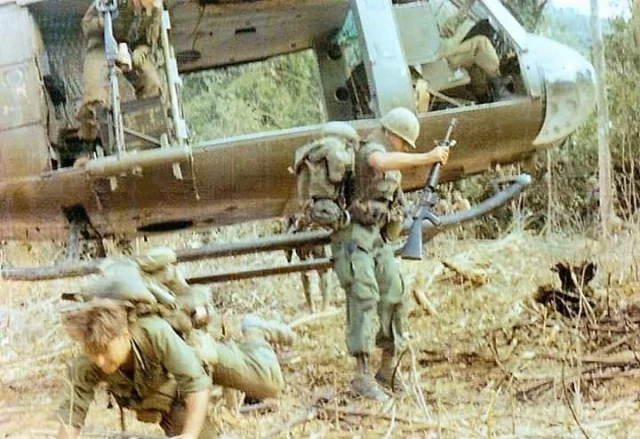
What was it like to go on a helicopter combat assault with the 1st Air Cav Division during the Vietnam War? As a platoon leader with A Company, 1st Battalion, 5th Cav, I went on more than 60 “Charlie Alphas” during my tour from 1968-69. Sometimes we made two assaults per day. This photograph gives the platoon leader’s view of what an assault looks like through the cockpit window. When it was my platoon’s turn to lead the assault I always rode in the first bird and that was a much different view.
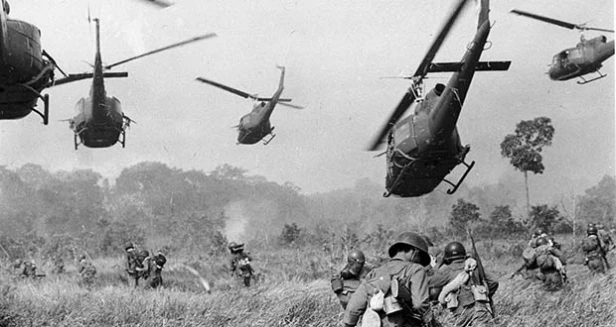
The North Vietnamese Army was notorious for being able to walk down the Ho Chi Minh trail in Laos and Cambodia and infiltrate into South Vietnam. They moved down the trail in small units and kept well hidden in dense jungle so that the Americans could not drop bombs on them. Then they would infiltrate into the northern and central areas of South Vietnam again concealed by dense jungle. When the situation was just right for attacking an American or ARVN unit, they would mass their forces and coordinate a carefully planned strike, usually at night, designed to cause the greatest damage and casualties in the shortest time. Breaking off the attack after accomplishing their objectives, the NVA were masters of disappearing back into the jungle and across the border into Laos or Cambodia where American and ARVN troops were not permitted to follow.
The concept behind the Cav’s strategy of a helicopter combat assault was that once an enemy force was spotted, a quick reaction force (QRF) consisting of a reinforced platoon of about 35 men would be stationed on a helicopter pad and ready to launch within 30 minutes’ notice. The objective of the attack was to assault as close as possible to the enemy force and engage them in a firefight. An entire company of 120 men would then be deployed within two hours’ notice to support the engaged platoon. If needed, an entire battalion of 300-plus soldiers could be ready to support the engagement within 12 hours.
All troops would be assaulted into various LZs on the battlefield by helicopter thereby ensuring that troops were fresh and ready to fight. With such tremendous helicopter support soldiers could carry lighter packs, more ammunition, and water, and wounded could be medevaced rapidly to lifesaving battalion aid stations only minutes away.
Riding on a helicopter assault was an awesome experience, especially if you were in the first bird. The platoon leader of the QRF would often receive a short intelligence briefing minutes before the first helicopter was dispatched. He would then brief his platoon sergeant, squad leaders, and men about what they could expect to find upon landing. The concern was always about landing on a “hot LZ” (one controlled by an enemy force), but the Cav had a strategy for ensuring that did not happen.
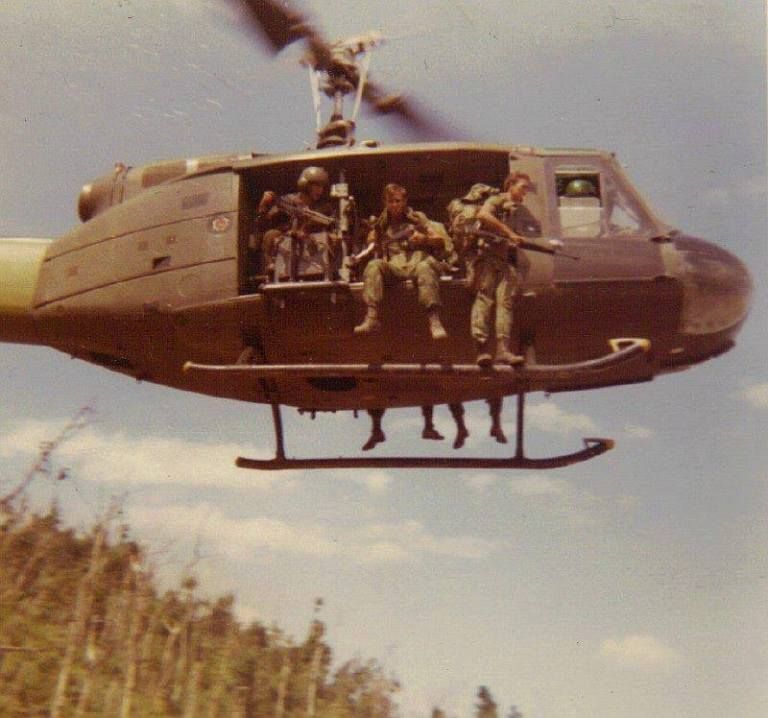
After loading into the helicopters and taking off, the soldiers would enjoy a brief respite from the usual daytime temperatures of 110 to 115. This was a short-lived experience as the flight usually lasted only 20 to 30 minutes. The platoon leader would coordinate with the pilots during the flight to mark the LZ location on his map and obtain any new intelligence that the pilots had received during the flight.
Five to eight minutes before landing, the following actions would occur:
- Soldiers would test fire their weapons, firing 3-5 rounds out the helicopter door.
- Artillery prep would begin firing 25 to 30 rounds on the LZ and surrounding perimeter.
- Firing a white phosphorus round signaled the completion of the artillery barrage
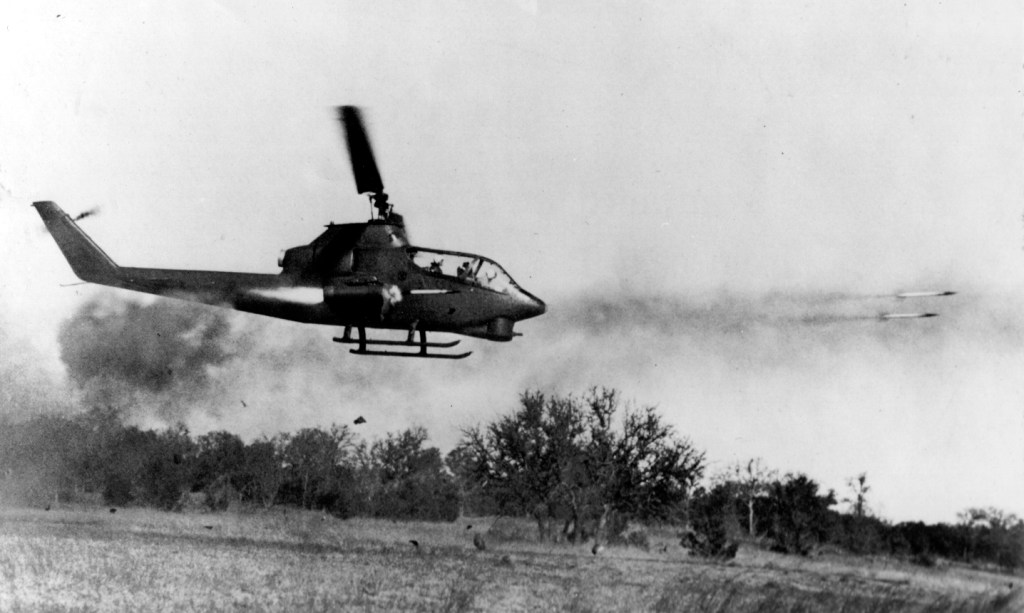
- Two Cobra helicopters accompanying the first assault bird would zoom ahead and fire miniguns surrounding the perimeter. They saved their rockets in case they were needed after landing.
- As the first helicopter came in for a landing, the door gunners on either side of the bird would open up with machinegun fire into the surrounding LZ right up until the bird touched down.
- As soon as the first helicopter started to land, soldiers riding on the skids would jump off and run for cover to the sides of the perimeter.
- The platoon leader and his RTO would also jump off and determine if the LZ was hot (red) or cold (green). A call would be made to the Command and Control helicopter flying overhead to report the status.
- Appropriate color smoke would be popped.
- If the LZ was green, additional birds would be brought in for a landing.
- If the LZ was red and the men on the ground were taking fire, they would engage the enemy and fight with the resources available. (This consisted of nine men: one equipped with a machine gun, one with a M79 grenade launcher, and the rest with M16s.)
- If the LZ was red, the remaining members of the platoon would be diverted to an alternate LZ, land and then move to support the engaged soldiers.
Landing on a hot LZ was a frightening experience for the platoon leader and his men. Immediate support was called for from the Cobra helicopters flying overhead to fire rockets and miniguns in the direction from where enemy fire was being taken.
Occasionally landing on a hot LZ resulted in a crashed helicopter and severe casualties.
Admin: I never test-fired my weapon from the inside of a helicopter…that was done at the firebase before the mission. Anybody else?
Robin Bartlett has contributed earlier articles to this website. See below:
Here’s my book review of Robin’s book, VIETNAM COMBAT: FIREFIGHTS AND WRITING HISTORY:
If you wish to visit Robin’s website, here’s the address to his blog:
https://robinbartlettauthor.com/blog/
*****
Thank you for taking the time to read this. Should you have a question or comment about this article, then scroll down to the comment section below to leave your response.
If you want to learn more about the Vietnam War and its Warriors, then subscribe to this blog and get notified by email or your feed reader every time a new story, picture, video and changes occur on this website – the button is located at the top right of this page.
I’ve also created a poll to help identify my website audience – before leaving, can you please click HERE and choose the one item that best describes you. Thank you in advance!

 CherriesWriter - Vietnam War website
Author’s account reflects an organization (Ist Air Cav) that knew, trained, and executed its business: the heliborne CA.
One item on the CA checklist, however, seems oddly flawed: test-firing small arms while in flight? Beyond the significant chance of accidents is the inability to remedy any problem a soldier might find. Last thing I’d want is a man trying to diagnose and clear a loaded, malfunctioning rifle in an aircraft full of people, especially under the massive stress of a CA in progress.
I know the door gunners routinely test-fired their M-60s en route, but riflemen…?
LikeLike
Never happen GI!…..1st Div combat vet
LikeLike
I was 1st Cav 67/68 A Co 1/12th during my tour we did not keep track of our CA’s – The Cav figured a grunt did 25 CA’s in a 3 month period and all were awarded Air Medals. If you add that up in a 12 month tour you did 100 CA’s grunts were only entitled to 1 Air Medal. RTO Gerry Gudinas A Co 1/12th 1st Cav Div. 67/68
LikeLike
I don’t know whether anyone can explain this but, after I extended my initial 12 month tour, by 2 more months, I was awarded an Oak Leaf Cluster for my Air Medal. BTW, loved to sit on the floor (best views) and be the first out, on landing in an LZ. In hindsight, not very smart, but when you’re young, you tend to be more adventurous. C-1/7, 1st Cav Div. (Jul’69-Sep’70)
LikeLike
I got 2 Air Medals as a grunt.
LikeLike
Very interesting reading. I’m a vet from ’66 to ’68. Spent the whole time in states having gone to RTO and Radio Teletype schools. Go Figure. Very close friend of mine was 11Bravo and in the bush as FTO. Thanks for sharing your combat experience, service and for postings. Bob Vetter
Sent from Mailhttps://go.microsoft.com/fwlink/?LinkId=550986 for Windows
LikeLike
We test fired in the company area, where we had resources to deal with any problem. In the air was too late. also hazardous to troops or civilians on the ground. My LRRP team was in a tree square in The Plain of Reeds west of Saigon when a gunner in a passing Huey “test fired” about 30 rounds into us.
LikeLiked by 1 person
seems like the Army had such matters better organized than us Marines. Helicopter assaults on Ch34s and Ch46s were chaos for subordinate enlisted Marines. We were on our own and always a hot L.Z.
LikeLiked by 1 person
Sounds familiar, all but the weapons test fire thing. We had “Eagle Flights” at times when we would do 2-3 assaults in one day. Quick insertions and then back out. Like dangling a bait for them to try and grab. Not sure how I got through those 40 or so CA. Seems like a dream or a movie I saw now. Cannot envision myself doing those things, especially as the Artillery FO. Sigh…. was much younger. 😉
LikeLiked by 1 person
I agree. Similar to most of the CA’s I went on, except for firing weapons from the bird. Never saw that or did it. You had your s**t together before you saddled up. I always hated hearing the Crew Chief when he told us the LZ was hot. Not the brightest spot in your day.
LikeLiked by 1 person
As a field grunt it was always a great thrill to here the choppers. It meant resupply or going in to basecamp for a rest. A big Thanks
LikeLiked by 1 person
What was it like to go on a helicopter combat assault with the 1st Air Cav Division during the Vietnam War? As a platoon leader, Robin Bartlett went on more than 60 “Charlie Alphas” during his tour from 1968-69. Read what he had to say about them. HELICOPTER COMBAT ASSAULTS (CHARLIE ALPHAs) – CherriesWriter – Vietnam War website
LikeLike
during my tour we Marines had the M14…much more cumbersome getting off a helo.. envied the army their m16s
LikeLiked by 1 person
69/70 1st Cav 15th med BN . 15th med e vac doorgunner. never went on an CA . but got to experience the same thing going in to fetch our WIAs . Was always a trip . how I survived riding 4 to the ground was beyond me . but , made the world ! Lucky me . love all my brothers and sisters ! GOD BLESS
LikeLiked by 1 person