
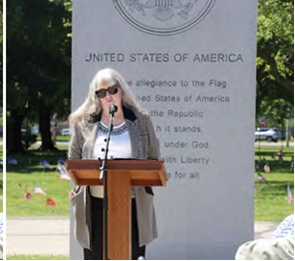
The author was a guest speaker at this year’s annual Memorial Day event at our local cemetery. Her speech is eye-opening and moving. Please give it a read.
By Lisa Marie Duncan-Edwards
Memorial Day 2026 Resurrection Cemetery
Good morning, everyone. Thank you for being here today as we gather to observe one of the most sacred dates on our national calendar. When the average American thinks of Memorial Day, a few familiar images come to mind. They think of the smell of backyard barbecues, the kickoff of summer, three-day weekend road trips, and the retail sales that flood our television screens. For others, the image is much more solemn. It is a sea of American flags in front of the perfect, geometric rows of white marble headstones at any National Cemetery, or a lone bugler sounding “Taps” into a crisp morning sky. But if you close your eyes and picture the person beneath that marble headstone—if you picture the fallen Warrior we are here to honor—what do you see?
Statistically, culturally, and historically, most people picture a man. They picture the young GI storming the beaches of Normandy. They picture the Soldier navigating the dense jungles of Vietnam. They picture the infantryman patrolling the dusty roads of Kandahar or Fallujah. And they are not wrong to see those men. The fields of honor are heavily populated by our brothers, fathers, and sons who gave what Abraham Lincoln so beautifully called “the last full measure of devotion.”
But today, I stand before you as a female Veteran to talk about a perspective that is too often left out. Today, I want to talk about what Memorial Day means to me as a woman who wore the uniform of this country. Every Veteran is familiar with the common misconception that confuses Memorial Day with Veterans Day. We all patiently explain to well-meaning people that Veterans Day is in November and when we celebrate the living who served; while Memorial Day is in May honoring those who died. To understand what this day means to a woman who served, you must first understand the unique world we served in.
For a female Veteran, there is an added layer of invisibility we navigate on a daily basis. When I wear anything with “Veteran”, or when I attend a community event, people frequently look past me to thank the man standing next to me. They assume I am the wife, the sister, the daughter, or the mother of a service member. They rarely assume that I am the service member. I am extremely blessed with having a husband who is also a Veteran and takes great pride in correcting people and telling them in no uncertain terms that I am a Veteran and what I actually did in the Army.
On Memorial Day, that cultural blind spot takes on a heartbreaking weight. Because when society forgets that women serve, society also forgets that women die. It almost feels like our service is less meaningful than that of our male counterparts. To a female Veteran, Memorial Day is a fierce, quiet battle against the narrative that women only occupy supporting roles in war. We know the truth. We lived it. We know that women do not just wait at home, weeping for the fallen; women are the fallen. When a woman steps into the military, she takes the exact same oath as her male counterparts. She swears to support and defend the Constitution of the United States against all enemies, foreign and domestic. She faces the exact same challenges as men, the exact same training requirements, and the exact same hostile environments. And when she falls, her blood stains the earth the exact same shade of crimson. Memorial Day means rejecting the idea that sacrifice has a gender. It means standing up and saying loudly, clearly, and with absolute reverence: Women bought a share of America’s freedom, and they paid for it in full.
The legacy of women laying down their lives for this country is nothing new. Women have been dying for American liberty since the birth of our nation 250 years ago, often without recognition, and sometimes even without their real names on their gravestones. Think back to the American Civil War, where hundreds of women disguised themselves as men just to fight on the front lines. They fought in the mud, they charged into artillery fire, and when they were killed, they were buried in unmarked graves under the male aliases they adopted. Their sacrifice was absolute, yet they died with their identity totally unknown.
Think of World War I, where the “Hello Girls”—bilingual telephone operators who served under army command near the front lines in France —faced artillery barrages and deadly influenza outbreaks. Or think of the nurses who stood firmly in field hospitals, refusing to leave their patients as bombs fell around them.
Think of World War II; in August 1943, the Women’s Flying Training Detachment and the Women’s Auxiliary Ferrying Squadron merged into a single unit for all women pilots and formed the Women Air force Service Pilots, known as the WASPs. These trailblazing female aviators flew military aircraft to test new designs, transport supplies, and tow targets for live-ammunition anti-aircraft practice. They flew more than 60 million miles in two years. During this time, the 6888th Battalion was formed as the first and only all-Black Women Army Corps (WAC) unit to deploy overseas during WWII.
Thirty-eight of these brave women died in the line of duty. Yet, because of the politics of the era, the government did not classify them as military. When a WASP died, her family had to pay out of their own pockets to ship her body home. Her coffin could not be draped in the American flag. Her family could not place a gold star in their window. To a female Veteran, Memorial Day is about rectifying those historical injustices in our hearts. It means remembering the battlefield caregivers of the past—the nurses and medical personnel who contracted fatal tropical illnesses in the Pacific or took direct mortar fire in the fields of France and Korea. These women paved the way for women like me.
In honoring the more than 265,000 women who served in the military during Vietnam, we look at the Vietnam Women’s Memorial in Washington, D.C. It is a bronze statue depicting three nurses tending to a wounded Soldier. There are eight yellowwood trees surrounding the sculpture in honor of the eight servicewomen who gave their lives in Vietnam. These eight women were among the 7,484 women who served in country. Their names are inscribed on the Vietnam Wall, alongside the men they served with.
These brave women’s names are:
❖ Army Cpt Eleanor Grace Alexander, a nurse assigned to the 85th Evacuation Hospital, died on November 30th, 1967, when her plane crashed. She was from Riverdale, New Jersey.
❖ Army 2nd Lt Pamela Dorothy Donovan, a nurse also assigned to the 85th Evacuation Hospital, died of pneumonia on July 8th, 1968. She was from Brighton, Massachusetts, but was born in England.
❖ Army 2nd Lt Carol Ann Elizabeth Drazba, a nurse assigned to the 3rd Field Hospital, was killed in a helicopter crash near Saigon on February 18th, 1966. She was from Dunmore, Pennsylvania.
❖ Army LTC Annie Ruth Graham, the Chief Nurse with the 91st Evacuation Hospital, suffered a stroke and died on August 14th, 1968. She had also served during World War II and Korea. She was from Efland, North Carolina.
❖ Army 2nd Lt Elizabeth Ann Jones, a nurse assigned to the 3rd Field Hospital, was also killed in the helicopter crash near Saigon on February 18th. She was from Allendale, South Carolina.
❖ Air Force Captain Mary Therese Klinker, a nurse who was part of an on-board medical team during Operation Babylift on April 4th, 1975. Her flight was carrying 243 infants and children when it developed pressure problems and crashed while attempting to return to the airport. This was just three weeks before the fall of Saigon. She was from Lafayette, Indiana.
❖ Army 1st Lt Sharon Ann Lane ~ a nurse assigned to the 312th Evacuation Hospital, was killed by a rocket explosion on June 8, 1969, less than 10 weeks after she arrived in Vietnam. Lt Lane was working in the Vietnamese ward of the hospital when the rocket exploded, killing her and her patients. She was from Canton, Ohio.
❖ Army 1st Lt Hedwig Diane Orlowski, a nurse assigned to the 67th Evacuation Hospital, was also killed on November 30th, 1967, when her plane crashed. She was from right here in Detroit, Michigan.
While we honor the past wars, Memorial Day for the current generation of female Veterans hits incredibly close to home. The Global War on Terror completely dismantled the traditional concept of the “front line.” In Iraq and Afghanistan, there was no safe “rear echelon”. Danger was everywhere, and women were everywhere. Since the attacks of September 11, 2001, more than 245 women have made the ultimate sacrifice in combat operations. These women were operating in every imaginable capacity: aviators flying through hostile skies, vehicle operators driving trucks through ambush-prone valleys, medics patching up wounded infantrymen, and special operations Cultural Support Teams serving alongside Navy SEALs and Army Rangers during missions.
To a female Veteran, Memorial Day has a specific list of faces. We think of Army Specialist Frances Vega, just 20 years old, who became the first female Soldier from Puerto Rico to die in the Iraq War when her Chinook helicopter was shot down by a surface to-air missile in 2003.
We think of Marine Captain Jennifer Harris, a helicopter pilot on her third tour of duty, who died in 2007 when her chopper went down just days before she was scheduled to return home to her family.
We think of Senior Chief Petty Officer Shannon Kent, a brilliant Navy cryptologist, mother of two, and master of multiple Middle Eastern dialects. She survived multiple grueling deployments, working in the darkest shadows gathering intelligence, only to be killed by a suicide bomber in Syria in 2019.
We think of Army Lieutenant Ashley White and Captain Jennifer Moreno, members of previously mentioned Cultural Support Team. They were deployed alongside special forces units because only women could access and clear the areas where Afghan women and children were located. They stepped on improvised explosive devices while executing high-risk nighttime raids. They died in the dark, far from home, doing a job few civilians even knew existed.
If you ever have the privilege of visiting the Military Women’s Memorial, which stands at the ceremonial entrance to Arlington National Cemetery, you will see what Memorial Day looks like in physical form. It is a breathtaking sanctuary dedicated to the more than 3 million women who have served this nation since the Revolutionary War.
Inside that memorial is a living database—a collective register of stories, photographs, and memories. We go there to look at the glass tablets on the roof, inscribed with quotes from fellow women Veterans that catch the sunlight and project their words onto the granite floor below.
June 12 commemorates the 78th anniversary of the Women’s Armed Service Integration Act – allowing women the right to permanently serve in the U.S. military. Before the signing of this act on June 12, 1948, only women NURSES could serve in the regular and reserve forces during peacetime. All other women were sent home after each conflict. The signing of the Act deemed women essential to the war efforts and allowed us to serve in the regular armed forces fulltime. Women finally began to be integrated into combat arms billets in January 2016, six years after I retired.
As I close today, I want to leave you with a challenge. When you leave here and go to your family gatherings, when you enjoy the freedom of this beautiful day, take a moment of silence at 3 pm. And, in that silence, consciously broaden your picture of the American hero. Remember that our freedom was secured by men, yes, but it was also secured by extraordinary women. It was secured by women who left behind their children, their careers, their safety, and their futures because they believed in the promise of the United States of America.
To me, Memorial Day means that our Veterans are never truly gone if we speak their names and remember their stories. It means that their courage is woven into the very fabric of the flag we fly. They made the ultimate sacrifice and for that, we are forever grateful. They may be gone, but they will never be forgotten.
Let us honor them today not just with our tears, and not just with our words, but with the way we live our lives—by being citizens worthy of their immense sacrifice.
Thank you, God bless our fallen heroes, and God bless the United States of America
Lisa’s speech was posted in the June 2026 issue of Boo Coo News, a monthly newsletter for Vietnam Veterans of America, Chapter 154. Here is the link to the magazine: https://vva154.com/wp-content/uploads/2026/06/Boo-Coo-News-June-2026.pdf
*****
Thank you for taking the time to read this. Should you have a question or comment about this article, then scroll down to the comment section below to leave your response.
If you want to learn more about the Vietnam War and its Warriors, then subscribe to this blog and get notified by email or your feed reader every time a new story, picture, video and changes occur on this website – the button is located at the top right of this page.
I’ve also created a poll to help identify my website audience – before leaving, can you please click HERE and choose the one item that best describes you. Thank you in advance!


I think Kristen Hannah’s book, The Women, should be posted on your “books to read” list.
LikeLike
Wow, that was powerful. And I did not know about the trees surrounding the memorial statues. I wonder how many do understand their meaning. I would hope that one larger but an appropriate size for reading could be placed to better explain the trees. As always, thanks for sending this one. SF, Bob
>
LikeLike
Thank you for posting this.
LikeLike