
Although this is not an article about the Vietnam War, I thought it important to feature this post on my website. If you read between the lines, this may lead to another draft or mandatory service in the future.
By SONNER KEHRT
In the spring of 1977, a letter appeared in Proceedings, the long-running journal of the U.S. Naval Institute.
“I am no malcontent,” wrote a junior enlisted Navy man. “I love the Navy and believe in a strong national defense. But, I believe a man who is treated with dignity and respect, rather than like a child by an elitist, is bound to be a better fighter.”
The letter writer represented his division at his ship’s human relations council, where he could bring his shipmates’ concerns to the attention of leadership. But the ship hadn’t held a council meeting in nine months. The man wrote that he had inquired up the chain of command as to why the meetings had suddenly stopped.

Spc. Ryan Cooley, 101st Airborne Division, reenlists in the Army for another five years on Camp Taji, Iraq, in 2019. Photo by Maj. Vonnie L. Wright, courtesy of the U.S. Army.
The answer he had received infuriated him. “If the ship has no problems,” a higher-ranking officer told him, “I see no reason to have the meetings.”
In his letter, the writer made it clear that he would not stand idly by.
“I am going to join the American Federation of Government Employees and stand up and fight for myself.”
He had written the letter in response to an article that had appeared the previous fall. Penned by four active-duty Navy officers, it was titled “Is Military Unionism an Idea Whose Time Has Come?”
In the pages of Proceedings in the mid-1970s, the topic wasn’t unusual. The title of a June 1977 article, written by a retired captain, was “The Military Union Card.” The next month, another article, this one by an active-duty commander, asked “Should Military Unionization Be Permitted?”
Four years earlier, the military had undergone a seismic shift. In 1973, Congress abolished the draft, which, apart from a short period in the late 1940s, had been part of the American experience since before the United States entered World War II.
Following widespread opposition to the Vietnam War, and the sense that the selective service system was unequal, Richard Nixon campaigned on ending the draft. After he was elected in 1968, he stood up a panel, known as the Gates Commission, to study the issue, and upon its recommendation ended mandatory conscription—50 years ago this month.

President Richard Nixon with U.S. soldiers assigned to the 1st Infantry Division in South Vietnam in 1969. Photo courtesy of the U.S. National Archives.
“A young man growing up in those years, the post-World War II era, plus the Vietnam era … the thought of being drafted was on your mind as a teenager,” says Al Martin, the director of accession policy for the defense department in the 1970s. “That was not an insignificant part of life. Today it’s hard to imagine that.”
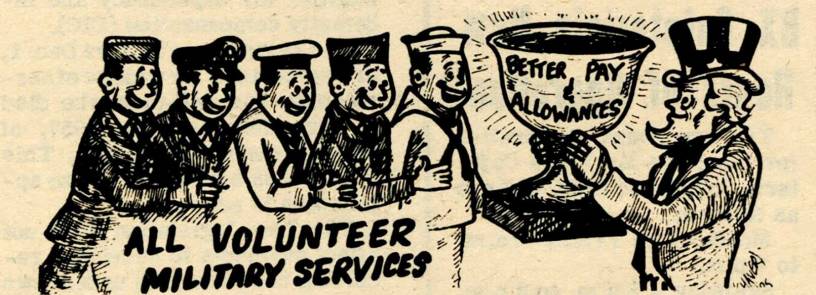
The issue had been pitched in part as an exercise in free-market economics: raise the pay, professionalize the Army, make service a viable career path—advocates like the economist Milton Friedman argued—and you’ll get a top-notch military without imposing the long arm of the government to do it.
The transition to an all-volunteer force came with a pay raise and, initially, recruiting numbers were high. But in the years following the transition, morale dropped. Pay stagnated, and the quality of recruits declined. Congress, hindered by a ballooning recession, zeroed in on axing military benefits to help balance the budget.
Into this discontent stepped the American Federation of Government Employees, which represented federal employees. Although its unionization campaign ultimately failed, it found many an open ear—at one Indiana post, 54% of enlisted soldiers and 22% of officers said they were interested in unionizing.
The debate raised uncomfortable questions for a nation grappling with what a fully volunteer military meant. Was military service a job? Was it something deeper? What should the military offer to get people to sign up? And what did it owe those who did?
“A change from conscription to the all-volunteer force is a tremendous change, in many ways—psychologically and practically and the way you treat people,” Martin says.

Men register for the draft before World War I on June 5, 1917. Photo courtesy of the U.S. National Archives.
These questions have renewed significance today. Over the last several years, every branch of the military has struggled to recruit and retain members, and fewer and fewer Americans serve in uniform. The recruiting pitches, from the practical—like pay—to the psychological—like purpose—that have, for decades, ensured a fairly steady flow of recruits is proving less effective.
For the last half-century, staffing the volunteer military has been an act of salesmanship. But these days, not many people are buying.
‘Can an infantryman be compared with a computer programmer?’
When news of the union’s interest in organizing the military broke, in a 1975 story in The Wall Street Journal, it catapulted into the public sphere the question of what military service means in a democracy in which nobody is obligated to serve.
Thousands of service members wrote to the union to express their interest in joining, and by one count, up to a half of the military at one point supported the idea of unionizing. But the news ultimately paved the way to the effort’s end. The American public overwhelmingly opposed it, and congressional leaders excoriated the idea.
Six years earlier, when Nixon announced the Gates Commission, he directed the panel to “study a broad range of possibilities for increasing the supply of volunteers for service”—language that reflected the belief, more popular at the time on the political right than the left, that maintaining a strong army was essentially an economic question, one of supply and demand.

Air Force personnel jump out of an HC-130J Combat King II during training over Djibouti on May 9. Photo by Staff Sgt. Aaron Irvin, courtesy of the U.S. Air Force.
Mandatory military service, the Gates Commission ultimately argued, was an unfair tax that a small number of men paid to ensure the security of the nation. The low pay that draftees typically received added insult to injury, effectively subsidizing what it really cost to maintain a world-class military.
The commission considered counterarguments to the idea of moving to a fully volunteer force—everything from concerns that the military would disproportionately draw from socioeconomically disenfranchised and minority communities to the worry that a military staffed with volunteers would be disconnected from the civilian population, fostering “irresponsible foreign policy” and military adventurism.
The commission determined that, particularly if wages were high enough, an all-volunteer military would be more professional and effective than a draft-based one.
But the shift away from the draft was not easy.
“There was a lot of hostility toward the volunteer force,” Martin says.
While in the first few years after the transition the military branches met their recruiting goals, by the late 1970s, the number of recruits who scored in the lowest permissible range on entrance exams rose as recruiters struggled to make quotas. Military leaders weren’t used to the idea of having to entice potential enlistees, and lingering resentment over the Vietnam War did not make it easy.

A cartoon from 1969 promotes President Richard Nixon’s plan to study an all-volunteer force. Image courtesy of the Defense Department.
“Imagine trying to talk people in the Army into believing that the volunteer force was essentially a marketing problem,” says Martin, who had studied business marketing before joining the defense department.
“Meeting consumer needs was not exactly what the people who were running the military at the time were thinking about.”
Recruiting slogans from the transition era reflect the military’s struggle to find its footing. A 1973 tagline read, “Join the people who’ve joined the Army.”
Slumping recruitment numbers, coupled with the unionization debate, forced a reckoning over what the services owed those who signed up to serve. The American Federation of Government Employees had capitalized on growing frustration that Congress, by looking to cut military benefits, such as health care, housing, and low prices at the commissary and exchange, seemed as if it were trying to shore up the national budget on the backs of service members.
But in debates over the issue, leaders like Donald Rumsfeld, then in his first tour as secretary of defense, argued that military members were owed special privileges and benefits—that, while the military was now a genuine career choice, there was also something ineffably different about working as a soldier or a sailor.

Col. Shirlene Ostrov, 376th Expeditionary Mission Support Group commander, left, and Lt. Col. Tom Doan, 376th Expeditionary Logistics Readiness Squadron commander, right, guide former Secretary of Defense Donald Rumsfeld, center, after completing a tour of the customs processing center baggage yard at Transit Center at Manas, Kyrgyzstan, June 20, 2013. Photo by Staff Sgt. Krystie Martinez, courtesy of the U.S. Air Force.
“Can a combat infantryman possibly be compared with a computer programmer?” he asked in 1976. The comparison, he argued, was “insulting and demeaning.”
The argument held. While the debate led Congress to back off targeting military benefits, the union effort failed. In 1981, the Army introduced a new recruiting slogan, one it would keep for two decades: “Be all you can be.”
“It was so well-executed because it truly did get into how service in the military is fundamentally different from anything else you can experience in life,” says Katherine Kuzminski, the director of the military, veterans, and Society program at the Center for a New American Security. “I think that’s an important message, whether we’re in a good economy or a bad economy.”
‘We Didn’t Break the Force. We Broke the Families.’
Over the last half-century, the economic winds of change have proven a useful indicator for the ebb and flow of recruits. When the economy booms, other opportunities beckon and the military must work harder to woo would-be enlistees. When the winds shift, those special privileges and benefits—things like free health care and tax-free housing stipends—offer shelter from the storm.
“I was probably one of the few people in the government that was rooting for recession because when unemployment is high, that helps recruiting,” Martin says.

U.S. Marines assigned to the 2nd Marine Division’s Charlie Company, 1st Battalion, move out on a mission after disembarking from a CH-46E Sea Knight helicopter during Exercise Imminent Thunder, part of Operation Desert Shield. Photo by Tech. Sgt. H. H. Deffner, courtesy of the U.S. Air Force.
When the economy tanked in 2008, military recruiting numbers soared. Every service met its quotas and pulled in higher-quality recruits.
Fifteen years later, the picture looks different. The job market is tight. Military pay has had difficulty keeping up with inflation, and the Defense Department’s own research found that nearly a quarter of military families have struggled to put food on the table in recent years. The Gates Commission identified low pay as one of its primary concerns when it started the all-volunteer military, but today, despite substantial military pay raises, potential recruits can earn more at some fast food joints than they can make by enlisting.
“Not only can you make more money flipping burgers,” says Michael Haynie, the founder of the D’Aniello Institute for Veterans and Military Families at Syracuse University, “Five Guys promises not to send you to war.”
Recruiters, stymied by obstacles like pandemic school shutdowns and even bans on TikTok, Gen Z’s social media of choice, have struggled to reach young people. And some incentives the military has historically relied on to sell the idea of service are no longer unique. High school graduates don’t need the military to help with financial aid for college—now companies from Starbucks and Chick-Fil-A to Apple and Amazon offer educational assistance.
Over time, the professionalization of the military means the percentage of Americans who serve is an ever-shrinking pool. People who joined up were more likely to make it a career than draftees were, and a reduction in the size of the service followed the end of the Cold War. In 1980, 18% of American adults were veterans. Today, it’s 7%, with less than half of 1% currently serving in uniform—a tiny fraction of citizens to bear the costs of war.
In Iraq and Afghanistan, the same service members, many of them only part-time reservists and guardsmen, deployed again and again. Family members of people who have served have long been a consistent source of recruits. But fewer families, and fewer veterans themselves, are recommending military service.

An Army recruiting poster from 1990 showcases a slogan in use once again: Be All You Can Be. Photo courtesy of the U.S. Army.
“We didn’t break the force necessarily, through 20 years or so, a trillion dollars of war, but we broke the families,” says retired Army Col. Lawrence Wilkerson. Wilkerson served as Secretary of State Colin Powell’s chief of staff.
Every branch of the military has faced recruiting challenges in the last several years, and the pool of potential recruits is shrinking. Only about 23% of Americans between the ages of 17 and 24 meet the physical and background requirements to serve. But perhaps more importantly, far fewer want to serve—Defense Department polling has found that 9% of eligible Americans are interested in joining the military.
“[It’s the] lowest it’s ever been since polling started,” Wilkerson says.
Young people report they don’t want to be killed or face the psychological consequences they saw in soldiers on the news as they grew up. But many just don’t think of the military as an option.
“I’m struck by how profoundly disconnected they are from the military service,” Haynie says. “One unintended consequence of the all-volunteer force was to disconnect the costs and consequences of war from society.”
‘They Can Smell B.S. Better Than Previous Generations’
In the past few years, the military has been tweaking—and tweaking again—its pitch to would-be Gen Z volunteers: recruiting in more progressive, Northern cities; creating memes; increasing enlistment bonuses; and launching esports teams.
“[T]his is a generation of kids who’s been marketed to their entire lives, tied to the fact that they’ve been on screens, so they can kind of smell B.S. a lot better than previous generations,” Kuzminski says. That means fully rethinking the sales pitches that have worked for the last half-century.
Rumsfeld’s comments during the union debate also haven’t stood the test of time: Today, the military relies as much on computer programmers as it does combat infantrymen. Recruiters must explain to a new generation why they should code for the military, rather than a tech company.

An Air Force second lieutenant watches the parade on Inauguration Day 1981 with his wife and child. Photo by Gary Kieffer, courtesy of the National Archives.
Kuzminski sees that as an opportunity.
“You could get a job in Silicon Valley, but you won’t be cracking the country’s hardest problems like you will in the military,” she says. “The shift to the all-volunteer force gave us … the ability to have a professional military. And so I think where the services can really benefit is by showing how this is different from anything else you could possibly do.”
Wilkerson agrees. He’s been traveling the country, talking to young people about one of the country’s hardest problems: climate change.
“[S]tart talking about this,” he says. “Start talking about humanitarian assistance and disaster relief and meeting the challenges of climate change. Maybe you will recruit some of these people, because they’ll see it differently than they’re seeing it right now.”
But his climate conversations with young people come up against a problem.
“They’re … all eager to be a part of this effort,” he says, “but they don’t want it to be militarized.”
And there’s another issue. Something else happened when the economy crumbled 15 years ago.
“One of the things that was a consequence of the 2008 financial crisis was people stopped having kids,” Haynie says. Since 1980, the birth rate in America had stayed fairly consistent, but in 2008, it started plummeting. It hasn’t recovered.
In the next few years, babies born during the financial crisis will turn 18. Researchers in higher education call 2025 the “demographic cliff.” It’s the year universities will suddenly have a steep drop-off in freshman students. It’s also the age at which people can join the military.
“If you keep the same stats, and you’re only able to get 9%, your 9% is going to be of a much-reduced total of eligible recruits,” Wilkerson says. “It’s not a good picture.”
What are your thoughts?
The story was originally posted on https://thewarhorse.org/ on 7/27/2023. This feature was reported by Sonner Kehrt, edited by Kelly Kennedy, fact-checked by Jess Rohan, and copy-edited by Mitchell Hansen-Dewar. Headlines are by Abbie Bennett.
*****
Thank you for taking the time to read this. Should you have a question or comment about this article, then scroll down to the comment section below to leave your response.
If you want to learn more about the Vietnam War and its Warriors, then subscribe to this blog and get notified by email or your feed reader every time a new story, picture, video and changes occur on this website – the button is located at the top right of this page.
I’ve also created a poll to help identify my website audience – before leaving, can you please click HERE and choose the one item that best describes you. Thank you in advance!

 CherriesWriter - Vietnam War website
When was the last time the continental US came under attack from a foreign nation? That was 1942 at Dutch Harbor in the Aleutian Islands. That’s about 83 years ago. Joining the military to defend the United States isn’t as easy as it sounds, because the United States is so rarely attacked. Now if you want to invade Grenada, Panama, Vietnam, Iraq, Afghanistan, Syria or be stationed at one of the US’ 700+ foreign bases, then the military might be for you. Just remember…war doesn’t have to conform to your religious ideals. The US is currently assisting in a genocide in the middle east. That’s enough to put some people off.
LikeLiked by 1 person
Would you enlist if you knew you might be bunked with a gay or trans person?
LikeLiked by 1 person
“Would you enlist if you knew you might be bunked with a gay or trans person?”
Wouldn’t affect my decision at all. Anyone who joins the military looking for sex partners is barking up the wrong tree.
LikeLiked by 1 person
I think it was a huge mistake to end the draft and still do. It’s now possible for people to be born and live their entire lives in the United States and NEVER have to do anything to earn that privilege. That is wrong. Everyone doesn’t have to serve in the military, but everyone should live with the very real possibility that they may have to; it engenders deep thoughts about what our country stands for and what it means to serve it. I was drafted and served as an infantry sergeant in Vietnam and Cambodia. I did not resent that. I accepted it as an obligation I owed to my country. Since the founding of our country, every male in my family who reached adulthood during times of war served in the military. I was and am very proud of that, and am glad I continued that tradition, whether by volunteering or being drafted. For some the military can be a career, but for most — especially in the combat arms it is a temporary situation necessitated by war or the fear of war or by personal economic necessity. It would be more honest and probably more effective if the military marketed itself that way.
LikeLiked by 1 person
I like the 2 year military or alternative service option. If the military would put a clause in your contract indicating you cannot be ordered outside the continental USA, then I think enlistments would go up. The National guard is now the International Guard, and potential recruits know it. During the Vietnam war, young men were drafted out of their lives, and sent to combat zones in Vietnam. Once they got a taste of the horrors of a war of attrition in the jungles of Vietnam, the reenlistment helicopter visited their firebase and offered them 3 or 4 more years of enlistment and a ticket back to the United States. Many of them signed as a means of survival.
LikeLiked by 1 person
Very good article. I personally think we should bring back the draft. It should require everyone to serve in some capacity. Men and women.
LikeLiked by 1 person
“Very good article. I personally think we should bring back the draft. It should require everyone to serve in some capacity. Men and women.”
Except those with bone spurs or connections to higher ups who can reserve a commission for them in the Air National Guard. Or those who can afford to acquire a Phd and the numerous student deferments that go along with it. Or those who burn their draft cards and relocate temporarily to Canada for the duration. But it certainly sounds like a good idea.
LikeLiked by 1 person
I can honestly say that getting drafted in ‘68 and going to Nam ended up being the best thing for me. It “grew me up” and set the course for the rest of my life to a successful career and retirement. Nothing wrong with everyone giving some small portion of their life to their country.
LikeLiked by 2 people
It “grew me up”. Nothing grows you up faster than a good ole war of attrition. The USMC is said to be the greatest institution ever invented for the killing of young Americans. Sink or swim is the fastest way of determining who can, and who can’t.
LikeLiked by 1 person
Good article with stats to back it up. In my humble opinion one glaring omission in this article is the lack of interest of people joining a “woke DEI” organization, especially a demanding one such as the military. And, how can you trust the top leaders when they allow a fiasco like the Afghanistan withdrawal to
take place? I would not sign up today or encourage those I love to sign up under such conditions.
Mike, Army Vet, 1972-1974
LikeLiked by 1 person
I served 73-76. I don’t remember woke DEI, but I do remember incompetence of command. Why would the US undermine democratic elections in Vietnam in 1956, then turn around and insist we had to invade the country in support of democracy? That country wanted to be led by Ho Chi Minh. They had an agrarian economy with no use for Wall Street, and everything suggested they were more than willing to fight for their choice of government and leadership. The domino theory was a hoax. Vietnam is less friendly with China than we are with Mexico. Today we sell Vietnam sophisticated air defense missiles. Get it?
LikeLiked by 1 person
We need to stop being the worlds “Police Force”. The military needs to keep it’s promises. Stop using the military as a means to balance the governments budget. Mandatory 4 year service is essential, I learned respect, common sense, basically street knowledge in the military. Men and women should be eligible for service. Take care of military families during their time in service and basic needs after serving. Any person seeking a government position all the way up to congress and the presidency should be required to have served, at least the minimum required time, in the military.
I am proud of my time in the Army. I am proud to be a veteran. I served and I survived the Vietnam adventure. My respect for those that did not survive is never ending.
D.M.
SP4 RA Army 68-70
Military Police
LikeLiked by 1 person
Recruit women to be paid handsomely for producing offspring to be adopted, educated, trained to be career military.
Utilize previous enlistees – combat vets – for source sperm [manually-assisted extraction]..
Pay bonuses to soldiers volunteering for robotic augmentation.
Skip “Curious George” in grammar school and double physical activity (including hide and seek and judo)
Emphasize (MANDATE) additional critical thinking and physical activity in high school instead of “Homeroom”..
Have Congress mandate elimination of first 35 minutes of SAVING PVT RYAN..
😂🤣
A. Brown
RTO
Ist Bde – 101st Airborne Division (AMBL)
Thua Thien/Quang Tri Provinces
1970-72
LikeLiked by 1 person
I volunteered for the Air Force in ’73,,,shortly after they signed the Paris Peace Accord to end America’s involvement in Vietnam…this wasn’t planned as such by me but just happened that way. I just felt it was my duty to serve at the time and no regrets along the way. But just seems like patriotism has peaked after 911 plus this woke attitude has lingered too long for many to step up and serve anymore…not to mention a slow decline on fitness within our younger generation…time will tell after Jan. 20th, 2025.
LikeLiked by 1 person
I was drafted along with 60,000 others in July 67. O really didn’t want to go but I was brought up as my duty as a citizen.
I completed four years of active duty and joined the CA NG to supplement my GI Bill for college. The NG was in bad shape from the exit of draft prospects during Viet Nam. I went to the CA OCS program as a SSG and earned a2LT commission.
From there it was on me to work my way up. Not easy when the NG had many cuts due to low numbers of recruits and President Carter’s cuts to the training schools and pay. Jerry Brown as governor was no help either.
I transferred to the Army Reserves where there was less political pressure and opportunity for a command and school education opportunities. I got those opportunities because I sought them. They weren’t issued to you.
Recruits need to see the potential for their growth, not the short term of basic learning skills all must endure. Today, kids believe they’re entitled to something not an opportunity if they work it. Big difference.
A draft is needed but the start is at the local schools, more math, languages, science and importantly, more physical education with dietary included . Too many are lethargic and plain fat! When somebody is fit mentally and physically they can accomplish so much more in life.
At 18 some mandatory service needs to be completed by able bodied men and women. A Reserve program can be developed to accept those completing minimum terms of training and active duty. The length of service can be the eight years of time we now apply. The best pay and rewards go to those that can accomplish the most by applying themselves.
I made it to Colonel which surprised me but I’m grateful and proud of my years of service and accomplishments. This can be anyone of the next group that enters MEOS for testing and induction. Good leadership will entice them to want to excel, rather than fail because that attitude will follow them for life as success does.
LikeLiked by 1 person
The saddest fact mentioned was that only 23% of those between the ages of 17 and 24 years old were capable of meeting the basic military physical requirements. We have become an obese and unhealthy society, over the past decade or two, such that mandatory national (but not necessarily military) service may be necessary for our national security and survival, in future.
LikeLiked by 1 person
get rid if the DEI shit, and never ending wars and recruitment will go up,!! it is the DEFENSE DEPT not the INVADE DEPT
LikeLiked by 1 person
Pull up your sox and hang on!
LikeLiked by 1 person
Insightful and revealing article about our military. A great analysis of where we’ve been and where we are today. I’m curious and concerned about where our military will be for the next four years.
LikeLiked by 1 person