
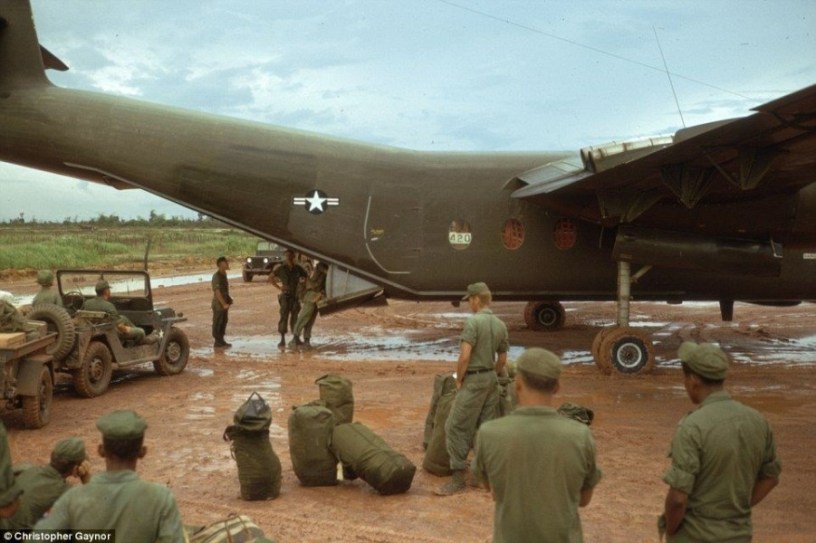
photo courtesy of CHRISTOPHER GAYNOR
One soldier recounts his flight home from Vietnam. How many of you had a similar experience?
By Douglas Crow, retired
We were given a ride in the Jeep on the morning of April 5th, 1970 to Phouc Vinh Airport and we waited four hours to catch a flight to Bien Hoa.
While boarding the De Havilland C-4 Caribou, its engines idled with a low coughing moan. I took a seat while looking out the opposite window and saw a Navajo Cavalryman sitting there in the hot noon sun. Silently and without motion or seeming emotion he sat passively.
As the engines idled, I watched the shadow of the rotating propeller blades being cast on the runway. The crew chief, sweaty as usual and carrying a revolver slung low on his hip, brought the boarding plank up into the aircraft’s belly and with a loud whirring sound of a servo motor brought up the aft door. The chief mumbled something in his headset, walked to the front of the craft just behind the cockpit cabin entrance, strapped himself in and fiddled with a circular slide-rule in conjunction with a map.
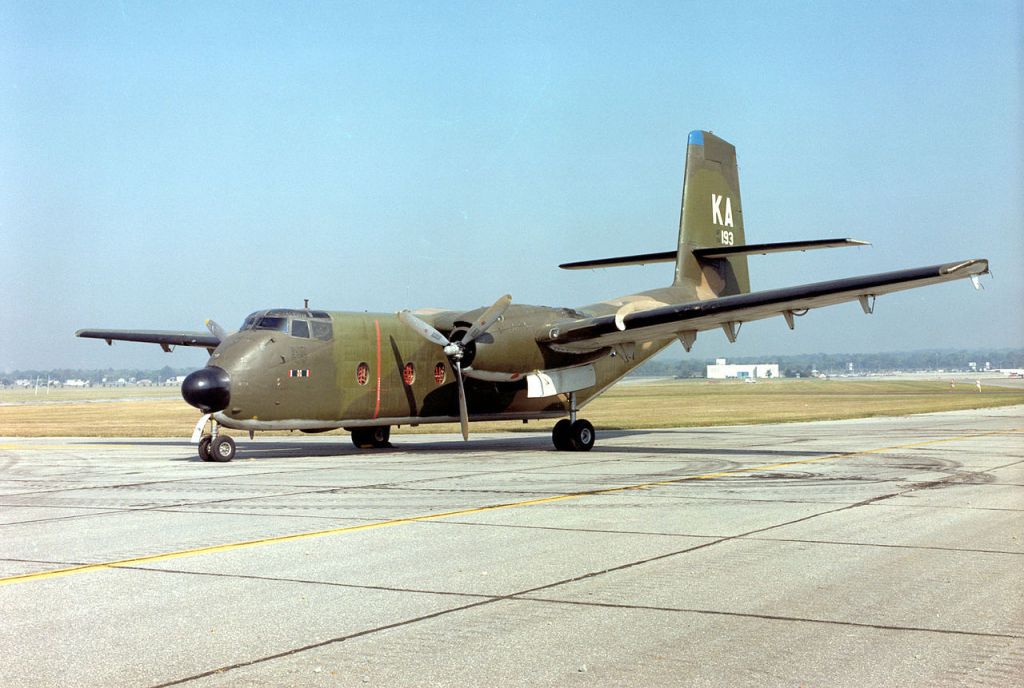
The pilot looked all around for visual clearance then slowly moved the throttles forward and as I looked out the circular port windows, I could no longer discern the shadows of the propeller blades but only a faint, grey oval optical shadow. The engines coughed a little but rallied and slapped the air with determination. The pregnant bird began to move and a vibration growled and grated throughout the fuselage as the bird’s wheels rolled faster and faster over the corrugated, olive drab-painted, steel runway. The grass on the airfield was tan and dead. As the Caribou taxied down the ramp I thought about the Navajo Cavalryman and it suddenly dawned on me that any time I left a place or arrived someplace in Vietnam, I had always seen at least one American Indian in jungle fatigues.
It’s funny that I should have realized that so late in the year, but as I thought back over the times of traveling through in-country airports; the three-day R&R to Vung Tau, the Hawaii R&R, the battalion moves to and from Tay Ninh and Phouc Vinh, I suddenly recalled meeting, talking with, or seeing American Indians at practically all those locations and that seemed unusual to me.
The Caribou swung around at the end of the runway, its brakes squealing as it came to a stop. After checking an operations list and conversing over a microphone, the pilot thrust the throttles fully forward for the takeoff. The craft sat there lurching for a minute, straining all its power against the brakes, wings shifting back and forth. Watching all the loose rivets bob and bounce as the craft trembled with a tooth-tingling vibration made me question whether the rivets were attended to during the craft’s overhaul maintenance.
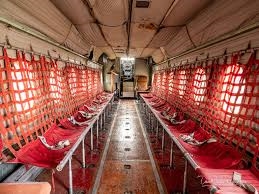
At last the brake was released and everyone in their side-by-side, single-line, orange polyester web seats seemed to be thrown almost on top of each other from force suddenly thrust upon us by the bird’s takeoff momentum. The aircraft seemed to struggle to get off the ground, like some frightened, waterfowl that had just been shot at. It rolled and rolled over the runway picking up more speed and with both engines thrumming with maximum power, the flight finally became airborne.
The Caribou is an over-wing aircraft and its round, port-like, windows are beneath the wings. The portion of the red nylon webbing bench I occupied happened to be positioned at the point where the wings joined the fuselage which gave me a full view out the port window, rendering the underside portion of the engine nacelle fully visible to me. We must have now been at an altitude of about 1500 feet or so and as we heard a servo motor groaning somewhere in the wings, the still-spinning wheels retracted themselves up through and into the bottom of the engine nacelles with the landing gear doors closing shut immediately thereafter.
At last, Phouc Vinh was behind and below us. Looking back, we could see the JAG and PIO buildings which seemed not all that far from the edge of the Camp Gorvad perimeter green-line bunkers and tower fortifications facing the vast rubber plantation stretching outwards toward a hazy horizon.
After an uneventful, short flight we were now in the approach landing pattern at Bien Hoa Airfield and in just 15 short minutes the Caribou’s wheels touched down on the airport’s runway with a barely audible and lightly felt screeching sound. As the aircraft rumbled up the ramp toward the terminal, the crew chief hurriedly unstrapped himself, hopscotched aft, and opened the rear exit ramp door. The door lowered with a slow but constant hydraulic moan as the horizon shimmered through the mirage-like heat rising from the runway. The craft slowed as the pilot cut the engines, and the prop blades swung ever slower until the sound of the engine’s valve lifters became discernible.
A procession of red-soiled, soldiers clad in jungle fatigues emerged through the Caribou’s aft ramp bay. Their postures were thrust forward because of their weighty packs as they set one foot in-front-of-the-other. Fixed eyes stared intently from beneath the heavy steel helmets and a PRC-25 radio antenna swung absurdly as an RTO (Radio Telephone Operator) made his way to the terminal. Finally, they were all lost to the throng milling about inside Bien Hoa terminal.
I must’ve sat at that terminal for an hour or so waiting for a bus to be transported to the Cavalry’s R&R DEROS Center. I finally boarded a bus, but got tangled up in misunderstood semantics and ended up in Long Binh for another hour or so before finally catching a bus ride and arriving at the R&R DEROS Center just before curfew. From then until late last night when boarding the “freedom bird,” my perceptions were a timeless blur of sleepless, hypnotic waiting.
THE FREEDOM BIRD
My entire military Vietnam out-processing phase had been blessed with artillery silence. There were tales I had heard from other soldiers about returnees being killed by enemy 122 rockets while they were waiting for or boarding their freedom birds, but I really didn’t know whether these stories were true or not. Admittedly, the fear those tales may have been true hung over me like an axe all year. Indeed, I think that’s probably why I never was really overwhelmed by “short timer’s fever” or never felt “short.”
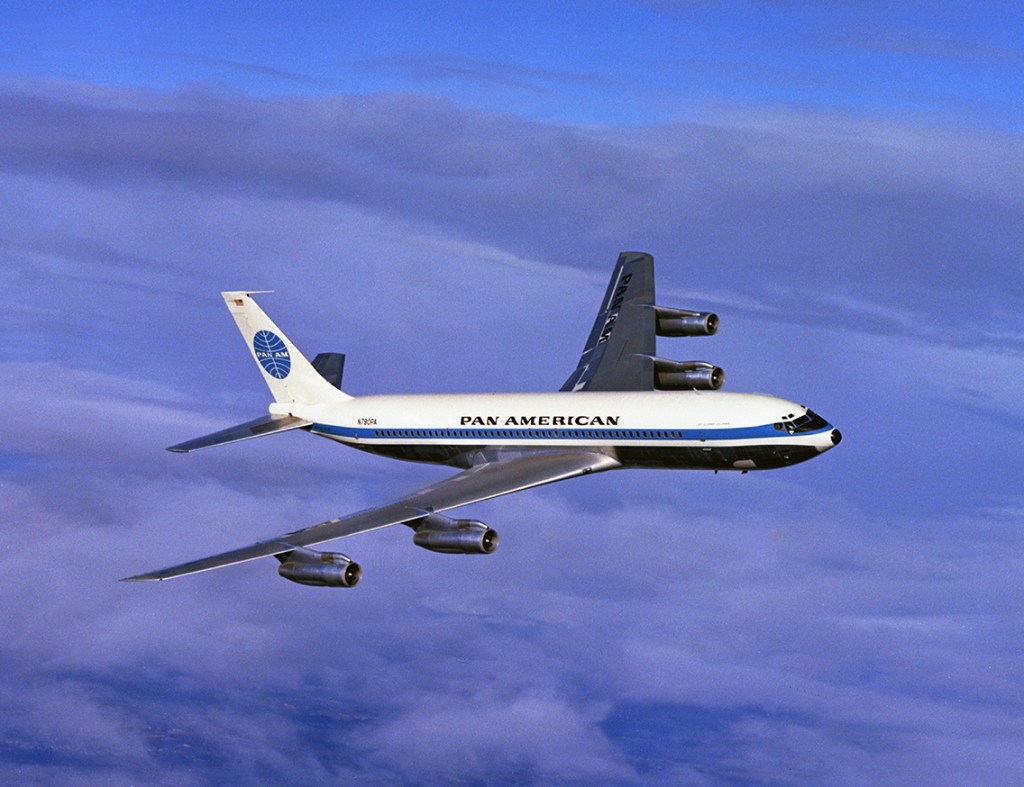
At long last, we boarded the 707 passenger liner in our jungle fatigues and I broke out in a cold sweat as the bird whistled down the runway. Finally, the great silver bird roared off the runway and ascended to an altitude far out-of-range of enemy .51-caliber enemy guns or rockets in no time at all!
But nothing happened, thank God, and the whole planeload of GIs cheered and screamed uncontrollably as the craft flew over the Vietnam Coastline out toward the Pacific and homeward. I have really never had such a feeling of total relief and freedom in my life as I had during that departure. To really know that at last, the threat of some rocket with my name on it was once-and-for-all extinguished at that country’s shoreline was unforgettable. The lifting of that burden puts a whole new fresh breath into one’s life! WOW, just plain WOOOWW!
BACK IN “THE WORLD”
By 1982, after the end of my stateside military service at Fort Riley, Kansas, employment difficulties, marriage tensions, the ambient anti-war sentiments, and a general cultural dislike of anything military, it became apparent to me that I was having just way too many close-call, near-misses, and narrow escapes. In analyzing these incidents, it became shockingly clear that there was something of a self-destructive dynamic occurring within my being. And that I was engaging in subconscious attempts to end my life!
Despite my analysis, just the fact that I was apparently being controlled by a “death wish” was an overwhelming shock. It was as if there was some indiscernible, subconscious, hunter-killer submarine pursuing me. All I knew was that I had to quickly discover the source of this threat before it sent me to the deep six. Becoming conscious of my apparent classic case of “survivors’ guilt” substantially unnerved me and I knew I had to overcome it in short order before it overcame me.
Upon that realization, I immediately sought help from my family, mental health professionals in the private sector, the Veterans Administration, and Vet Center Counselors where I lived.
It heartens me to report that if it were not for my Creator, Family, Country and the VA in particular, I am certain, retrospectively, that I would have become yet another non-KIA statistic of that war. I credit my Maker, beloved father and mother together with the Veterans Administration for my recovery from that deadly, tumultuous interval. If it were not for these blessed positive elements available to me, I am convinced my physical and mental welfare would have been severely denigrated if not annihilated.
Douglas Crow had an earlier post published on my website titled “Close Calls”. You can find it here: https://cherrieswriter.com/2020/09/20/close-ones-during-the-vietnam-war/
*****
Thank you for taking the time to read this. Should you have a question or comment about this article, then scroll down to the comment section below to leave your response.
If you want to learn more about the Vietnam War and its Warriors, then subscribe to this blog and get notified by email or your feed reader every time a new story, picture, video or change occurs on this website – the button is located at the top right of this page.
I’ve also created a poll to help identify my website audience – before leaving, can you please click HERE and choose the one item that best describes you. Thank you in advance!

 CherriesWriter - Vietnam War website
on my last day, 8 August 1969. I can recall very little. I think I left Nha Be on a bus to the Navy Support Activity Annapolis Hotel in Saigon. Another bus the next morning to Ton San Nhut. Do not recall being interviewed, talked to or anything. I boarded a Braniff Airlines jet. We took off at a steep climb, and what I do remember is the stewardess saying, we have now left Vietnam air space and everyone clapped, yelled and whistled. The stewardess continued and said this is a government sponsored flight no alcohol will be served. Now who wants coke and who wants water. You head laughter and AWOL bags being unzipped, out came the booze. We flew to Clark AFB, Japan, Alaska, and Travis AFB. Ask directions to the bus to San Francisco, found out you had to go by Taxi. Then flew home to the Adirondacks. Only people to say welcome back was family.
LikeLike
I’m a CG vet from the era you served but never went to Nam. I’m in a vet support group at the local VA Clinic. The group includes some Viet Nam vets. One guy is a Purple Heart recipient who tells of being shipped to some island base where he and others were observed and interviewed for a minimum of two weeks before being deemed emotionally stable enough to be shipped home. He said some stayed longer and some never left. To him this is one source of the MIAs.
LikeLike
What in the world were Americans doing in Viet Nam anyway?
LikeLike
Interesting story! My father, an Army Aviator, flew the ‘Bou in Vietnam in the early days, then at Ft. Benning, as an Instructor Pilot,transitioning AF pilots into it until the last one was turned over. A great plane, and he was fortunate to be able to fly safely in it to Saigon for his DEROS.
LikeLike
Doing what we were told to do. Unfortunately for all involved the people who were telling us what to do knew little or nothing about Vietnam and its people.
LikeLike
I joined in June 1975, so I missed going, but to all of you men and women who went, served, some lived, some died, I am grateful to each and every one of you. Semper Fi Warriors, Semper Fi.
LikeLike
interesting, but wordy story. My departure began at CRB, Dec ‘66 in a C-130. Compared to the Caribou, it was a luxury air liner. All on board were headed to Saigon and a stretch 8 to Alaska. Everything went fine accept for the lost engine half way down country (caused a Master Sergeant to cry), and the bomb evac at the Saigon airport. God bless us all.
LikeLike
Interesting story although the author should have consulted with someone who flew the ‘boy. First, it’s a C7A….not a C4.
The crew member was most likely the flight mechanic/loadmaster. The C7A is a STOL aircraft (short take off-landing) so it really doesn’t roll down the runway for an extended distance.
As a crew chief on the Caribou I got to experience many sorties/hours on mine.
The story was well written with the exception of the technical aspect. I loved landing on the dirt/mud/grassy landing strips with some in the middle of small villages. Glad all of you who “enjoyed” a ride on a ‘bou, in route to your escape from a bad place. Welcome home!
’67-‘68
LikeLike
My flight home was similar to so many others. Bien Hoa, to Yokota, Japan, to Alaska and finally Travis Airbase, California. We were met by anti-war protesters outside the gate yelling obscenities at us simply for serving our country. After been fitted for a set of new dress greens in Oakland, I grabbed a cab over to San Francisco Airport then home to Chicago, December 22, 1968. 1/27th Wolfhounds, 25th Infantry Div – 67-68.
LikeLiked by 2 people
Mr. Crow’s story is very familiar to me in may of its details. All of us who survived the Vietnam War and our readjustment to “normal” life after we left it are very fortunate… and none of us managed it alone.
LikeLike
My return to the WORLD was disparging to say the least when I arrived to Phoenix, AZ. Still wearing my Vietnam suit, which was well used, fadded and frayed at the edges I got off the airplane to face a crowd of screaming unwell wishers. As I passed through the nasty crowd, they spit on me, grabbed at my fadded “suit”, and some of them tried to punch me. I slugged a couple and kicked some in the balls as I mady my way to the terminal where my wife was forced to wait for me. Airport security did nothing to quell the angry mob. Once united with my wife, we made a hasty departure from the terminal and founs sanctuary in our vehicle.
That was the last time I EVER wore ANYTHING that identified me as a Vietnam Vet until recently when the temperment toward Vets and active military had made a radical change.
Now people go out of their way to thank me for my service. I wear a Vietnam Vet ball cap with my Aviator’s wings proudly spread in front and to the side, a 101st Airborn Div. emblem.
Not uncommon will some unknown person(s) pay for my wife and I restruant meals.
Being a vet is once again a proud thing to be.
LikeLiked by 1 person
Very typical of all . Thanks for bringing back some memories.
LikeLike
You might be home , however you remain a victim of war , until your light is extinguished, you count yourself lucky, as there are many who never had a chance, their names remain immortalised forever on that that black granite wall.
LikeLiked by 1 person
Each of us who left Vietnam in one piece experienced our own personal thoughts as we departed and left the war behind us. I personally do not recall what my thoughts were and maybe there is a deeper message there for me to try to resurrect. I recall the common experience of cheers as we went “feet wet” over the coastline, but I have to search for my deeper thoughts. Thanks for the inspiration to try to remember.
LikeLike
Had not thought about that Tiger Airlines takeoff in a long time and the emotions got me teared up, and I don’t cry easily. Guess I’m getting old . Thanks for your story.
LikeLiked by 1 person
Can totally relate to catching the last flight out of Bien Hoa on the Freedom Bird, hoping the end wouldn’t come on this long anticipated exit from hell? Fortunately, escape was successful. Great story!
LikeLike
It’s a very familiar story for Nam Vets…
LikeLike