
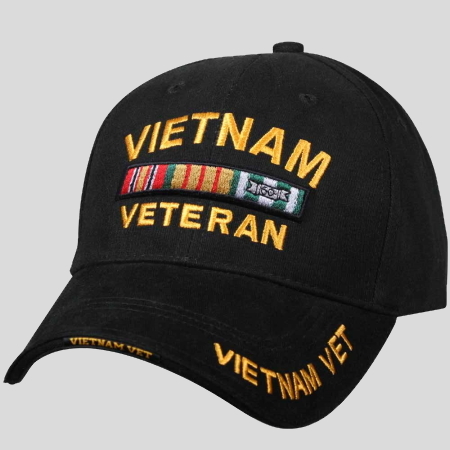

The author of this piece contacted me right after posting my article last week about how many Vietnam Vets are still alive. The debates relating to what constitutes a Vietnam Vet continued within both the comment section of the article and on my many FB group pages. This is worth a read and pretty much sums it all up.
Have you ever asked yourself that question? I have, and I’ve struggled with the answer since the day I returned home from Vietnam in January 1972. That in itself seems to be an odd statement. Of course, I am a Vietnam Veteran if I did a tour in Vietnam. Right? Well yeah, I was there but the question is: “Am I a ‘REAL’ Vietnam Veteran?”
When I think about all of the stories I have read, and the movies I have seen, “real” Vets had a much different experience than I had. I didn’t get shot; I didn’t even get wounded. Other than a battle with the delirious fevers of malaria, I came home unscathed… physically. So why wasn’t I a happy camper? What more could I have asked for? And why did I feel so guilty about that? And why did I have nightmares? And why do I even question whether I am a real Vet or not? None of it makes sense to me.
For many years after I came home, “back to the world”, I never talked to anyone about my Army service and I chose not to seek out other veterans. I kept to myself for the most part. But then on one unexpected occasion when I had an opportunity to speak with a fellow Vet who was a bit older than I was, he asked me what year I served in? When I replied “1971,” he laughed and said: “OHHH, that doesn’t really count, we had the war mostly all wrapped up by then!” I’m sure his intent wasn’t malicious, but man those words stung! And that for sure strongly reinforced my doubt… coming from another Veteran… Nope, I’m not a “real” Vet!
The most devastating years of the war as far as the number of casualties was during the peak years of 1967-1968-1969. That is when 2/3 of all of the war’s 58,318 American deaths occurred. Those three years were the heaviest combat years from what was America’s longest war at the time. Those were the times during the war that most of the books and movies were about. The guys who fought in the actual “heavy combat” during those three years were real Vets for sure. They have absolutely and unequivocally earned and certainly deserve the highest respect and recognition from all of us.
But what about the earlier 60’s and then the 70’s years of the war? Do those years count? As the war was winding down when I was there in 1971, the casualties had dropped way down. There were “only” 2,357 men killed. Only!!? That counts, right? Of course it does, those 2,357 men and the men who fought in the battles with them, large or small, are for sure real Vets, but what about the rest of us in 1971 and the other years? Should being a “real” Vet be defined as ONLY those who have been in “heavy combat” that resulted in heavy casualties?
I don’t think there is any doubt that receiving military orders to report to Vietnam for a one-year tour of duty was traumatic for anyone, no matter what year it was. The big unknown is: Will it be bad? or really bad? Will I ever come home again? Will I live or die? There’s no way around those thoughts. Those psychological contemplations and fears were real, and in my mind, all of us who had to face that basic reality from day one and going forward, are “real vets” regardless of what years we served in and regardless of what our assignments were.
However, I am sure that some may disagree, so let’s delve into it deeper to try to determine if some of my following listed encounters and experiences count toward being a “real” Vet or not.
Does just being assigned to an infantry unit as a rifleman and sometimes a grenadier and at times a machine gunner count?
Does pulling guard duty on the perimeter of an LZ or a Firebase or an Airbase, for 30 consecutive nights or longer without a day off count? Even though the “only” casualties that my unit suffered there were few?
Does going outside the wire with just a small squad of 6-8 men on dozens and dozens of ambush patrols overnight into the rice paddies count? Even though the “only” casualties my unit suffered there were from friendly fire?
Does the fear and exhaustion of carrying a rifle and humping a heavy rucksack up and down the mountains and hacking through the jungles of the dangerous Central Highlands count?
Does the intense fear that results from being shot at and pinned down by snipers as bullets from automatic weapons whiz by you on a hot and humid afternoon in the jungle count? When you are so scared that you’re holding your steel pot tight against your head and lying flat on the ground, trying to hide under your heavy rucksack which is your only cover? Even though none of that resulted in any casualties at all?
Does hearing the terrifying loud explosions of artillery rounds that came in so dangerously close that you can hear the shrapnel cutting the tree branches above and around you count? Even though there again we somehow luckily avoided casualties?
Does being in a convoy roadside ambush count? Seeing trucks get blown up, seeing soldiers wounded and bloodied? Seeing helicopter “dust-offs” landing to pick up the wounded? Hearing the sounds of the gun-truck’s 50 caliber machine guns firing up the hillside where the rockets were fired from, so very close by. Even though my platoon was rushed out of the kill zone and unable to return direct fire after the initial terrifying explosions, does any of that still count?
Does the fear and adrenalin of flying around the country in helicopters and being dropped into remote areas to perform search and destroy missions count? Even though we rarely made enemy contact?
After all, the casualties in my 1/22 infantry battalion were comparatively minimal during 1971 as the war was winding down, and as I stated earlier, I didn’t even get shot, or see any of my buddies get killed. I know of some that were killed while I was there, but I didn’t see it happen. So maybe that doesn’t count. None of what I saw or participated in would be called “heavy combat.” I have never been in a “real” combat battle. Real combat battles have names. Right?
The reality is: any battle that YOU are in is a big one, no matter how small it may be, because it doesn’t take a large enemy force or a big battle to kill you… it only takes one man, with one gun, to shoot you one time.
I don’t even want to get into how the majority US population felt about all of us Vets when we returned home, questioning why we as individual soldiers even chose to go over there in the first place! Chose!!? Everyone knows those regrettable stories about how disrespectful we Vietnam Veterans were treated. Not like “real” Veterans, that’s for sure!
And then there was the time that I was sitting around a campfire one night with 3 or 4 older Vets that were from the Korean War and WWII, drinking beer and listening quietly to their military service stories. Like many Viet Vets, I never talked much about Vietnam before. But I decided to join in and take a turn that night. I simply mentioned how hot and humid it was over there, and how much rain there was during the monsoon season, and how I hated sleeping on the wet ground. One of the old guys replied: “Well that’s your own fault because you didn’t do a good job trenching around your tent.” I cordially laughed and said “what tent? We didn’t have tents, we just draped ponchos over tree branches in the jungle!” The Old Vet then scolded me: “Why do you Vietnam guys always think you had it so bad and came back always whining and complaining about how bad your time over there was!?” Ouch!
Well, maybe I shouldn’t have dropped it, but I bit my tongue, as I was raised not to talk back to my elders. I think you can see the point though, that negative attitude was prevalent, not only in American society as a whole but also in some of the older Vets from previous wars as well. And it had a devastating effect. Yep, it reinforced that I wasn’t a “real” vet.
Even some of older Veterans organizations such as the VFW that were predominantly run by the much older “real” Vets back then, shunned and rejected us Vietnam Veterans. We were thought of as rogue soldiers that were not even in a declared (real) war. To them, Vietnam was simply just an unpopular, poorly run, failed police action. And we were not “real” war vets that were worthy of membership, regardless of the level of our combat experience. That will never happen again! Please note, the point is not to denigrate the VFW (or any other Veterans service organizations), as they serve a great purpose and need for many Veterans and have long ago reversed that type of unfair prejudice. The point is, that was just one example of the reality that we faced in our society upon returning home from war!
At some point, many many years later, actually fairly recently, I became involved with the DAV as a volunteer driver. I transported Veterans to and from their medical appointments at the VA hospital.

That was really the first time I had any serious interaction with other Veterans. And I discovered something that I never really gave much thought to before: There are tons of Veterans who served in Vietnam without seeing any combat, let alone “heavy combat.” The fact is, only a small percentage of those who served were in the infantry. The vast majority of the troops served in non-combat support roles while in Vietnam. However, the war engulfed the entire country of South Vietnam and there were no front lines or rear lines, so as a result, EVERYONE who served, lived with the reality that anyone could get hit at any time, no matter where they served in-country or what branch of the military they served in, or what year it was. The reality was that any base, large or small, could be subject to sapper attacks or incoming mortar rounds at any time. Still, those who served on the bases all bravely reported for their duty regardless of whatever unknown dangers and fears lie ahead of them. Does that count? I think it does.
I had a lot of free time while waiting for the guys to finish up with their Dr. appointments. So, I sometimes wandered around the VA medical center to kill time. I often walked past a doorway that opened up into a large room. There was a sign over top of the door that said “Heroes Hall.” I was amazed and wondered what elite honor group was allowed to go in there! I thought that must be some kind of private club. I would just peek in sometimes to see what “real” heroes looked like. But I couldn’t really see them very well, and I certainly wouldn’t dare go in there! I wasn’t even sure if I was a “real” Vet, and I was positive that I was no hero!
Eventually, when some of the guys that I was transporting as a volunteer, found out that I was also a Veteran, they invited me into Hero’s Hall to have a cup of coffee with them. Well, I could tell from talking with those guys that they were no different than me and certainly didn’t seem to be heroes either. It was interesting but surprising to discover that the men and women in Heroes Hall seemed to be just regular Veterans like me, and all Veterans were welcomed into Heroes Hall. After talking for a while and getting to know them better, they seemed to think that I was a “real” Vet too! I felt good about that.
Believe it or not, The Army thought I was a “real” war veteran. They awarded me the Combat Infantryman Badge (CIB), along with some other medals that I put away in a drawer after returning home, hidden for 40 years. Even though I didn’t get them out again until I became a grandfather, it seems like that should count.
And as it turned out, the VA also thinks that I am a “real” Vet. The more I volunteered and the more time I spent in the VA facility, the more comfortable I became with it. I even started seeing some of the doctors there, and they found that I didn’t return home unscathed! The wounds just took a while to be diagnosed. Besides having had malaria, I have been diagnosed by the VA doctors as having service-connected PTSD, and also service-connected Cancer which the VA attributes to agent orange exposure in Vietnam.
It’s very possible that you didn’t come home unscathed either. The VA has a whole list of cancers and heart disease and diabetes and a lot of other medical ailments that they attribute to agent orange exposure. If you haven’t already, it’s worth checking into because many of us were exposed unknowingly to agent orange, regardless of our duty assignments and roles in combat or non-combat activity. Agent Orange wasn’t selective! You may have read the following assertion regarding the ticking time bomb named Agent Orange; which goes something like this: We survived, came home from the war, and brought death home with us. That makes me ask: how many of us are still dying from the war? And, does that count?
And, I found out that you didn’t have to be in “heavy combat” to suffer from PTSD. I went all those years without seeking treatment because I questioned whether I was even a “real” vet and therefore couldn’t possibly have PTSD (think denial!) So, if you have asked yourselves similar questions, like the ones that I have raised here, or have had some similar thoughts or feelings or doubts about the effects of your service, that in itself can be a form of or a part of PTSD. It’s estimated that 30% of Vietnam Veterans suffer from PTSD. It’s treatable and it’s worth seeking help for. AND it counts!
It has been more than ten years ago now that I wrote this preface in my book Rucksack Grunt :
“You can engage in a conversation with 1,000 different Vietnam Veterans and get 1,000 different stories about their war experience. Some guys had it bad; some guys had it not so bad. It all depends on what part of the country they were in, what year they served in, and what their specific MOS and duty assignments were.
They all served.“
So in closing…. To all of my fellow Vietnam Veterans:
If you can relate to this story in some way or if you have ever asked yourself: “Am I a Real Vietnam Veteran?”
Yes, WE all served!
and Yes, it all counts!
I like to think that is the answer.
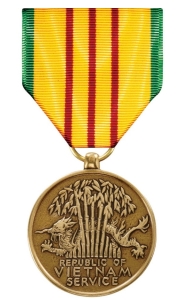
An essay by Robert Kuhn
B-Co. 1/22 Infantry 1971-1972.
https://rucksackgrunt.com
With contributions by Michael Belis
C-Co. 1/22 Infantry 1970-1971.
www.1-22infantry.org
#####
Thank you for taking the time to read this. Should you have a question or comment about this article, then scroll down to the comment section below to leave your response.
If you want to learn more about the Vietnam War and its Warriors, then subscribe to this blog and get notified by email or your feed reader every time a new story, picture, video or changes occur on this website – the button is located at the top right of this page.
I’ve also created a poll to help identify my website audience – before leaving, can you please click HERE and choose the one item that best describes you. Thank you in advance!

 CherriesWriter - Vietnam War website
if you were within range of gunfire you were a vet. i was on merchant ships. perhaps not a llrp or marine, but i was ambushed in saigon, attacked in a rubber plantation and threatened by the vc in the hold of my discharging ship, fired on by mgs on the river to cholon. just doing the job.
LikeLike
If the little toe of your right foot EVER touched the soil of the Republic of South Viet Nam, YOU ARE A VIETNAM VETERAN ! THERE IT IS!
LikeLike
great article thanks,as a flying crew chief on c130e, I did two rotation in Vietnam 1964 and 1965,I have respect for ever veteran that went there whether you drove a truck or was on front lines in the jungle flying a plane you name it.we all had a job to do and I think we did it with honor, many died many were wounded with lifetime disability. Wear your veterans cap if you wish it’s not for recognition, it’s to honor our fellow men and women who have served. I’m 81 years old now I don’t need any recognition, but I’m proud to have serve with many great Americans in Vietnam.
LikeLike
Very good discussion of how to deal with a guilt trip imposed thoughtlessly by (mostly) Vietnam Veterans who claimed the “high ground” of being in combat more than some of us other Vietnam Veterans. It’s time to end the artificial distinction who is and isn’t a Vietnam Veteran. All of us signed the same oath. All of us were obligated to follow orders to fight, to drive a truck or a helicopter, or to process mail. During WWII and during Korea, there was no distinction between “war era” veterans or “war” veterans. We were all in the same military defending the Constitution of the United States, no matter where our orders placed us…and when we returned, those who protested didn’t care where in the world we had served. The protesters realized we were all Vietnam Veterans.
LikeLiked by 1 person
If you were there, then, you are a vet. We don’t need to make classes. If you drove a truck, If you unloaded cargo at Da Nang or pumped gas into tanks. you are a vietnam vet. let’s keep it simple. and honest, and fair. the NVA never made distinctions, neither should we.
LikeLiked by 2 people
So true if you were there for a year or more you are a vietnam vet
LikeLiked by 2 people
Looks like a 2200 -word essay desperately in search of an audience, sir. Not meaning to demean your effort but it seems to be a discourse with a prearranged feel good ending. If you went to Vietnam and got a CIB, you were an 11 Bravo. You had to engage the enemy to be awarded that. If you didn’t see “combat”, you should turn it in and ask to have it stricken from your 214. I’ve seen one chopper pilot awarded one but he was shot down and had to fight to get his crew back to civilization from west of the Trail. He also got a PHM.
As to whether you were there in 65 or 75, it matters little. Boots on the ground (BOTG) is the metric, not the year. Most of us take umbrage with the idea that Vietnam “Era” Vets try to stretch that Era definition to somehow encompass them as Vietnam Vets.
I did two years (70-72) with AirAm- most of it over the fence north of Thailand-way north… like Long Tieng north. I never gave it a thought as to whether I’m a real V Vet. Seems like you’re giving yourself a serious lipwhipping about nothing, sir.
Truth be told is if you go to a VFW bar, you’ll find it’s a miracle the population of the US didn’t decrease with 98% of the men in uniform in RVN. I don’t consider anyone a true BOTG Vet unless they got red clay between their toes. That includes the Squids unless they were brownwater. But then, I’ve heard folks who claim to have been there pronounce Bien Hoa as Be-in Ho-wha. I’ve met guys who were born in 1957 swear up and down they were there. Shoot. Maybe they own one of them Deloreans that can go back in time, too. Who cares?
As for how many BOTGs are left? A worthy discussion. Google articles swear it’s 850,000 but they’ve been quoting that same number since 2008. I’ve personally lost about 10 of my V buddies I represent before the VA just since 2016. At that rate nationally, I’d say our numbers are way down below 500 K easily. Remember, we have to count AirAm and US Medical Service folks in that number. VA adjudicates their claims, too.
LikeLiked by 1 person
Right on! I repaired com/nav gear at Phi Bai 69-70 on anything that flew. I can still identify which aircraft by their sound. We got occasional rockets and mortars and were mostly safe, thanks to the grunts outside the wire. We were always waiting for the “next” volley, never knowing when it would come. TAD on carriers did not help. Tons of fuel, explosives and sometimes damaged planes coming in. Got home and had lots of anxiety and anger issues and became a raging alcoholic. PTSD was not a label back then. Almost attempted suicide and got help with AA program and got my demons under control after a few years and got my life back with a lot of help and good people who understand. 31 years sober now, still have demons but now we talk things out and sometimes snuggle. Some things never go away, but I have learned how to manage things now before they get out of control and live a pretty normal life.
LikeLiked by 1 person
If you had Boots on the ground, slopping around in the mud, diving for cover during a mortar attack you might be a real Viet Nam Vet!! I served from Jan 28th / 68 to Feb 16th / 69. Was with 4th Infantry Division/ 4th Engr BN. A Co. up at Dak To then was moved to E Co Armor platoon as Tank Commander. Ran the Div Mine Roller up Hwy 19 between Plekiu, Kontum, Dak To. Everyone I came across did their job as best they could and only complained they didn’t have enuff ammo at times. All you guys out there—- give up that guilt shit!! You didn’t earn it!! You hold your heads high, I Damn sure do!!
LikeLiked by 1 person
I had a similar experience in 1970. Some guy on his second tour told me how lucky I was. I suggested we go down to the evac hospital and tell them how lucky they are. But, as things turned out, I was lucky
LikeLiked by 1 person
Well said….USMC “Vet” 1966-67
LikeLiked by 1 person
July 12, 2021 at 1:06 pm
i would like to confuse the issue a bit more. I was a merchant marine officer on cargo ships, american export lines, for three years, back and forth to viet nam. we spent sometimes a month or more in one port depending on the cargo and the need. I do not believe we were counted as vets. It took about 30 years for the government to acknowledge we were even there. for myself, being bored sometimes, and anxious to see and do more, i volunteered and went on a number of supply missions to the fire bases. no body turned down extra hands, and my india purchased white shirt and shorts made me attractive target in the event of a problem, and provided some humor to the 130 crews. was i a veteran by the numbers? maybe, maybe not. but i was happy to serve.
LikeLiked by 1 person
You could be a Veteran of the Merchant Marines. Are all the pilots who flew MATS are they veterans ? How about the reporters that stayed in Saigon for the 5 O’clock follies are they veterans. The rear Echelon are veterans. I served in foreword areas. When I came home I was greeted by protesters. I think it’s safe to say were were all Tourists because I cannot find a defining definition of veteran in any dictionary. Frank
LikeLiked by 1 person
I live in Montreal part of the year. i was crossing the border a few years ago and some immigration/customs officer asked when i left the us. i told him 1971 or so. He said, you were a draft dodger. I said no. He kept pressing and i told him i had served on merchant ships for three years in vn. shortly after i wrote someone in veterans affairs and i got a small card, a vn service pin and a chest badge. the card said i had served. Not that it would mean anything to the guy at the border, but i decided i was not going to be insulted. carter pardoned those people that left the country. the customs guy was way out of line but i never pushed.
LikeLiked by 1 person
Honor and Respect, Thank You For Your Brave Service Brothers And Sisters Vets. We ALL had our jobs do to toward Protecting Our Country and Our Freedom no matter what our duties entailed. I have as much respect and gratitude to Our Support Team as I do for MY Brother ‘Grunts’. Thank You for ALL you did to keep ‘Our Boots On The Ground Moving. Welcome Home to the Brothers and Sisters still with us to read this. Honor and Respect Our Fallen Brothers and Sisters and Their Loved Ones. God Bless You and God Bless America…!! 🇺🇸️🙏🙏🇺🇲..(The Big Red One, 1st/16th, Combat Medic, Full Year of 66. Proud to have been a Grunt ‘Doc’..)
LikeLiked by 1 person
I think it is well written and he has a point being in-country at a air- base Army and Marines think you had a easy job, I was a Air Force Security Police and received Outstanding Unit Award with a V for Valor and in combat. People and Veterans think we did nothing but have fresh milk and ice cream. I went out on 2 search & destroy missions with the South Vietnamese Army. both in January 1968 before TeT 68. Yes combat. I get shit from all Veterans you expect pilots and air crew to get in combat air medals but we defended the aircraft and personnel of the Air Force . You can die in a clean uniform just as you can die in the jungle.Rockets, mortars and sappers.Convoy duty shit in a jeep with no armor. Some of Skycops,Security Police nick name learned as we went along and we were a defenses force and had to learn to be the light infantry for the Ar Force. Use of a m-60,50 cal,,m-79, mortars, patrolled in 3 man jeep on Highway One . Skycops have to defend jp-4 jet fuel, bombs 250,500, pound and bigger and yet you had it made , sure I didn’t sleep in the jungle but I was on op’s and lp’s once went into the DMZ with Marines(Dong Ha) it was a Marine Base but the Air Force had a top secret Radar site there and if the NVA sappers got in the wire the radar site was a key target plus the control tower and forward air controllers plus PJ Para-rescue were all Air Force in many Marine bases near the DMZ. Skycops lived as Marines on the base they gave us a lots of trash talk. But mortars, rockets 122 mm loved the air bases cause we just sat there and took it like the Marines. Air Bases were primary targets to the VC & NVA, Charlie can fly!
From a Skycop 67-68
Started at Cam Ranh AFB to Dong Ha
LikeLiked by 1 person
Awesome!!! I was Naval Air! We were aboard the USS AMERICA CVA 66 1972-73 in SQUADRON VA-86! I never went to the VA until 2014!!! I joined the DAV in 2013! I have Ischemic Heart disease. In 1987 I had a heart attack and my LAD was 95 to 100 percent blocked. The hospital performed angioplasty and sent me home. That was in June. In November I got the symptoms again and ended up having a by-pass for Thanksgiving!!! I am doing okay with that.
LikeLiked by 1 person
Having served in Signal, always admired those like yourself who were Infantry. What was memorable, for me, were the rocket attacks, and getting caught unprotected as they came in. In other words, I ducked. And when people ask about my time there and what I did, I tell them, I ducked. Successfully. I’d like to think that ducking — even if successful, allows that, perhaps, I’m a Vietnam veteran. In any case, YOU certainly are!
LikeLiked by 1 person
So many thoughts come to mind about this article. First off, when one signs up for the “team,” one is not signing up to coach or manage, instead, by signing up, you are indicating a willingness to play a position when sent into the game. Coaches and managers decide what position you will play, as well as when/if you get into the game.
The fact that one showed up with the willingness to be a part of the big picture is all I need to consider someone else a vet. Not many of us realized at the time, that for each of us in the field of combat arms, it took seven individuals working in other capacities to support us…supply, pilots, medical, engineering, personnel, finance, and a host of other military occupational specialties. Whatever position you were called up to play, that makes you a vet. It has nothing to do with being shot at, or shooting back. You were assigned a job and you performed it, you watched out for the guys to the left and right of you, your patriotism in the process shrunk from country and family, to self and squad. Self-doubt after the fact is normal.
Myself, I was on Hamburger Hill in May 69, and continue to berate myself for not having done more. I still carry metal in my body…I should have done more!
For the author of this piece, YOU ARE A VET! Thanks for showing up and being part of the team
LikeLiked by 1 person
Thank you for this article. Our family became a Gold Star family on 04-APR-69. I have met or had correspondence with many who knew him and was with him when he died. My husband and I have since volunteered with veterans groups to give back for all the sacrifice every veteran makes for our great nation. Visiting with veterans from different wars we noticed that the veterans from wars before Vietnam had a different outlook for when and where veterans served. If you served you were that war’s veteran. The place served and MO did not matter. They all knew that no matter where or what you did, it was still for winning the war. Someone has to be behind the scenes so those in the field in combat can do their fighting more efficiently. As far as my husband and I are concerned, anyone who served from 1959-1975 is a Vietnam Veteran. Thank you all for sacrificing your personal lives for our great nation and doing what your country asked you to do. Honor and respect you all
LikeLiked by 1 person
The veterans of the Vietnam separated themselves
. Some of the vets distinguished them selves from the ridicule by saying they did not serve in Vietnam to separate them selves from the hatred shown toward the Vietnam Veterans who served in Nam . That’s where the Era Veterans Came from . In had a good friend serve in Iceland the same time I served with the 1st. Cav. In Nam and we were treated totally different.
LikeLiked by 1 person
Excellent article! just another Vietnam Vet. And Proud of It!
LikeLiked by 1 person
I liked this as a Vietnam Vet, but also didn’t like it as an American. Individual mutually reciprocated Self-Sovereignty as Equals with unity of All. Only my vote/opinion counts with me.
LikeLiked by 1 person
everybody doesn’t get to ride on the wagon and even fewer get up close to the harness and the pulling team but it is what it is and everyone didn’t take the same ride or go to the same places but if you were there you were there and if you were an 11B or a mail clerk you did what you were supposed to do…end of story.
LikeLiked by 1 person
In my opinion a Vietnam Veteran is one who served in country, “Boots” and the “Bluewater” in direct support . I was Navy, a REMF 66-67 brought fresh and frozen food to Chu Lai and PhuBai/Hue. I believe that an “Era” Veteran is not the same , this is my opinion and I stick with it
LikeLiked by 1 person
Great story that all of us can relate to. I personally felt a little embarrassed about taking of my experience in Vietnam because I was a disbursing officer and never went out in the bush. Like all of us, I went where I was told.
Serving in the Marine Corps has made me a better American who is extremely proud of our country. I still have tears welling in my eyes every time I hear the national anthem
LikeLiked by 1 person
Took everyone to get job done. I was ARTY scout. Spent my time with 9th Marines 3Rd Recon and ARVIN. Mostly in Bush. Really
Appreciated ARTY batteries providing accurate fire when I called. My Battery D/2/12 was great
Getting us special things. Appreciated MAG
16 Bringing us food, ammo and bandages. Taking our dead and wounded. We mostly
Looked like homeless people with ragged
Clothing. I blamed 06’s and above for not
Taking care of the Bush Marines.
LikeLiked by 1 person
You served! You are a Vietnam Vet! I served three tours and spent 7 months in the hospital. But, you are as “Vet” as I am! Hold your head up and wear your hat proudly. You’ll find that the ones who talk the biggest game are usually posers!
LikeLiked by 1 person
Good review of your time in Vietnam and afterwards. You served, did your duty and that is what counts. I was there 66-67 and hated every minute but I served in a non-combat mos and did the best I could. Thank you for your essay and experiences.
LikeLiked by 1 person
I flew Dustoff ’69-’70. I remember the WW2 vets seemingly implying ” We won our war. Ours was a real war.” Some may have been more what I felt than what they meant. Everyone there counted as REAL.
LikeLiked by 1 person
I was a Aircraft Navigation Tech first stationed at Clark in the PI . First TDY took me to Phan Rang RVN with 8th Tac Bomb Sqdn – B-57 Canberras for 3 months then no.2 was Danang with 509 th Tac Interceptor Sqdn end 67 thru Mar 68 ( yes I “endured ” TET ) then hopeing to return to Clark for some PCS anywhere BUT SEA…Not so…Back to Phan Rang with 35th Tac Ftr Wing F-100’s , B-57’s, O-1 , O-2 & OV-10’s..We had many mortar attacks at PRAB & of coarse theres TET..I flew on anything I could get a ride on , C-123’s , O-1’s , HH-43 PEDRO’s on sweeps U-10’s & C-7’s..I felt bullet proof ( & stupid )..Got winged from a mortar strike that messed up the dude walking in front of me & always felt that I was just some REMF that didnt qualify..I too found a lot of hostility from guys from earlier conflicts so I just kept all my experiances to myself until a few years ago…Really ” on the mark article “…Welcome Home.Bro
LikeLiked by 1 person
I’ve been on the receiving end of those comments from WWII and Korea vets at the VFW and American Legion, “we won our war” Thus I did not join but as time went on those organizations began to lose members (they were dying ) and now they needed us VN vets. I just joined the VFW two years ago and the American legion last year and the Son’s of Legionnaires. My Dad was a WWII US Navy vet. Funny how that works and even now we are trying to recruit Desert storm vets to begin to take over the reigns. We’re getting older and dying everyday too!
I served with the 1/9 HHT 1st Cav flight platoon and flew 153 combat missions and recorded 700 hours. I was a proud flight platoon leader of 16, 8 helicopters and was the Crew chief for Major General George W Putnam Jr, Commander for the First CAV. He was just a few years younger than my Dad and I always looked up to him as a father figure. Proud to wear my Vietnam Veteran hat and even more proud to be a Commemorative partner to recognize my fellow Vietnam Vets and those who served during the Vietnam War. it includes the dates between 1955 and 1975. The 50th anniversary of the end of the Vietnam war is in 2025. We have more than 3 million to recognize. If you know of someone or yourself that has not received your Commemorative lapel pin, drop me an email. I’ll make sure you get one. Great article, brought back some good and some bad memories but that’s okay. We all have a story to tell. Tell it!
LikeLiked by 1 person
I have a photo of Gen. Putnam that he inscribed to my father Albert Fern, so I think he must have served with you as well. He never spoke of his service. After he died, I discovered many photos from that time – many soldiers whose stories and endurances I will never know. I know my dad served alongside an officer from another country who died in a helicopter crash, and I knew it devastated my father – only because my mother told me. I have a black and white photo of a young man laying in a hospital bed, with a big glass IV bottle next to him and yellow tubing leading to his arm. He was too wounded to sit or stand. I know this because the photo revealed that my father had pinned the man’s medals on a sheet and held the sheet up for the camera. Nothing written on the photo. I don’t know if the young man survived, and I suspect I’ll never know his name or the story behind that moment. My heart is heavy at the thought of it. I was told once that when my father returned home, he said to someone complaining of the flu, “You don’t know suffering.” It might have been a cruel thing to say, but that awful, poignant photo spoke a million words of the suffering my father saw in Vietnam – and the full-color images etched in his memory – unspoken scenes that likely haunted him until the day he died.
LikeLiked by 1 person
I went over in May of 68 and was assigned to (USMC)Golf 2/27 and then to Hotel 2/4 after 27 Marines return to the world. I saw a lot of combat was wounded 3 times, and on 25 Feb was wounded my last time and sent back to the world. In my heart if you had boots on the ground they you are a Vietnam Vet period, When reading the VFW hit a nerve because they treated me the same way.
LikeLiked by 1 person
Many Thanks to all of you who have commented on my very first article. I was nervous about posting it, not sure what reaction to expect. But you have made me feel proud to be a “Real Vietnam Veteran!”
Thank You,
Bob Kuhn
LikeLiked by 1 person
I was with Co C 2/27 (wolfhound)25th Inf. Div ( 1967 to 1968). mortar platoon. I am very lucky to not have a Purple Heart but I do remember the bullets hitting very close to me. Remember the night of May 16 when I put a body on the chopper for his last ride out of the field. Did not know his name until a few years ago from my squad leader . I never talked about any of my time in Vietnam until I retired and started going to reunions which took around 45 years. Thank for such a great article.
LikeLiked by 1 person
When I got home everyone in my circle knew I was a Vietnam Veteran, because neighborhood news travels wide. I did the best I could do to blend back in to society to the point I convinced myself I never served. Almost twenty years after coming home my attitude took a turn when confronted with people telling stories about their Vietnam Service that were lying about it. Most of the followers they had believed them. One statistical study suggested 3.2 million served, but more than 10 million were claiming to be Vietnam Vets.
Slicing the numbers which ever way one wanted it felt most important to me to write about my experiences to validate what I went through. I went to great lengths to prove I was a combat veteran. I was not awarded a Combat Service Ribbon in my SRB. It was my Corpsmen friend Doc Woody, that awarded me a Combat Action Decal to place in my rear truck window. The decal was my claim to Combat Service. To get VA benefits I had to hire an attorney to help me prove I was in Combat. Later it became a felony to impersonate yourself to the VA to get benefits.
After nearly 50 years I got my story published. I guess in defiance of what I , and what my fellow squad members will testify to; I put my Ribbons on the cover of my book “Honor & Indignity”.
I am a Vietnam Veteran. I Honor all sacrifices and achievements of my fellow Veterans. Peace.
Greg Doering 2/9 Third Mar Div 1968-1969 Fox Company & H & S Motor T.
LikeLiked by 1 person
Very impressive summary of what we all have experienced for the last 50 years. Yes, if you were there – on the ground, in the air or on a ship – it counts. You are a Vietnam Vet. And so many of us have suffered from the treatment and slow death we brought back with us you describe so well.
It is so unfortunate our war will never receive the recognition that was accorded to WWI, II, Korea and those who have fought subsequently in the Midfle East. Our flag and the Vietnam War Memorial is black. That’s unfortunate, but it seems appropriate nonetheless.
It’s something we can talk about, sometimes, with other Vietnam Vets, but ultimately we carry that war and those memories with us, daily, in our hearts and minds.
That is why the words “Welcome home, brother,” are so meaningful to us.
LikeLike
Served 12 months in Vietnam-11B- Dec 1967 to Dec 68 with 1/27th Infantry- (Wolfhounds) 25th Infantry Division. All that served in Vietnam should be very proud of their service.
LikeLike
Great article,with me you hit the nail on the head ! I was stationed in Cam Rahn. Bay 9/66 3/68 Built barracks USAMMAV.Did come home with a very annoying case of malaria that still acts up from time to time. Thanks again ,I’m sure they’re are others who think the same.
LikeLike
I was in Nam 67 /69. Americal div, 196th Lt inf. And I can say All who went to Nam, no matter what year has my respect. Yes he or she is a real vet. They didn’t run to Canada or where ever to get out of service. They served. Please feel you belonged. You did. I was scared the whole time I was there 24/7 . One spit second I could be dead. I didn’t want to be there but I was. If a bullet didn’t get me a Cobra or other bad ass snack could kill me. You Men and Women who went to Nam in the 70’s Thank you and a salute to you……………………………….. Twobears I am a Native American.
LikeLike
Very good article. I am an Infantryman, WIA 23NOV 70. I was there a very short time. It was irritating reading in the newspaper that the war was “over” in 1970, sure did not look like it was where I was !
LikeLike
This article was interesting. The same questions could be asked about those who served in any war. Whether one is on the front line, bringing in supplies, or are fortunate enough to be in a part of the country where it is less dangerous. If you weren’t there the enemy would be. How does one know when danger may strike. If you were in Vietnam you are a Nam Veteran. Many of us have guilt feelings because others had it worse but no one knew when the circumstances would change. I am proud to have served in Vietnam and you can feel proud as well.
LikeLike
You got combat pay while you where there enough said Welcome Home Brother
LikeLike
If you went to Vietnam you did not know if you were coming back. Whether you were in long been with God rocket attacks or if you were in town to note at the R&R center is still face the same danger as every other vet.
LikeLike
Great Article I served 3 tours 1967 to 1971 some good and some bad.. I wasn’t spit on in airports when I came home but I was cussed at and even looked at by others in uniform (That was the worse) like I was some sort of monster. I remember once in an airport in Calif where a Mother grabbed her little boy and said don’t talk to that monster and pulled him back. I had good tours where only a few incursions occurred and others I wish to forget but when I meet another Vet with his hat proudly on I salute him.. Yes my friend if you were there you are a true Nam Vet and deserve all the thanks you can get. When I finally came home I got married and my wife couldn’t understand the nightmares that sometimes woke me and we never talked about my experiences. After she died I started talking to other vets and some of the pain started to ease. Any and all that served in Nam have my respect for what its worth.
LikeLike
Smutty 1947 I spent two tours in Vietnam in heavy artillery . I saw sappers in the wire , incoming rockets and mortar , ambush in combat . Yet was never wounded . Even now some Veteran try to act as though because you didn’t receive a CIB you aren’t a real combat vet . Some in Nam had that attitude also . I’m a Vietnam combat vet no doubt in my mind . Great article .
LikeLike
Receiving the CIB has requirements that are as follows: For award of the CIB a Soldier must meet the following three requirements: (1) Be an infantryman satisfactorily performing infantry duties. (2) Assigned to an infantry unit during such time as the unit is engaged in active ground combat. (3) Actively participate in such ground combat. Receiving the CIB is an indication that you met these 3 requirements. Being a Combat Vet may have no medals specific to your particular experience but I can tell you that I as a CIB recipient look at you as a real combat veteran experiencing some of what I did working out of an LZ and gladly having you there to support us whenever called to and supporting us with the knowledge that without your support some of us would not be here today.
LikeLike
In all the wars of which I am aware, we have never differentiated the veterans of any war by the role they played. Military service is teamwork and everyone on the team is important and has an important role to play. It doesn’t matter if you were stateside or overseas “in country” to use a divisive term, you are a Vietnam War veteran…just as were World War II veterans, etc. Artificially labeling veterans by where they served probably started with the Korean War, when we began to superficially differentiate those who were on active duty and “in country” from those who were on active duty, but not deployed. Instead, we should all recognize our WWII, Korean War, Vietnam, Gulf War and Global War on Terror veterans for when they served, not where or how. Stop the bickering, sophomoric analysis and silly arguments. Enough! I am Vietnam 66′ and 67′
LikeLike
You are overthinking this. It is quite simple, If you served in Vietnam for at least 30 days you ARE a VN vet.
LikeLike
So if you served only a few days or a few weeks and were killed on an ambush or defending a LZ then you were not a VN vet as you referred to us?
LikeLike
That was good I was in viet – nam 68-69 3/17 air cav recon Delta troop rice Patty’s the hobo woods it was a tuff time I was young 18 years old now IAM 71 years old I salute aii vets and you are a viet-nam vet
LikeLike
That was good I was in viet – nam 68-69 3/17 air cav recon Delta troop rice Patty’s the hobo woods it was a tuff time I was young 18 years old now IAM 71 years old I salute aii vets and you are a viet-nam vet
LikeLike
Hello! My highest respect to you and your service over there! My father was there 68-69, Company,A 2/60th, 9th Infantry on the Delta. I was wondering if you knew him and was with him at times? He’s still around and doesn’t know Im inquiring but I am. Im having a hard time trying to find any of his brothers from there. I know from what he told me a lot of his peers in his gang didn’t make it but there were some that did so if you knew him or know anybody that does know him would greatly appreciate your reply. Thanks so much!!
LikeLike
I totally agree with this article. I was an entertainer in Vietnam in 1967, May, June, July. Worked hard performing 150 shows during that time. I am not a Veteran, but I experienced fear, was shot at in a chinook leaving a base, and saw the body bags being unloaded as me and my group waited our turn to get on those same choppers. I have had Veterans say to me they had a desk job or some other non-combat assignment, and my answer to them was, “You were there. If asked to do more, you would have done it.” They don’t say anything else and only nod.
LikeLiked by 1 person
Anyone who served from the time the first advisors went to Vietnam and until the last American left in 1975 are Vietnam Veterans.
LikeLiked by 1 person
Very well written article. My opinion is that the only requirement to be a real Vietnam Veteran is that you actually served in country. Some jobs were harder than others, but all were important. No disrespect to anyone who served their country in any capacity anywhere else. I was a RTO and Purple Heart recipient with C- 4/12, 199th Infantry Brigade, in Vietnam (1967-1968).
LikeLike
I was in Viet Nam from end of Jan62 till mid May 62. I never got a medal, ( or wanted one).
I spent the most of my time, along the borders of Laos and Cambodia, in a Montagnard unit. I didn’t wear a uniform, or carry dog tags or an ID card. I came home, an no one knew I had been anywhere. I claim the right to be a Viet Nam Vet.
LikeLike
In my opinion you definitely are a Vietnam Veteran.
LikeLike
I served in Vietnam as an Artillery Forward Observer with an Infantry Battalion in 70-71. I agree that the most consistent contact occurred in 67,68 and 69. But regardless of what years/s you served or even where in country you served you still faced the possibility of death at any time. There were no safe locations in Vietnam. I spent 10 1/2 months in the jungles and mountains of Thua Thien/Hue Province. I you were awarded the VSM/VCM you are a Vietnam veteran.
LikeLike
Well said and very true. Everyone who was assigned to the Vietnam theater were Vietnam Veterans.
LikeLike
I’m not much of a fan of “micro-pigeon-holing”. I am a Vietnam ERA Veteran, if I must micro-pigeon-holed. I have the NDSM. I am not a combat veteran, unless combatting boat fires counts. I enlisted in ’73, and I am not ashamed to say so. As my cap says, I “Proudly Served”. That will not change. I don’t care how anyone else classifies me. Each of us was one part of the “machine”. If any part was missing, that machine could not function at its peak. It would have suffered if we had not been there. We all did our part.
LikeLike
I have recently found that I was one of the last combat troops that left ‘nam in June of 72. I started out with Co. E 1st of the 501st in the 101st as a mortar gunner. Spent quite a while in the bush, on fire bases and in the rear in PhuBai.
I have no record of the number of insertions I took part in (I was awarded an Air Medal and a CIB ) or how many ambushes I was asked to deploy with, how many hours of guard duty I pulled.
The 101st stood down and I was transferred to the 196th infantry in Danang doing security around the air base. Still doing helicopter insertions, coming in contact with tigers, poisonous snakes, guys getting heat stroke and one of our troops dieing from a booby trap. I was never fired upon and never fired my rifle at an enemy.
A couple of years ago I started going to the VA and was diagnosed with PTSD and Tininitis but have not been able to get approval from them. I put in a request for my records but COVID-19 shut down the records center.
I, too, have wondered if I am a true veteran at times. Thanks for your article, it has given me strength.
LikeLike
People forget that there were much fewer Americans in Vietnam during the latter years of the war. You can’t kill someone who isn’t there. Most of my tour was in 1970. I was in B-Co, of the 1st 327th Inf of the 101st. My entire company only had 70 men. The platoon that I was in (1st) had the most men, 27. We split into platoons and tackled a hill that an entire battalion (2nd 502) couldn’t take. My platoon had over 50% casualties. The other two platoons had it just as bad. We did eventually take the hill. Comparing casualties by troops KIA or WIA during the individual years is an apples to oranges comparison. If percentages are applied instead of raw numbers, 1970 was a bad year. Erick W. Miller, Author
LikeLike
Including mortars we never had 50 guys in my company. In fact my platoon had 7 guys in it when I left the field. In April/69.
LikeLike
Thought provoking article which has probably been asked after all wars! My uncle flew as a bottom ball turret gunner out of England, and then Italy for 80+missions, but said on many occasions that he was glad he wasn’t storming beaches ! Who is a real vet is a personal thing determined by no one. Be proud of your service and respect others🇺🇸🇺🇸🇺🇸
LikeLiked by 1 person
For what it is worth many people were treated just as shabbily as you were. I enlisted in 1974, long after we had troops in Vietnam. Yet, when I enrolled in the University of Illinois because I was a Vietnam “Era” Veteran per the GI Bill, I got shit from fellow students, professors and everyone who knew I had served in the military. At the time everyone who served was under the shadow of both Vietnam and Kent State. Most didn’t care to know the difference. I reenlisted and served until I was wounded and got out in 1984. Sometimes even today when I go to the VA for treatment there are those who feel that way.
LikeLike
We, all who served in RVN are real vets. To some degree some had a harder time than others. I as a pilot was over there flying UH-1H helicopters with over 2000 hrs combat time. As we learned in flight school: hours and hours of sheer boredom punctuated by moments of stark raving terror!
LikeLike
Thanks for your thoughts. I legally qualify as a Vietnam Vet, but I don’t mention it because I never actually touched the ground there. I served honorably, but did not make the sacrifices so many made. Everyone should support veterans’ groups. 🇺🇸
LikeLike
Yes I understand. Vietnam had 10 support troops for every man in the field. More than in any previous war, hence the self questioning. And re the heavy fighting occuring in “66, 67, 68, the 173rd Bgd went through hell before that, before the later build-up. Thanks for this article. 👍
LikeLiked by 1 person
So true ,the ones of us in the front lines could not have done our jobs as well as we did without rear echelon support. Thanks for their help .
LikeLiked by 1 person
Thank you for sharing. I served from 71-75 as a B52D G Crew Chief and KC 135
Crewchief.in 72 a supplied in flight refueling on F4 supplied Air Support During ArcFlight and Linebacker II Provided ground support in Guam for the evacuation of Saigon.From Guam Okinawa Thailand Cambodia Philippines and Vietnam. As an 18 year kid only knowing the Southside of Chicago and making a transition to a foreign land. I went I served and am proud to say that a I served my Country Proudly. Made friends lost friends. And 50 years later I stay in touch with two brothers that I Proudly served with.We can only learn from our experience that we are all here for each other. Time is short now share with your children and grandchildren what you did to help keep this country safe and free. They will only know the truth from you.God Bless you all.
LikeLiked by 1 person
You were a grunt, you were in Vietnam, you saw combat. Why would any person, let alone Veteran, question your service ? Welcome home ! D/2/16, 1st Infantry Division, 1967-68
LikeLiked by 1 person
Thank you for this article. I always look at your column………YES…..SOME served…..some did NOT return. Like the 137 from the shipboard fire/FORESTAL…… I am pleased to wear VETS NAVY hats……all the times I go out. ALL served. I went into navy to LEARN a trade….for life work. A war came along and we were THERE…..so THERE we went. STAYED till end of cruise 1964. Went home. Then promptly RETURNED to LINE service YANKEE/DIXIE stations. I got out of service in AUGUST 1965. Still a LOT of the Nam left to GO…… : ( I started eng school in 1967. Finished in 1971. VERY thankful am I to BE a VET…..and a NAVY vet to……. Its irritating some dude sees my hat ….and says….”Thanks for your service”…….and I say politely……you….mean you did NOT serve? NOPE. Sigh. Way it goes. Course there was none of that at; when I got out. No MFer EVER called ME a child-killer though THEN…or now. I served. Glad I did. Thankful we had no SERIOUS hassles….only ASS busting work……..18-20 hours a day….EVERY day…..for 54 day straight stretches. And relief theater in Subic Bay…..then right back out to LINE service. YES. Nam vet? O hell YES…….there at the start and got out. BEEN very pleased with VA stuff my life also.
Thank you. Right Hand salute to YOU too.
Paul D. Rhodes AO3 VA-196 AD Skyraiders/ FLITE DECK ORDNANCE USS Bon Homme Richard CVA 31 1964 and 65 Nam cruises. ________________________________
LikeLiked by 1 person
Paul, I agree with you since we share similar experiences. I made three deployments in 66-68 on board the carrier Constellation so I do consider myself a VIETNAM Vet.
LikeLiked by 1 person
I served in the USN for two tours in Vietnam in 67. We exchanged fire night and day with shore batteries. And, yes, we had casualties resulting from those exchanges and death. I’ve had a few vets say you didn’t have boots on the ground so you are not a real Vietnam vet. Tell that to my comrades who were killed during those exchanges or the 9 sailors killed and wounded as the result of a direct hit from one of those shore batteries.
LikeLike
Pdoggbiker, Thank You for this article. I served too in Nam from May of 69 to 1 July of 70. I had a MOS OF 72C 20, CENTRAL OFFICE SWITCHBOARD OPERATOR ON A MOUNTAIN called Lang Bian Mt. North of DaLat, RVN. I was drafted so I had an issue about not being combat qualified as a grunt but soon recognized my issue was mis directed as I spent 13 months and 5 days on a relatively safe base for that time. I have recognized my value as a Veteran that is proud of his service and know that that service was not in vain. Thank You again.
On Sun, Jun 27, 2021, 3:17 PM CherriesWriter – Vietnam War website wrote:
> pdoggbiker posted: ” The author of this piece contacted me right after > posting my article last week about how many Vietnam Vets are still alive. > The debates relating to what constitutes a Vietnam Vet continued within > both the comment section of the article and on my many FB ” >
LikeLiked by 1 person
69-70. 1st Lt. MACV. l lived in the Delta for a year. 2 years Prep. OCS etc.
“Hearts and minds” time.
Great Article!
LikeLike
When you take that oath you write a blank check to the government worth up to and including your life. You never know if, where, or when that check might be cashed.
I was too young for Vietnam and enlisted in ’79. But I was old enough to have several friends later in life who were Vietnam Veterans and saw several combat tours. One was a UDT member in the Mekong Delta area and one served mostly in the central highlands area. They both had my deep respect.
I did not experience combat and I consider myself lucky for that. But had it been necessary, I would have gone. Those who served in combat in any war, whether it was WWI, WWII, Korea, Vietnam, or the Middle East, deserve our deep respect and gratitude. Vietnam Vets, in particular and though many won’t ask for it, deserve an apology from many in this country for how they were treated when they returned from doing their job.
However, combat or not, I will never disrespect any man or woman who raised their hand and swore on oath to defend this country from all enemies, foreign or domestic.
LikeLiked by 1 person
I agree with you completely on this issue. I was in Vietnam with a Armored Calvary unit from 3/67 to 3//68.
LikeLiked by 2 people
Way, way too long.Check your DD214, not some other veteran.
LikeLike
You served in Vietnam for one tour regardless what year it was, you’re a REAL Vietnam Vet! I missed the war by a hair’s breath. I went to Guam in 1975 to aid the refugee’s coming out of there during the Fall of South Vietnam. I’m a Vietnam ERA Vet. Nothing fancy. Proud to serve!
LikeLiked by 2 people