
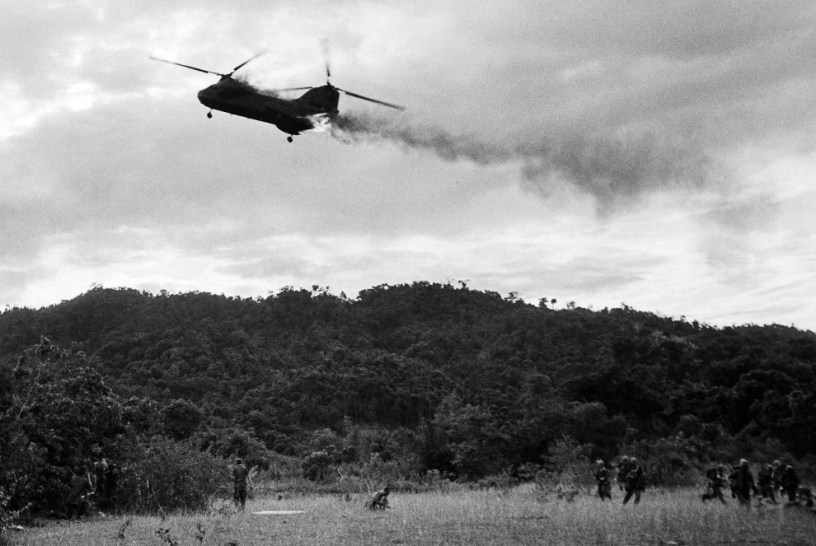
Photo above from 7/15/66 shows the crash that killed two men from the Fulton/Montgomery County area of upstate New York just west of Albany, SGT Robert R. Telfer (Fonda, NY) and CPL Orsen H. Case (Johnstown, NY). Thanks to Gus Kappler for the info.
One out of every ten Americans who served in Vietnam became a casualty. As a result, 58,169 were killed and 304,000 wounded out of 2.29 million who served. Although the percent of dead is similar to other wars, amputations or crippling wounds were 300% higher than in World War II. 75,000 Vietnam Veterans are severely disabled.
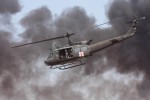 MEDEVAC helicopters flew nearly 500,000 missions, airlifting 900,000 patients (nearly one-half were Americans). The average lapse between being wounded and reaching a hospital was less than one hour, and as a result, less than one percent of those wounded died of their wounds within the first 24 hours.
The helicopter provided unprecedented mobility. Without helicopters, it would have taken three times as many troops to secure the 800 mile border with Cambodia and Laos (the politicians thought the Geneva Conventions of 1954 and the Geneva Accords of 1962 would secure the border).
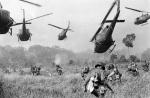 Army Huey’s totaled 9,713,762 flight hours in Vietnam between October 1966 and the end of American involvement in early 1973. Cobra helicopters totaled 1,110,716 flight hours in Vietnam. This is also the main reason that soldiers in Vietnam saw more action than those soldiers of preceding wars. Large groups of soldiers could be air-lifted into a battle and then be withdrawn after a few hours and flown to another area to reinforce other units or to engage the enemy again in a different portion of the country.
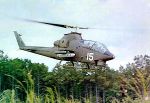 The chart below is not all inclusive but includes most of the helicopter units that served during the Vietnam War. Where it is known, I’ve indicated their unit name / call sign, and a sample of nose art or unit patch for those units. I did post another article on this website a while ago that includes hundreds of photos of nose art used by these crews in-county. I’ll leave a link at the end of this article in the event you want to check it out.
If I’ve erred on the chart below, please let me know so I can make corrections. Also, I invite you to get back to me on any missing units, call signs or duplicates. I am aware that many of the units mentioned herein had multiple call signs and nose art – I’m just limited to the available space I can’t show them all in this format..
| CIVILIAN HELICOPTER UNITS | |||
| UNIT | UNIT CALL SIGN | ||
| Air America | |||
| U.S. ARMY HELICOPTER UNITS | |||
|
Southern Cross | ||
| B Co. 123rd Avn. Bn. | Warlords  |
||
| D Troop 1/1 Cav. | Dragoons | ||
| First Cavalry Division | Armed Falcons | ||
| 1st Brigade – 1st Cav Div (Airmobile) | Flying Circus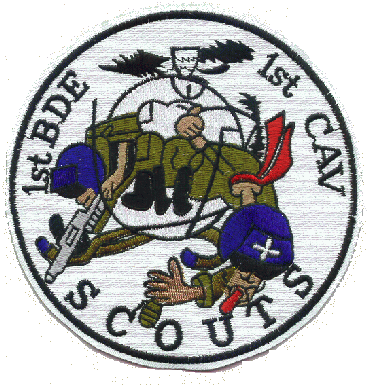 |
||
| 1st Aviation Detachment 1st CAV | Guns-A-Go-Go 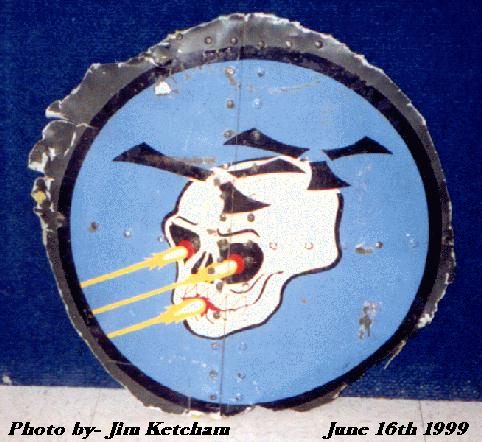 |
||
| First Infantry Division | Bulldogs, Rebel Guns, Longhorns, Danger Hawks | ||
| 1st Infantry Division 1/4th Cav | Quarter Cav | ||
| 1st Infantry Division A – C Troop 1/4th – Armored Cav Squadron / Troop | Quarterhorse, Darkhorse | ||
| 1st Infantry Division D Troop 16th Cav | Darkhorse, Mustangs  |
||
| Fourth Infantry Division Aviation – The Ivy Division | Blackjacks and Gamblers  |
||
| HHC 1st Brigade 5th Infantry Division Aviation Detachment | Batman  |
||
| 1st Squadron 9th Cavalry, 1st Air Cav Div | Bullwhip Squadron | ||
| A Troop 1/9th | Apache Troop & Headhunters | ||
| B Troop 1/9th | Bravo Troop | ||
| C Troop 1/9th | Charlie Troop | ||
| E Troop 1/9th | Echo Troop | ||
| F Troop 1/9th | F Troop 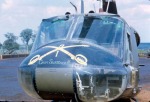 |
||
| Aviation Platoon Headquarters & Headquarters Company – 173d Airborne Brigade (Sep) | Casper  |
||
| Air Cav Troop 11th Armored Cavalry | Thunderhorse | ||
| A Troop 2/17th Cav | Assault 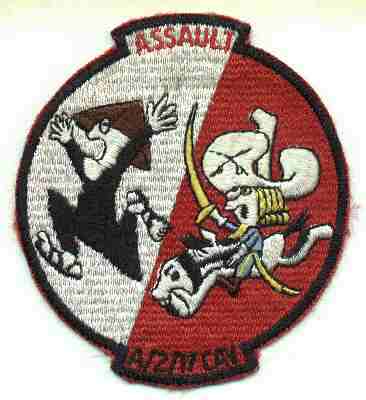 |
||
| B Troop 2/17th Air Cav. | Banshee  |
||
| C Troop 2/17th Air Cav | Condors 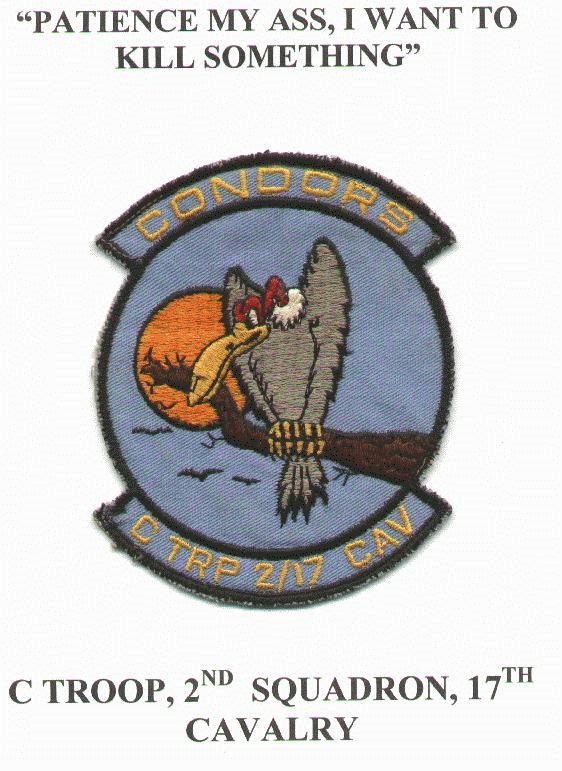 |
||
| 12th Combat Assault Group – A Troop 3/17th Cav | Silver Spurs  |
||
| 12th Combat Assault Group – B Troop 3/17th Cav | Blackjack, Stogie  |
||
| 12th Combat Assault Group – C Troop 3/17th Cav 12th Combat Assault Group – F Troop 3/17th Cav | Comancheros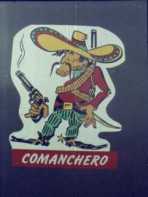 |
||
| 7th Squardron 17th Cav Regiment (Air). | Ruthless Riders | ||
| B Troop 7/17th Cav. | Scalphunters 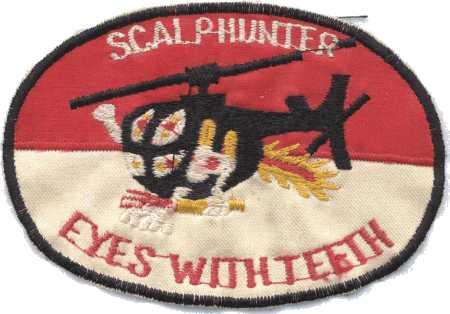 |
||
| 7th Armored Squadron 1st Cav | Blackhawks | ||
| HHC 3rd Brigade 25th Infantry | Aloha Airlines  |
||
| A Company 101st Aviation | Thunderbirds |
||
| B Company 101st Aviation | Kingsmen  |
||
| C Company 101st Aviation and 188th AHC | Black Widows and Spiders  |
||
| D Company 101st Aviation | Hawks  |
||
| B Company 123rd Aviation Battalion | Warlords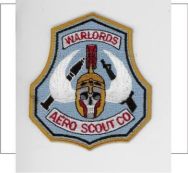 |
||
| A Company 158th Combat Aviation Battalion 101st Airborne Division | Ghost Riders  |
||
| B Company 158th Combat Aviation Battalion 101st Airborne Division | Lancers  |
||
| C Company 158th Combat Aviation Battalion 101st Airborne Division | Phoenix  |
||
| B Company 159th Combat Aviation Battalion 101st Airborne Division | Varsity 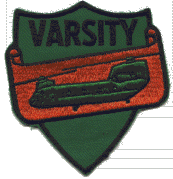 |
||
| A Company 227th Aviation 1st Cav Div | Chickenman 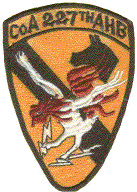 |
||
| B Company 227th Aviation 1st Cav Div | The Good Deal Company 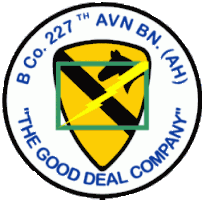 |
||
| C Company 227th AHB 1st Cav 1966-67 | Ghost Riders / Snakes  |
||
| D Company 227th AHB 1st Cav | El Lobo 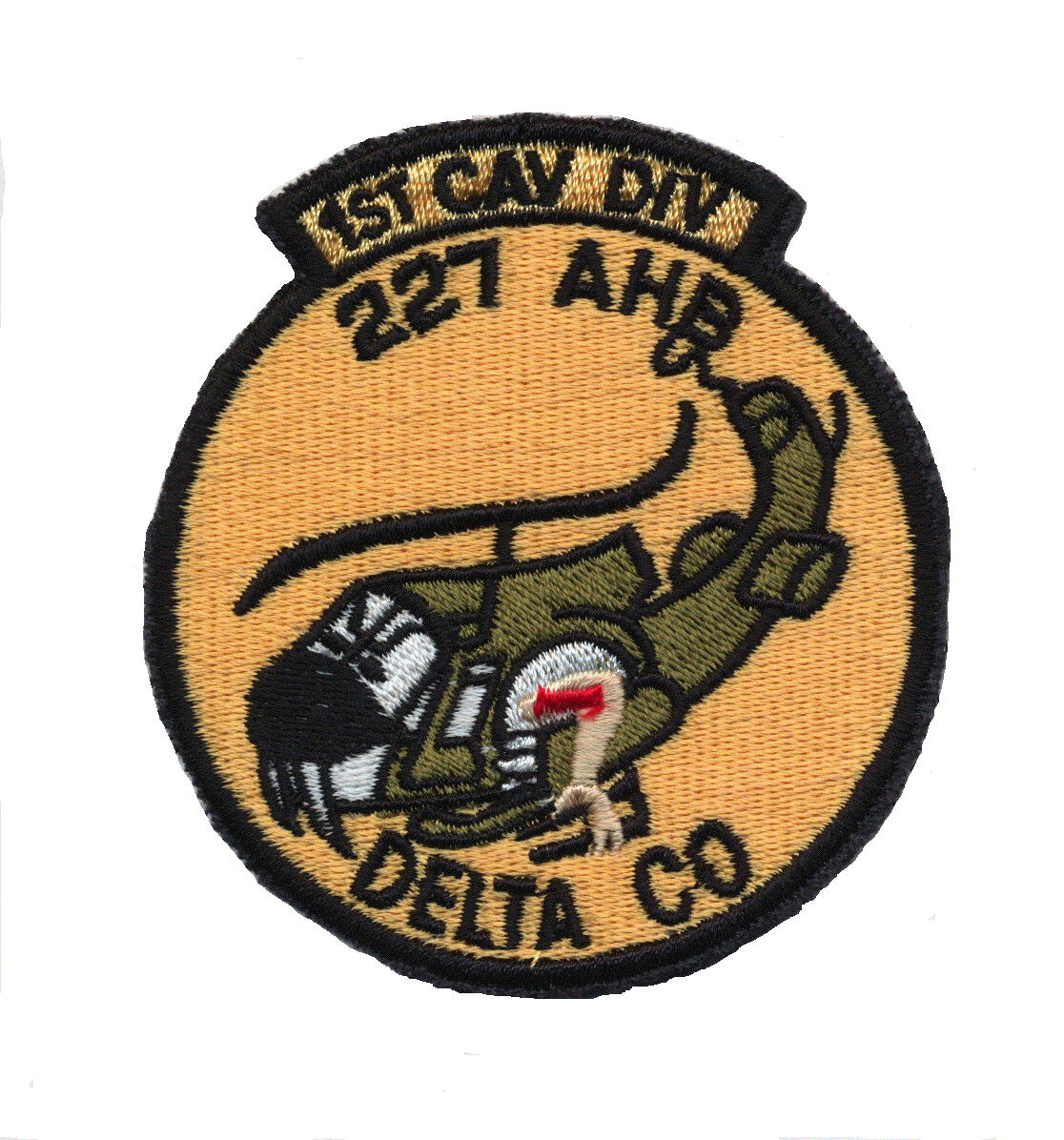 |
||
| 229th Assault Helicopter Battalion | Winged Assault 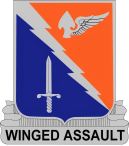  |
||
| A Company 229t AHC | Load Hackers | ||
| B Company 229th AHC | Killer Spades | ||
| D Company 229th Aviation 1st Cav Div | Smiling Tigers | ||
| D Troop 1st Squadron 10th Cav | Shamrock
|
||
| D Troop 1st Squadron 1st Air Cav 101st Airborne | Dragoons | ||
| D Troop (AIR) 1st Squadron 4th Cav 1st Infantry | Darkhorse | ||
| D Troop (AIR) 3rd Squadron 4th Cav 25th Inf Div and F Troop (AIR) 4th Cav | Centaurs 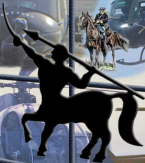 |
||
| D Troop 3/5th Cav | Spooks / Raven / Long Knives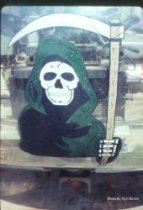 |
||
| E Troop 82nd Artillery 1st Cav Div | |||
| F Trp 8th Combat | Blueghost  |
||
| HHC 10th Combat Aviation Battalion | Vagabonds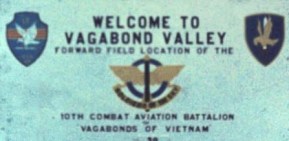 |
||
| A/377 ARTY 101 ABN | |||
| 2/20 ARA 1 CAV & F/79 CAV & 4/77 ARA & E82 (All ARA and AFA units) | Blue Max | ||
| 8th Transportation Company | |||
| 11th Armored Cav Regiment Aviation | |||
| 12th Combat Aviation Group | |||
| 14th Transportation Battalion (AM&S) (GS) | The Reliables  |
||
| 15th Medical Battalion | MEDEVAC | ||
| 17th Assault Helicopter Company (From Jerry F) | Kingsman & L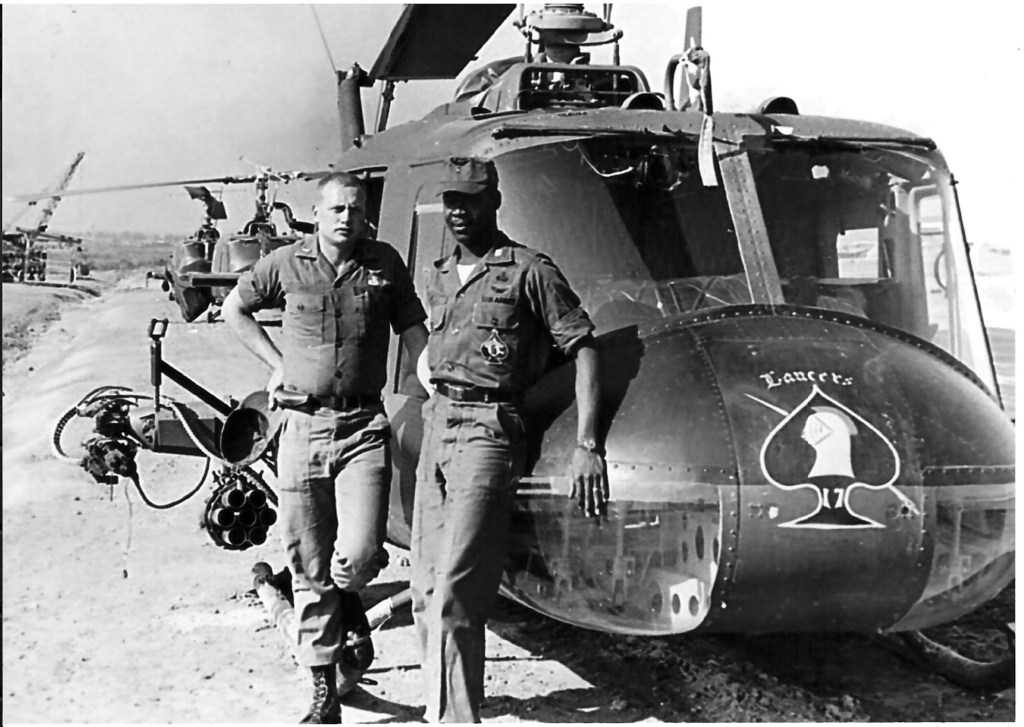 ancers ancers 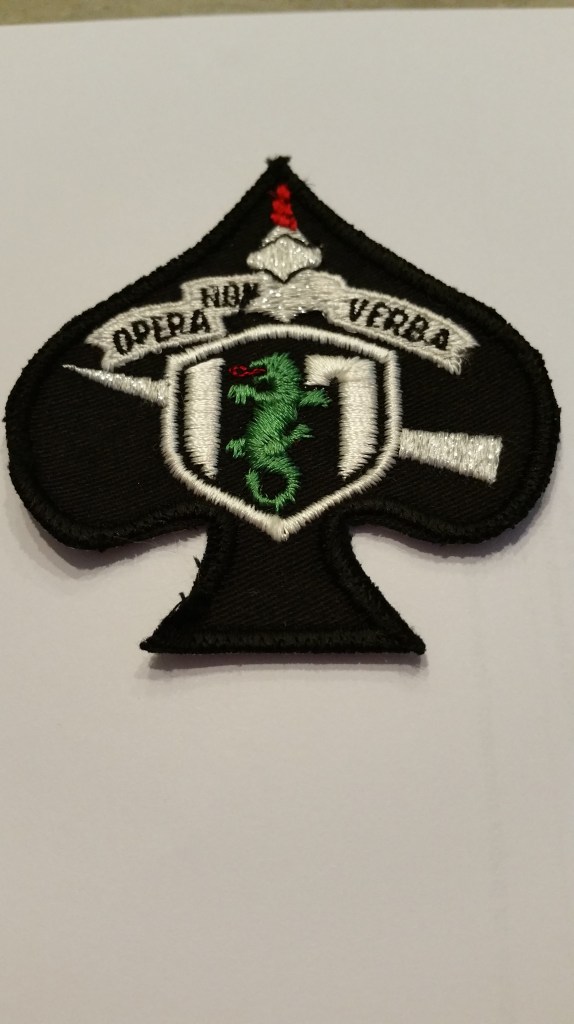 |
||
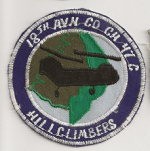
18th Corps Aviation Company (patches & info supplied by Lester Scates)By mid-1971 most all U.S. military combat forces (including aviation assets) either had or were in the process of departing Vietnam and were transferred their combat responsibilities and equipment to the ARVN forces. This was especially true in the Mekong Delta (IV Corps) where no U.S. ground forces remain. However, there still remained a requirement for ongoing non-combat aviation support to ARVN military units, regional/provincial militia (Ruff-Puffs), MACV advisers, VIP transportation and non-combat classified missions. On 1 June 1971 the 18 th Corps When aviation units deactivated, portions of their assets and personnel were transferred to the 18 th CAC. Since the CAC was still evolving, the first couple of months was organized chaos. When the dust settled, aviation wise, the CAC wound up with four flight platoons and one VIP flight detachment. There were 30 UH-1H Hueys divided into two flight platoons of 10 aircraft each, one VIP detachment of On 6 June 1972 there was a change-of-command. Major Jerry Childers became he new commander and remained until the unit stand-down on 13 March 1973. At 0800 hrs. 28 January 1973 the long-awaited cease fire became effective. Therefore, the war was officially over. However, someone forgot to tell our former enemies, the North Vietnamese Army (NVA) and the local Viet Cong (VC). The 18 th Corps Aviation Company was to be short-lived. On 27 February 1973 the 18 th CAC received orders to stand-down and prepare to transfer all assets to the |
Green Delta 18th CAC Aircraft Recovery Team 18th CAC Aircraft Recovery Team
CH-47 Hillclimbers
Green Delta Typical Flight Platoon
UH-1 Maintenance Platoon
UH-1 Flight VIP Platoon
|
||
| 25th Combat Assault Company | Red Carpet | ||
| 25th Aviation Battalion | Little Bears and Diamondheads  |
||
| 31st Transportation (CH-34) Company and 138th Transportation Detachment | |||
| 48th Assault Helicopter Company | Bluestars and Jokers 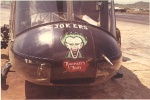 |
||
| 52nd and 119th Camp Holloway | Dragons | ||
| 52nd Combat Aviation +Battalion | Flying Dragons 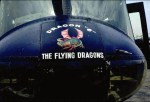 |
||
| 57th Assault Helicopter Company | Gladiators and Cougar  |
||
| 57th Medical Company | Dustoff | ||
| 59th Combat Assault Company | Red Cloud | ||
| 60th Assault Helicopter Company | Ghost Riders | ||
| 61st Assault Helicopter Company | Lucky Stars and Star Blazers  |
||
| 62nd Corps Aviation Company | Royal Coachman  |
||
| 62nd Assault Helicopter Company | Outlaws & Mavericks | ||
| 68th Assault Helicopter Company | Top Tigers, Mustangs & Raiders 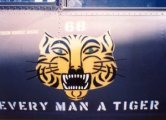 |
||
| 71st Assault Helicopter Company | Rattler and Firebirds  |
||
| 82nd Medical Detachment | DUSTOFF | ||
| 92nd Assault Helicopter Company | Stallions and Sidekicks 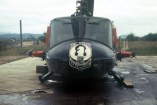 |
||
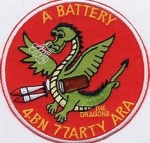
| 101st Airborne Division Association D Co, 158 Avn Bn (Cobras) Redskins A Co, 101st Avn Bn (Huey’s) Comancheros A Btry 377 Arty (Huey and LOH) Gunner A Btry 4/77 ARA (Cobras) Dragons B Btry 4/77 ARA (Cobras) Toros C Btry 4/77 ARA (Cobras) Griffins 326 Med Bn (Huey’s) Eagle Dustoff 1st Bde Hdqtrs (LOH and Huey) Deadbone 2nd Bde Hdqtrs (LOH and Huey) Brandy 3rd Bde Hdqtrs (LOH and Huey) Thunder 163 Avn Co. (LOH and Huey) Roadrunner A Co, 159th Avn Bn (Chinooks) Pachyderms C Co., 159th Avn Bn (Chinooks) Playtex 478 Avn Co (Cranes CH-54) Hurricanes |
    |
||
| 114th Assault Helicopter Company | Knights/Cobras 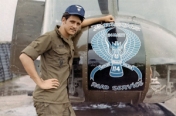 |
||
| 114th Aviation Company | Knights of the Air  |
||
| 116th Assault Helicopter Company | Stingers, Hornets, Yellow Jackets & Wasps 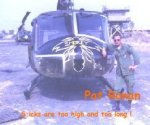 |
||
| 117th Assault Helicopter Company | Beach bums, Warlords, Annie Fannies, Pink Panthers & Sidewinders  |
||
| 118th Assault Helicopter Company | Thunderbirds and Bandits  |
||
| 119th Assault Helicopter Company | Gators and Crocs 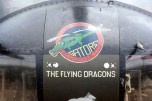 |
||
| 120th Aviation Company and Attached Units | Deans & Razorbacks 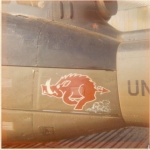 |
||
| 121st Assault Helicopter Company | Vikings and Tigers 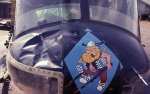 |
||
| 128th Assault Helicopter Company | Tomahawks, Gunslingers & Witch Doctor 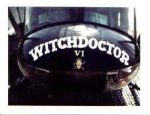 |
||
| 129th Assault Helicopter Company | Bulldogs and Cobras  |
||
| 132nd Assault Support Helicopter Company | Hercules  |
||
| 134th Assault Helicopter Company | Demons and Devils  |
||
| 135th Assault Helicopter Company | EMUs and Taipans | ||
| 145th Combat Aviation Battalion First in Vietnam | |||
| 147th Assault Support Helicopter Company | Hillclimbers  |
||
| 155th Assault Helicopter Company | Falcons & Stagecoach 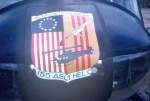 |
||
| 159th Assault Helicopter Company | Liftmasters Pelicans & Scorpions | ||
| 159th Medical Detachment (Helicopter ambulance) | Dustoff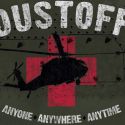 |
||
| 161st Assault Helicopter Company | Pelicans & Scorpions 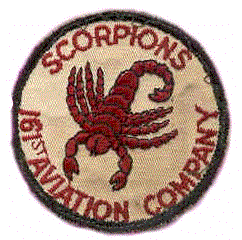 |
||
| 162nd Assault Helicopter Company | Copperheads & Vultures. 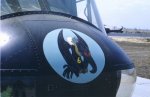 |
||
| 165-HMM (Helicopters, Marine Medium (Squadron)-165) | White Knights | ||
| 170th Assault Helicopter Company | Bikinis and Buccaneers 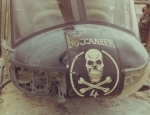 |
||
| 173rd Assault Helicopter Company | Robin Hoods and Crossbows | ||
| 174th Assault Helicopter Company | Dolphins and Sharks 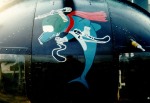 |
||
| 175th Aviation Company | Outlaws & Mavericks | ||
| 176th Assault Helicopter Company | Minuteman/Muskets 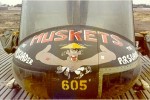 |
||
| 178th Air Support Helicopter Company | The Boxcars | ||
| 179th Air Support Helicopter Company | Shrimpboats & Hooks  |
||
| 180th Assault Support Helicopter Company | Big Windy 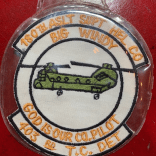 |
||
| 187th Assault Helicopter Company | Crusaders & Rat Pack  |
||
| 188th AHC and C/101 | Black Widows and Spiders 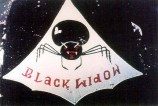 |
||
| 189th Assault Helicopter Company | Ghost Riders and Avengers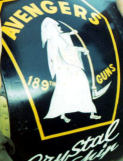 |
||
| 190th Assault Helicopter Company | Spartans and Gladiators 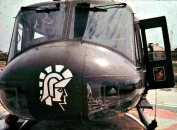 |
||
| 191st Assault Helicopter Company | Boomerangs and Bounty Hunters  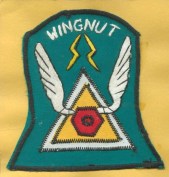  |
||
| 192nd Assault Helicopter Company | Polecats and Tigersharks  |
||
| 195th Assault Helicopter Company | Sky Chief, Ghost Riders, Sky Pilots and Thunder Chickens | ||
| 196th Assault Helicopter Company | Flippers & Chargers | ||
| 197th Assault Helicopter Company | Gangbusters & Playboys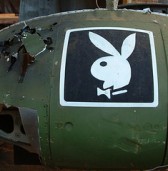 |
||
| 199th LIB Aviation Group | Fireball Aviation 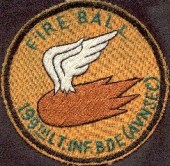 |
||
| 200th Assault Support Helicopter Company201st Aviation Company | PachydermsRed Barons | ||
| 203rd Air Support Helicopter | Wildcats | ||
| A Company 203rd ASH | Wildcats | ||
| B Company 203rd ASH | Longhorns | ||
| C Company 203rd ASH | What more can we do? | ||
| 205th Assault Helicopter Company | Geronimos 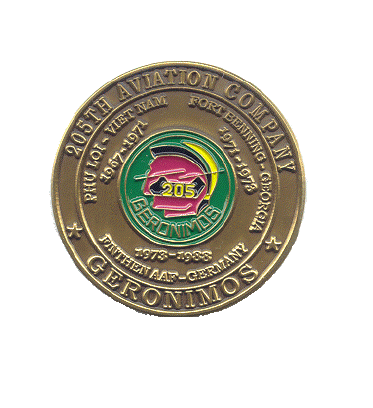 |
||
| 213th Assault Support Helicopter Company | Blackcats 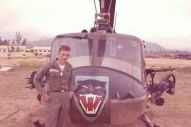 |
||
| 227th Assault Helicopter Battalion 1st CAV | Pouvoir 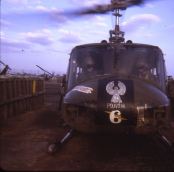 |
||
| 228th Assault Support Helicopter Battalion | Guns-A-Go-Go, Winged Warrior, Long Horns, Wildcats  |
||
| 235th Air Support Helicopter Company | Delta Devils | ||
| 237th Medical Detachment (Helicopter Ambulance) | Dustoff | ||
| 238th Aerial Weapons Company – | Gunrunners  |
||
| 240th Assault Support Helicopter Company | Greyhounds, Maddogs and Kennel Keepers  |
||
| 242nd Assault Support Helicopter Company | Muleskinners 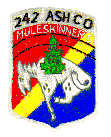 |
||
| 243rd Assault Support Helicopter Company | Freight Train  |
||
| 254th Medical Detachment (HA) DUSTOFF271st Assault Helicopter Company | “Helen Sue” Crew Chief Ronald Hannon “Donna Sue II” Crew Chief Ronald Hannon “Crystal Ship” Crew Chief Jerry Schneider (Capt. Crystal) “The Rebel” Crew Chief George Roberts “The Iron Butterfly” “Mother Goose” Crew Chief Ben Trickle “Proud Mary” “Ugly Duckling” 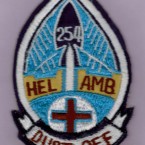 Innkeepers & Bartenders Innkeepers & Bartenders |
||
| 272nd Assault Support Helicopter Company | |||
| 273rd Heavy Helicopter | Super Hook | ||
| 281st Assault Helicopter Company | Intruders, Rat Pack, Bandits, Wolf Pack  |
||
| 282nd Assault Helicopter Company | Blackcat & Alleycats 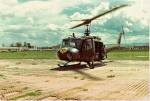 |
||
| 334th Aerial Weapons Company | Sabers, Playboys, Raiders & Dragons | ||
| 335th Assault Helicopter Company (A/82 in 1965) | Cowboys, Falcons and Caspers 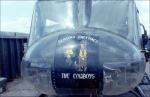 |
||
| 336th Assault Helicopter Company | Warriors and T-Birds  |
||
| 339th Transportation Company (DS) | Always in good hands |
||
| 355th Heavy Helicopter | Workhorse | ||
| 361st Aerial Weapons Company | Pink Panthers 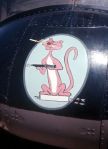 |
||
| 362nd Aviation Company – The Last Chinook Unit in Viet Nam | Fly United 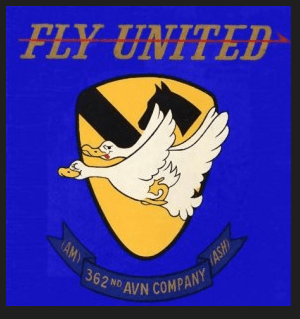 |
||
| 478 Heavy Helicopter | Hurricane | ||
| 498th Medical Company (Air Ambulance) | Dustoff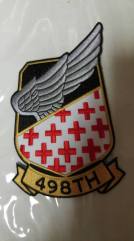 |
||
| 610th Transportation Company (AM) (GS) 1966-1972 | Fast and Sure  |
||
| A Company 501st Aviation Battalion | Rattlers & Firebirds | ||
 |
|||
| USMC VMO-3, HML-367, HMLA-367 | Deadlock, Hostage, Cowpoke & The Angry Two | ||
| USMC VMO-2 | Oakgate, Scarface, Eagle Claw, Cyclone  |
||
| USMC VMO-6 | Klondike | ||
| HMM-161 | |||
| HMM-163 | Evil Eyes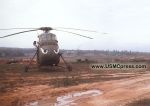 |
||
| HMM-164 | Yankee Tango | ||
| HMM-165 | White Knights | ||
| HMM-167 | Warriors | ||
| HMM-261 | Raging Bulls | ||
| HMM-262 | Old Tigers | ||
| HMM-263 | The Thunder Eagles | ||
| HMM-361 | Flying Tigers- | ||
| HMM-362 (first USMC helicopter unit in and out of Vietnam) | Ugly Angels  |
||
| HMM-363 | Lucky Red Lions | ||
| HMM-364 | The Purple Foxes | ||
| HMM-365 | The Magnificent Flying Circus. | ||
| HMA-369 | Pistol Pete | ||
| HMH-463 | Pennant Day, Dimmer, Pineapple | ||
| White Hat Airlines | Aircofat | ||
| U.S. NAVY HELICOPTER UNITS | |||
| HA(L)-3 | Seawolves 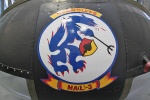 |
||
| Helicopter Combat Support Squadron Seven (HC-7) | Seadevils  |
||
| Helicopter Anti-Submarine Squadron 6 (HS-6) made WESTAC deployments in 1966 and 1967-8 on the carrier USS Kearsarge and provided Combat Search and Rescue in the Gulf of Tonkin prior to the establishment of Combat Support Squadron 7 (HC-7). | |||
| Combat SAR operations | |||
| U.S. AIR FORCE HELICOPTER UNITS | |||
Rotor heads  |
|||
| SOUTH VIETNAM HELICOPTER UNITS | |||
| VNAF (Viet Nam Air Force) was the air force of the Republic of South Vietnam. | |||




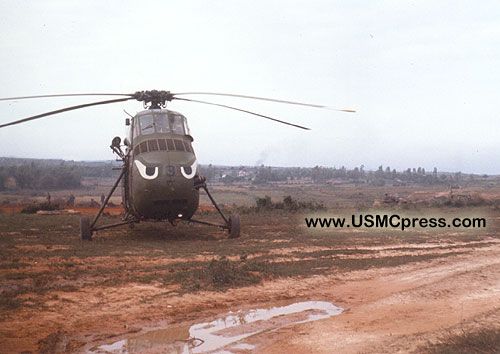
 Approximately 12,000 helicopters saw action in Vietnam (All services) and it’s estimated that 40,000 pilots served in the war. Those red figures in the chart below represent the combined total of all other helicopters / crews outside of the Huey category; I was unable to locate individual statistics for each line item for that group. The numbers in the destroyed column are actual numbers which are verified by tail numbers.
It should also be pointed out that 532 American passengers were killed in downed aircraft and are not included in any of the KIA totals.
| KIA | KIA | |||
| Model | # Served | # Destroyed | Pilots Lost | Crew Lost |
| All UH-1 Huey Slicks/guns | 7,013 | 3,305 | 1,074 | 1,103 |
| All AH-1G Cobras | ⇑ | 272 | ⇑ | ⇑ |
| CH-21C Banana | ⇑ | 18 | ⇑ | ⇑ |
| CH-3 Jolly Green’s | ⇑ | 14 | ⇑ | ⇑ |
| CH-46 / 47 Chinook | ⇑ | 284 | ⇑ | ⇑ |
| CH-53 Sea Stallions | ⇑ | 23 | ⇑ | ⇑ |
| CH-54 Flying Crane | 5000 | 9 | 1128 | 1601 |
| HH-37 Heavy lift transport | ⇓ | 2 | ⇓ | ⇓ |
| HH-3 Jolly Green Giant | ⇓ | 21 | ⇓ | ⇓ |
| HH-43 Huskie Rescue | ⇓ | 13 | ⇓ | ⇓ |
| HH-53 Super Jolly Green | ⇓ | 9 | ⇓ | ⇓ |
| OH-13/23 Light Observation | ⇓ | 240 | ⇓ | ⇓ |
| OH-6 LOH Scout | ⇓ | 842 | ⇓ | ⇓ |
| OH-58A Armed Scout | ⇓ | 45 | ⇓ | ⇓ |
| Misc Sioux / Sikorsky SH-3/34 | ⇓ | 14 | ⇓ | ⇓ |
| Totals | 12,013 | 5,111 | 2,202 | 2,704 |
It’s believed that the Huey and Cobra have more combat flight time than any other aircraft in the history of warfare assuming you count actual hostile fire exposure versus battle area exposure. As an example, heavy bombers during World War II most often flew missions lasting many hours with only 10 to 20 minutes of that time exposed to hostile fire. Helicopters in Vietnam were always exposed to hostile fire even in their base camps.
The following short video offers an animation presentation that shows crash sites during the war on a map of Southeast Asia. It’s interesting to note that only three major areas of the country show heavy concentrations in additions to the many locations in Cambodia and Laos.
The following article was published in the San Diego Union Tribune by John Wilkens on January 8, 2017 about the last pilots to die in Vietnam:
History remembers them as the last two American pilots to die in Vietnam, killed when their Marine Corps helicopter went into the South China Sea during the frantic evacuation of Saigon on April 29, 1975. Their bodies were never recovered
“I’ve thought about it every day for 41 years,” said Steve Wills, who was on the helicopter as crew chief and survived the crash. “I think it would be a healing thing for the whole nation.”
One of the aviators was Capt. William Nystul, who grew up in Coronado. The oldest of four sons, he graduated from Coronado High and San Diego State. He was 29 when he died, married with a young son. His co-pilot, 1st Lt. Michael Shea, from El Paso, Texas, was 25.
YT-14 was on search and rescue duty off the carrier Hancock that day, ready to swoop in if other helicopters crashed and the crews needed to be pulled from the water. It took off at 6 a.m. for what would turn out to be about 17 hours of flying, interrupted a half-dozen times to land on the carrier to refuel.
About 1 p.m., Nystul and Shea came on board to relieve the original pilots. Nystul, who had been teaching at a fixed-wing flight school in Pensacola, was sent back to Vietnam for his second tour after about 20 hours of re-training in the CH-46. Shea, a CH-53 pilot, had about 25 hours of training in the 46 before he was deployed.
Wills, the crew chief and right gunner, and Richard Scott, the mechanic and left gunner, were the other crew members. It was a busy day. They transported refugees from one ship to another. They rescued a Vietnamese man who crashed his small plane in the water.
“We were dodging aircraft left and right,” Wills said in a phone interview from his home in Kalispell, Mont. “The helicopter flew good that day.”
At about 11 p.m., YT-14 was running low on fuel and needed to land on the Hancock. But there wasn’t room. Nystul got waved off twice. Finally cleared to come in, he had to make a hard right turn away from the carrier to avoid being hit by a plane arriving from behind.
“Missed us by less than 100 feet,” Wills said.
He remembers the pilot telling the crew, “Somebody is going to die up here tonight.”
Into the water
Bruce Collison was a medic that night on board the Hancock. Now living in Sarasota, Fla., he recalls being on the flight deck, transfixed by the red, blinking anti-collision light of a helicopter overhead: YT-14.
“It continued circling the length of the ship, running out of fuel, looking for a place to land, losing altitude with every pass,” he said. “I’m convinced that if they had tried to land, with all the other helicopters there, some of them refueling, there would have been a total conflagration and a lot of people would have been killed. So they took it into the water instead.”
Others have surmised that the pilots got disoriented; it was a pitch-black night, no visible moon, impossible to see the horizon. The last thing Wills remembers hearing over his headset was a voice saying: “Pick it up! Pick it up! Pick it up!” Then darkness.
He regained consciousness underwater and made it to the surface. His left leg was fractured and his right hip dislocated. His helmet had been torn off. He fired two pen flares, then activated his rescue strobe. Scott was nearby and turned on his strobe, too.
On the Hancock, Collison remembers seeing the two strobes and thinking, “Great, there are survivors!” Then it dawned on him: “There should be four strobes.”
Another CH-46 lifted off the carrier, and to those on the flight deck, it looked as if it might disappear, too. Its landing lights went under water. Moments later, the engines roared and it lifted into the air and back toward the ship, carrying the engines roared and it lifted into the air and back toward the ship, carrying the two survivors.
The next day, on board the Hancock, they held a traditional burial at sea for the pilots. There were no bodies, so they put mock corpses under the American flags, and slid those into the ocean.
“We were numb like zombies,” Collison said. “We’d spent all day saving people and then we lost two Marines. Nobody wanted to be the last guy to die in Vietnam, and then it happened to two guys that we knew. The whole thing felt surreal.”
It’s part of military lore that no man is left behind, but the evacuation task force had orders to move on. Saigon had fallen to the Viet Cong.
A sobering video showing the aftereffects of helicopter crashes…many after the recovery:
<iframe src=”https://www.facebook.com/plugins/video.php?href=https%3A%2F%2Fwww.facebook.com%2Fproud.us.veteransss123%2Fvideos%2F387690968724384%2F&show_text=0&width=560″ width=”560″ height=”315″ style=”border:none;overflow:hidden” scrolling=”no” frameborder=”0″ allowTransparency=”true” allowFullScreen=”true”>
Click on this link to read the entire story written above: http://www.sandiegouniontribune.com/military/sdut-vietnam-helicopter-crash-2016may28-story.html
Link for nose art: http://wp.me/pRiEw-1P4
Information for this article was obtained from Wikipedia, The Military Channel, The History Channel, https://www.archives.gov/research/military/vietnam-war/casualty, and Vietnam Helicopter Pilots Association. (Visit the VHPA museum in the near future at http://www.vhpa.org )
I want to personally thank the 40,000 pilots and crews for being there when called. You are all held in the highest regard by us grunts and others who were in harm’s way. Thank you for your service and Welcome Back to those who made it home. Side note: Every time a Chinook or Blackhawk passes overhead from nearby Selfridge National Guard Base, I still find myself looking into the sky and watching it cross over until it’s gone…and then sometime when I’m outside, I hold my cane in both hands overhead in tribute to those magnificent men in their flying machines – and was then thankful that they didn’t land in my backyard.
Thank you for taking the time to read this. Should you have a question or comment about this article, then scroll down to the comment section below to leave your response.
If you want to learn more about the Vietnam War and its Warriors, then subscribe to this blog and get notified by email or your feed reader every time a new story, picture, video or changes occur on this website – the button is located at the top right of this page.
I’ve also created a poll to help identify my website audience – before leaving, can you please click HERE and choose the one item best describing you. Thank you in advance!

 CherriesWriter - Vietnam War website
Where the Hell Is the U.T.T.—-1963 ????
LikeLike
C/229th 1st Cav. North Flaag
LikeLike
HMM-164 was first ’46 sqd in RVN in 1966. Unit went over on helicopter carrier from Long Beach, CA.
LikeLike
I like it, trying to find some information on my brother who served in vietnam during the late sixties. His name is Ronald Carter from Columbus, Ohio, he was in the 135th AVN Co, F Troop. (statehosp@aol.com)
LikeLiked by 1 person
Try searching Facebook groups to see if one is available for your brother’s unit. Somebody there may have known him.
LikeLike
D Troop (Air), 1/10 Cavalry was the air cav troop organic to the 4 ID and not an independent unit.
LikeLike
Recalled some bad and good memories.
LikeLike
Why is the 224th Avn Bn, or any of the five company not listed. I was with the 156 Avn (RR) and the Bn Hqs 67-68 time frame. Any one serving with any of those units, give me a shout.
JB Polson
LikeLike
JB, if you have a copy of the patch for the unit(s), please ID them and respond to my email john.podlaski@gmail.com
and I’ll add them to the post. Thanks!
LikeLike
hi there.
Can anyone tell me anybody else who worked with my father john bertrand 273 aviation company he was there from 1970 -1971 I a m trying to jog his memory and im sure he’d like me to know a few names out there
if anyone remembers him or what the company did please can you email me
battyflower@gmail.com
LikeLike
The 273rd was a heavy lift helicopter co. Ch54 Skycranes! We flew Support for any one that wanted heavy stuff moved 20000 Lbs. 10 Tons! We moved a lot of Artillery. I shared a Hooch with John for awhile. John worked in the Motor Pool And the hanger at Air field. Long Binh. I was a helicopter Mechanic Also Spared as a crew chief. Flew on Ch54’s. hope this helps you with john. any questions just ask. Regards Wayne Shirshac Super Hook 419
LikeLike
t@Wayne .thank you for your time to get back to me what you wrote was very interesting .I was wondering if you could email me battyflower@gmail.com
LikeLike
You left out the 571st Medical Detachment (DustOff). We flew out of Danang and Hue. I left with the last of the unit out of Vietnam 28 Feb. 1973.
LikeLike
Great article! The 213 AVN Co Black Cats a CH-47 Unit at Phu Loi. In 72 stood down part went to 120 AVN Co The Deans a Combine unit of different ACFT.
LikeLike
Great. I was in 227th AHB. I read somewhere It had the most losses or casualties of the war in Nam. I can’t find any info on that. Can you help? alawa2@att.net
LikeLike
I was a member of the 45th Medical Company Air Ambulance which was part of the 44th Medical Brigade. I don’t see either the 45th Med Co or 44th Med Bde listed regarding units and losses.
LikeLike
Thanks to all who served and your historical work. Do you have any info. on the history of the 17th AHC stationed at Camp Eagle? My brother served in that unit 1967-69. Thanks, James Pullen
LikeLike
I don’t, but you may want to visit this FB group page: (12) 17th Airborne Division Family and Friends | Facebook https://www.facebook.com/groups/145058802186754
LikeLike
Assault Helicopter Companies? Before there was Cav units, we were there. 173rd AHC Robin Hood’s/Crossbows set more lift records than had ever been. We more or less invented Combat Helicopter use for both slicks and guns. We performed more Med-evacuation in III Corps area in ‘66, ‘67, and ‘68 than the Med-boys did, simply because we were in the field and Med-Eva a were usually 30+ minutes away. ( no offense to those ballsey guys) it was simple logistics and focused answer to need.
During ‘68 Tet, Crossbows flew an average of 13 hours a day for 32 days straight, on call 24-7. Ask me how I know. Our Robinhood slicks set new records for moving troops in and out of tight spots, rescuing wounded from “hover-holes” in teakwood forests. Ask me how I know. An estimated 200,000 NVA were moved into III ant this time and we led the way, beating s___ out of them.
No faulting the Cav guys, wish we’d had “Blue Boys” when we got shot down, but the word in the field from 1st Infantry Boots, was, if you want things done right in the field, call the Robin Hood’s!
And in your generally historical account, we don’t even rate a unit patch?
Jim Visel CE
Robin Hood/ Crossbow
‘66,’67, ‘68.
Shot down 5 times, wounded twice.
LikeLike
You’re missing 571st Med Det. Dustoff.
LikeLike
I put in a lot of North Flag CAs as the brigade C&C bird. You are right a fine unit…
LikeLike
Please add C/229th AHB 1st Air Cav. Many fine men survived in the unit over the course of the Viet Nam war
LikeLike
ANYONE KNOW ANY THING ABOUT F TROOP 1/4 CAV AVIATION UNIT IN DANANG AIR BASE 72′- 73 CAMP SWAMPY.
LikeLike
Why there’s not much about Darkhorse c/16 co.?Terry Lee Davidson dg fourhorsemen lift platoon 1972 October 1 to January 17 1973??
LikeLike
Great site, excellent research.
Not sure if you’re still working this, but fwiw… I was in both 201st in 1980s and 377th Med Evac Co , you nailed the 201st callsign “Red Barons,” still used it in the 80s…. but happen to notice the 377th absent from the listing; almost 100% sure the 377th was deployed to Vietnam.
Kudos on a great site and thanks for all the hard work!
LikeLiked by 1 person
I served as Crew chief for Major General George W Putnam jr. First Cavalry Battalion Commander. We had 8 helicopters and 16 crew members. I flew over 600 hours of CA time on 153 missions. Our specialty was inserting LRRPS. We were HHT 1/9. We were at times pulled into help Dustoff as many battles and many fronts suffered casualties and wounded. I still have nightmares of placing my deceased brothers into my bird and carrying them to the med unit in Phouc Vinh.
It would be nice to be listed amongst the troops of helicopter units. SGT Gagnon 1/9 HHT Flight Platoon leader.
LikeLike
George Gagnon, I’d be glad to add the unit to the list, but don’t have a clue where to do so. Help me out and I’ll get it posted.
LikeLike
Great article. For pictures of the 1st Bde, 5th Inf Div (Batman) logo, please go to our Facebook link https://www.facebook.com/groups/211983242724999/
LikeLike
Do you know anyone who served with the A Company of 158th AHB during 69-72? I have a pilot who has cancer with a VA claim.
LikeLike
Sorry, I do not. I was stationedat Quang Tri, with 1/5 Inf Bde Avn Section from June 1970 thru April 1971. During Lam Som 719 I was at the Red Devil Forward location working in the TOC Bde Avn Sec. My contact to other Avn units was next to nil.
LikeLike
AMERICAL DIVISION Southern Cross Hq. Hq. Co. 123rd Aviation Battalion, 23rd Inf. Div. (Griffin). If you wish I can send you a photo of our unit patch.
BTW Loved the article.
LikeLike
Great Job Posting all these Units
LikeLike
From my August 20, 2017 comment: “I served as a trauma surgeon at the 85th Evac in Phu Bai.
We rededicated (originally dedicated in 1984) our local Vietnam Veterans Memorial to the 37 KIAs from our tri-county area in upstate NY in Sept. 2016. Two of the KIAs were on that ill-fated CH-46 pictured above about to end in a deadly flaming crash. It was Helicopter Alley, Quang Ngai Provence, 7/15/66.
Crew Chief Sgt. Robert R. Telfer, USMC, Fonda, NY
Cpl. Orson H. Case. USMC, Johnstown, NY”
For this and every Memorial Day: Thirty-seven young men (primarily kids) were killed in the Vietnam War from Fulton, Montgomery, and Hamilton Counties in Upstate New York. In 1984 the Vietnam Veterans of America Chapter 91, lead by Greg Fassett, Gary Stoller, and Gus Kappler, solicited funds to erect and dedicate a memorial to these KIAs. Fulton Montgomery Community College granted permission to locate it on their campus. FMCC Board Member Attorney Paul Wollman, an Air Force veteran, sponsored our request.
The Memorial is located next to the 911 Memorial. Our Vietnam Memorial was rededicated in September 2016 when the “Traveling Wall” visited FMCC, and the 911 Memorial was dedicated. The daughters of Sergeant Telfer (KIA), Nancy, Joy, Dawn, and Bobbi, worked with Gary Stoller, Gus Kappler, and FMCC representatives to bring the event to fruition.
Please watch: https://youtu.be/_4pBmqQ5VKw
Visit: http://www.guskappler.com
LikeLiked by 1 person
Gus: Were you at the 85th in early Oct of 68? I passed through there about that time and wonder if you worked on me. It’s a long time ago but was wondering.
LikeLike
That was before I was there. Glad you made it home
LikeLike