
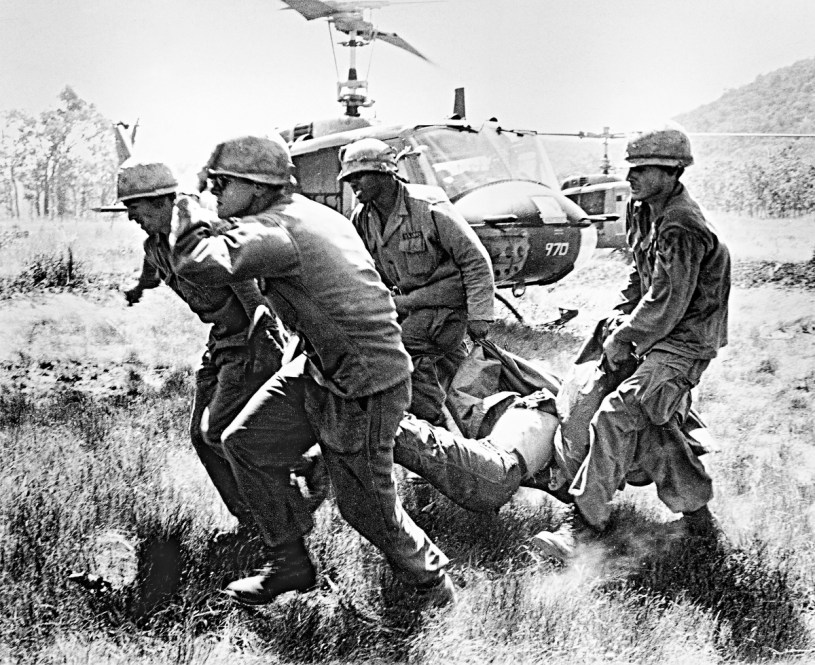
Moore’s mission was to find the enemy and strike them first. His troops ended up fighting for their survival against a numerically superior force. Two MIAs remain from that battle.

discharging a load of infantrymen on a search and destroy mission.
On November 14, 1965, the 1st Battalion (Bn), 7th Cavalry Regiment (Regt), 1st Air Cavalry (Cav) Division (Div) was sent on a search and destroy mission deep into the jungles of a plateau in the Central Highlands in the Ia Drang River Valley, thirty-seven miles west of Pleiku in the Gia Lai Province, Republic of (South) Vietnam (RVN). There they met the 32nd, 33rd, and 66th Regts of the People’s Army of Vietnam (PAVN). The U.S. had fought against local Vietnamese Communist (Viet Cong) forces in small skirmishes since the withdrawal of the French in 1954; however, the Ia Drang Valley marked the first time U.S. forces faced off against trained North Vietnamese regulars in the battle that has become synonymous with the beginning of full scale U.S. involvement in the RVN. While the Battle of Ia Drang constitutes roughly a month-long period, the two major battles occurred at Landing Zones (LZ) X-Ray and Albany.
In mid-October, the month prior, 32nd Regt had surrounded and attacked the American Special Forces camp at Plei Me, seventeen miles to the east. Using an old ploy, the 32nd Regt stopped short of destroying the camp in the hopes of drawing Army of the Republic of Vietnam (ARVN) troops into an ambush set by the 33rd PAVN Regt. At the behest of ARVN forces, the U.S. joined the fight and severely crippled the 33rd PAVN Regt. Remaining members of both PAVN regiments retreated westward into the Ia Drang Valley, which bordered Cambodia along the Ho Chi Minh Trail. The U.S. Military decided to send the 7th Regt of the 1st Cav Div, led by LTC Harold G. Moore, to investigate the Ia Drang Valley. Up to that point, contact with the enemy had been limited. When Moore touched down with the men in the first wave of sixteen helicopters at LZ X-Ray near the base of the Chu Pong Massif, he found no enemy. Moore remained cautious. With only 90 men on the ground and the next ninety at least an hour away (34 miles to Plei Me and back), he was operating lightly in a region largely unexplored and that American Intelligence had suggested could be filled with a regiment of enemy forces. During the first hour, Moore’s men captured an enemy private; a boy. He informed Moore that there were two PAVN regiments on the mountain next to them that “wanted very much to kill Americans but have not been able to find any.” There were, in fact, three. At that point Moore knew he would be fighting a battle for survival rather than mounting a first strike. His premonitions were confirmed when roughly 90 minutes after landing, his forces met with enemy fire. The battle at LZ X-Ray would last for three days and two nights as members of Moore’s 1st Bn, and later 2nd Bn replacement, fought for survival against a numerically superior force

1st Cavalry Division – Ia Drang Valley, Republic of (South) Vietnam, November 16, 1965.
On the morning of the seventeenth, the 2nd Bn, 5th Cav (2-5), the 2nd Bn, 7th Cav (2-7), and one company of 1st Bn, 5th Cav (1-5) would march out of LZ X-Ray. Shortly thereafter, the 2-7 and 1-5 broke off toward LZ Albany. At one point, strung out over a narrow road, these battalions halted to question two prisoners who had been captured. Unbeknownst to them, the enemy commander, Lt. Col. Nguyen Hu An’s 66th PAVN Regt was resting adjacent to U.S. forces under the cover of the jungle. As the battle-weary Americans rested, the PAVN Regt attacked with mortar and sniper fire. Over the next six hours, a bitter fight claimed the lives of 155 American men and 120 wounded. Unfortunately, some of these casualties were friendly fire incidents, as the fighting devolved to a situation where artillery and napalm airstrikes were called in to alleviate the pressure from PAVN forces
At the battles at LZ X-Ray and LZ Albany, 234 men were killed and more than 250 were wounded in a period of four days. In the 43-day Ia Drang campaign, 545 Americans were killed. Enemy deaths have been estimated at 3,561. It was the greatest loss of American life in the Vietnam War at that point, and a premonition of how determined the enemy was. The DPAA and its predecessor organizations have completed 130 Joint Field Activities in Socialist Republic of Vietnam (S.R.V.) to recover the remaining 1,251 personnel still missing there. Those activities involve excavations, conducting oral interviews with Vietnamese veterans and villagers, and work with the Ministry of National Defense archives to locate information pertaining to the still unaccounted-for Americans. In FY2018, the DPAA’s 2nd Joint Field Activity will range from the Gia Lai Province, where the Ia Drang Valley is located, to the southernmost province of Cau Mau.
Two U.S. service members remain unaccounted-for from the Battle of Ia Drang:
• Specialist 4 Jerry Allen Hiemer, U.S. Army, was lost on November 14, 1965, when his unit was ambushed near LZ ALBANY
• Captain Paul Truman McClellan Jr., U.S. Air Force, was lost on November 14, 1965, when his A-1 Skyraider was shot down
This article originally appeared in the Defense POW/MIA Accounting Agency:
https://dpaa-mil.sites.crmforce.mil/dpaaFamWebInIaDrang
To read more about these battles on my website, click on the magnifying glass on the top right of this page and type IA DRANG or ALBANY then <enter>. A drop-down menu will list all the available articles. After reading an article, use the back arrow on the top left of the page to return to the search results.
*****
Thank you for taking the time to read this. Should you have a question or comment about this article, then scroll down to the comment section below to leave your response.
If you want to learn more about the Vietnam War and its Warriors, then subscribe to this blog and get notified by email or your feed reader every time a new story, picture, video and changes occur on this website – the button is located at the top right of this page.
I’ve also created a poll to help identify my website audience – before leaving, can you please click HERE and choose the one item that best describes you. Thank you in advance!

 CherriesWriter - Vietnam War website
10 minutes before lift off for LZ X-Ray Hal G. Moore was told there were 1,500 enemy troops near LZ X-Ray.
Hal G. Moore told no one not even Bruce Crandall the commander of the lift Huey’s the one who helped Hal G. Moore with the assault plans!!
Quote Hal G. MOORE: “OK. About 10 minutes before we took off for (LZ X-Ray) the Ia Drang Valley in the initial assault, I received information that there were three battalions of enemy – and a battalion of North Vietnamese is around 500 men – that there were three battalions of the enemy within two miles of our landing zone.”
And so I sifted this through my head and immediately realized that we could be into a fight almost immediately upon landing and which, indeed, we were!!
Hal G. Moore that fact didn’t really bother me.
that fact 10 minutes before lift off for LZ X-Ray Hal G. Moore was told there were 1,500 enemy troops near LZ X-Ray.
after landing cleared the LZ than sat down and ate lunch!!! over an hour the ate lunch
the reaction force of 1/7 was told to finish eating, and to let the one’s in contact handle the situation.
FICTION: Fabrication applies particularly to a false but carefully invented statement or a series of statements, in which some truth is sometimes interwoven, the whole usually intended to deceive
And so you have Ramon A Nadal A company commander following that code of code of silence.
Ramon A Nadal but there are some discrepancies.”
“The article about LZ Xray and subsequent events is ” generally correct, but there are some discrepancies.”
and I’m not going to tell you what is wrong.
https://www.waaytv.com/news/ia-drang/follow-me-retired-col-ramon-tony-nadal-shares-his-memories-from-the-battlefield/article_0ed990f8-e9e2-11ed-ac69-3362e68d1fb7.html
Individual soldier rotation in combat is a recipe for disaster and lousy units.
The results, though, turned out to be pretty disappointing: in 1996 Specialist 4 Bill Beck and Specialist 4 Russell E. Adams (Platoon 3, Company A, 1/7 Battalion) were awarded the Bronze Star with Valor!
The Vietnamese officer gasp and turned pale: to Bill Beck “You and your machine gun killed my battalion! 400 men.
From page 50 of WE ARE SOLDIERS STILL by Hal G. Moore and Joe Lee Galloway, a book that is fiction
Vietnam LZ X-Ray Nov 14-16 1965
634 enemy troops kia
Machine Gunner Bill Beck alone killed 400 enemy troops.
From page 50 of WE ARE SOLDIERS STILL
The Vietnamese officer gasp and turned pale: to Bill Beck “You and
your machine gun killed my battalion!
400 men.
B co from the 2/7 killed 200 enemy troops.
The rest of the 1/7 killed 34 enemy troops!!?
page 199 of We Were Soldiers One and Young
Hal G. Moore 834 enemy dead by body count, 1,215 estimated killed and wounded.
Hal G. Moore on my own I cut the 834 back to 634 enemy dead, and let the 1,215 estimated killed and wounded stand.
Hal G. Moore took his M-16 pencil with him to Vietnam 1965-66, and let the 1,215 estimated killed and wounded stand.
LikeLike