

Having big balls usually refers to a person who exhibits exceptional bravery, no matter the consequences. The Vietnam War POWs were all heroes. Some had bigger balls than others. Here are some examples:
John A. Lucas
Last Saturday, I posted ‘Sappers in the Wire,’ which tells a story about veterans among us. It focused on actions over 56 years ago by a relatively small group of men now in their 70s and 80s. My thesis was that there are many veterans among us whose very interesting and sometimes heroic stories are unknown to most of us and will remain that way, unless their stories are told. Today, I want to share the story of some other veterans who were better known in their youth, but whose stories, spanning 55+ years, are largely unknown to many (if not most) people today. These veterans, some of whom are now deceased, must be remembered and honored this Veterans’ Day.
In recent months, you have heard of a young DOGE staffer nicknamed “Big Balls.” I don’t know the exact origin of his name, but he recently lived up to his moniker when he suffered a concussion and broken nose when he was attacked while attempting to protect a young woman from a gang of DC thugs. But what you may not know is the story of the “Original Big Balls.” The stories of he and some of his companions are told below.
A few weeks ago, I met the Original Big Balls, also known in polite circles as Paul Galanti (a former Vietnam War POW), when we both attended an event featuring an invited speaker who made a presentation on the Battle of Leyte and Leyte Gulf. I knew that he was a Naval Academy graduate, so I decided to say hello.
The lady with him was anxious to get him situated in an adjacent room, where we would be listening to the speaker. But I convinced him to delay for a couple of minutes, based on my promise to give him the “experience of his lifetime.” When he looked at me quizzically, I explained that I was giving him the chance to have his picture taken with a West Point graduate. Of course, he immediately agreed to my terms, and we had a pleasant, if spirited, conversation.
Here he is (on the right!):
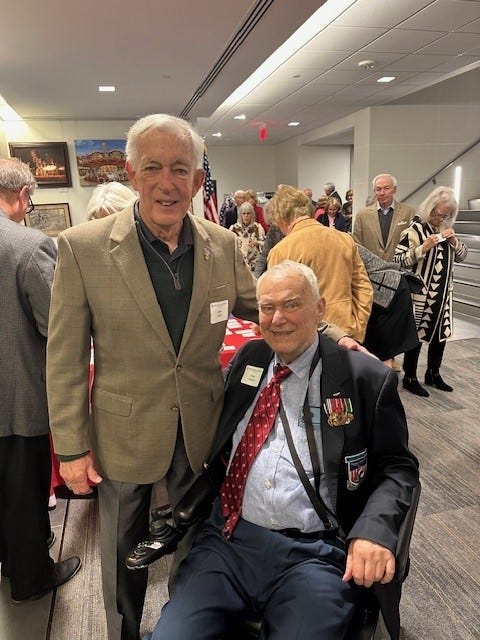
Now, if you met Paul when he was not wearing the medals on his lapel, you might think, “Just another old guy in a wheelchair.” Right? WRONG! Later in this article, we will take a look at him in his younger days. And even that short look will explain why I refer to him as the “Original Big Balls.”
But first, here is the story of his and some of his compatriots’ sheer courage and devotion to duty and comrades.
Hỏa Lò prison in Hanoi — nicknamed the “Hanoi Hilton” by U.S. airmen held there — became notorious during the Vietnam War as a site where captured American aircrews and other prisoners of war were interrogated, beaten, and tortured. The brutality was part of a systematic program of coercive interrogation that included prolonged isolation, bone-breaking beatings, forced stress-positions for prolonged periods of time, prolonged solitary confinement while shackled in irons 24 hours a day, mock executions, electric shocks, denials of medical care for untreated wounds or fractures, and extreme malnutrition and even starvation, and, perhaps most notoriously, a brutal torture method referred to by prisoners as “the ropes.” Some were even literally tortured to death.
These tortures were sometimes employed for punishment and other times to coerce “confessions” and forced participation in propaganda sessions.
The “Vietnamese rope trick”
“The ropes” or the “Vietnamese rope trick” was one of the tortures most feared by the POWs. Multiple POW memoirs and U.S. Navy histories describe it:
The prisoner’s hands would be handcuffed or bound behind his back; sometimes legs were also bound. A rope would be tied to the prisoner’s wrists or cuffs and threaded over or around a pole, bar, or other leverage point. Interrogators pulled the rope and used the pole to rotate and stretch the prisoner’s arms upward toward the back of his head, forcing his shoulders and elbows into extreme extension and rotation. Prisoners have described how their arms were rotated under stress until they were over their heads. Often, their shoulder joints popped out while the stretching continued, resulting in excruciating pain. Often, men were tied and left in these unbearably painful positions for hours on end. The stretched and torn tendons, ligaments, and muscles typically cause long-term and permanent damage to the shoulder. While they were screaming in pain, prisoners could also be beaten with clubs or whips.
The physiological result of this treatment — extreme shoulder and elbow strain, dislocation of joints, torn ligaments, and intense nerve pain — made the ropes both physically debilitating and psychologically devastating. John McCain and other high-profile POWs described being subjected to rope treatments as part of repeated interrogations and beatings; McCain reported his ribs broken and his arms tied and tightened behind his back until the pain was unbearable.
POW resistance
Despite the ever-present risk of being tortured, the prisoners resorted to a variety of stratagems to resist the North Vietnamese interrogators and propagandists. They engaged in forbidden communications by using a tap code on their cell walls. Their senior ranking officer, then-Captain James Stockdale knew that everyone would eventually break under the torture, so he modified the strict military Code of Conduct (name, rank, and serial number) and instructed the prisoners to resist making propaganda statements or appearances for as long as they could hold out under torture, but they had permission to give in after undergoing extreme torture. Even then, they made forced “confessions” that would obviously be recognized by Westerners as bogus. That conduct regime actually buoyed their spirits and reinforced the sense of discipline that they needed to survive their ordeals.
Doug Hegdahl, a young seaman who had been captured after falling off his ship in the South China Sea, played the role of “The Stupid One.” His interrogators finally gave up in frustration because he clearly was too stupid to be of any propaganda value. I tell his story in “The Incredibly Stupid One — An American Hero,” including how he followed an order to accept early release because he had valuable information that the senior POW commanders wanted to get to the U.S. military. Read his story here to see what he accomplished.
Others gave performances in their forced appearances that showed the world that their appearances and “confessions” were a sham induced by torture. The first public exposure of torture was publicly confirmed early on by Navy Commander Jeremiah Denton’s coerced television appearance. Commander Denton conveyed his message by a series of long and short blinks of his eyes, in which he spelled out “T-O-R-T-U-R-E” in Morse code.
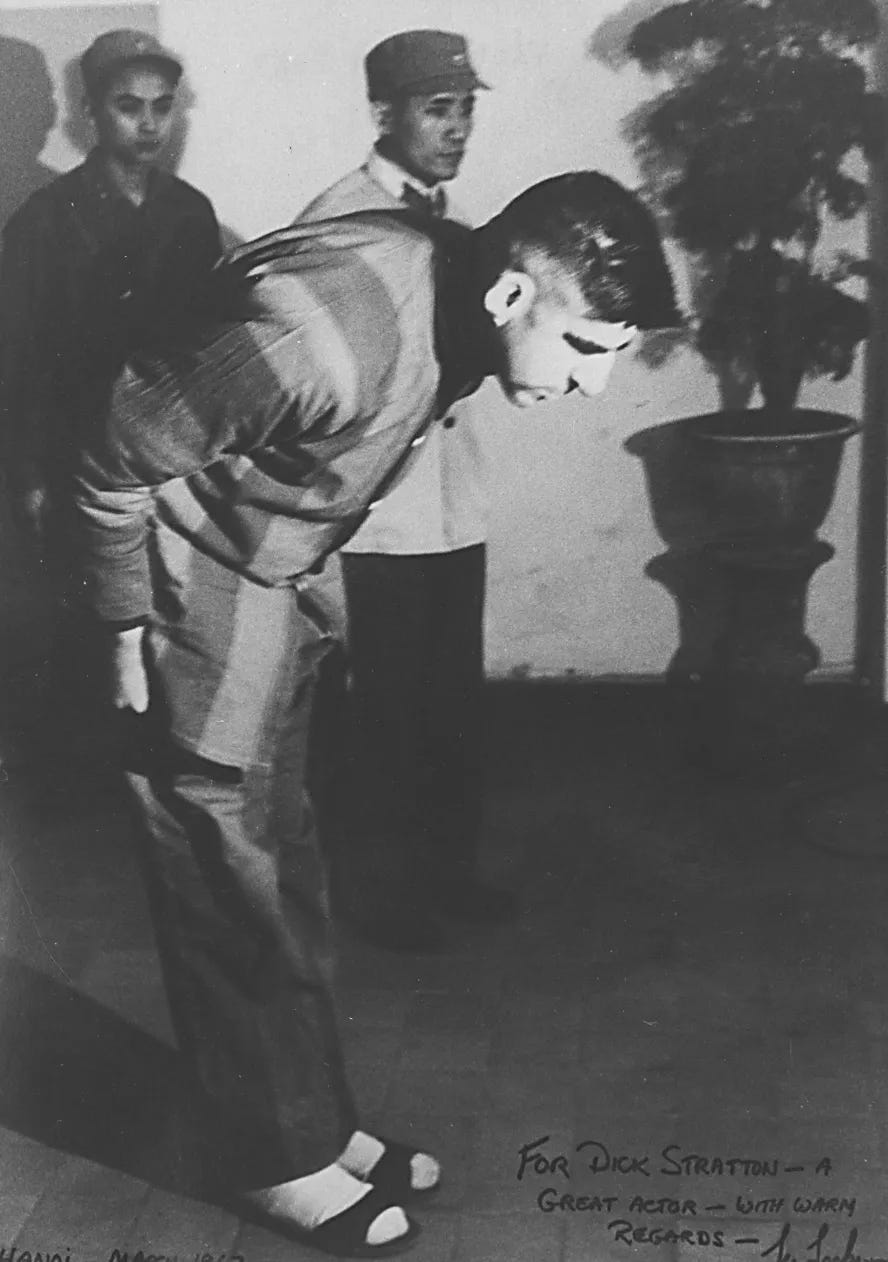
Another Navy officer, Lieutenant Commander Richard Stratton, was brought before a carefully staged press conference. Wearing prison garb, he entered and then performed a series of deep, formal bows—from the waist, rigid and repeated — turning toward different directions as if submitting to his captors and camera crews. An American journalist present described him as “looking like a puppet” whose “eyes were empty”.
Stratton’s demeanor and exaggerated, robot-like bowing were widely understood as a signal by Stratton that he was participating in a propaganda exercise under duress, rather than freely cooperating with the enemy.
Back to the Original Big Balls
But my favorite of all the stories of heroism, leavened with imagination and even a touch of humor, is the story of Original Big Balls, a/k/a Lieutenant Paul Galanti. In 1967, Lieutenant Galanti was tortured until he finally agreed to pose for staged propaganda photos by an East German camera and film crew. So, he complied. Here he is:
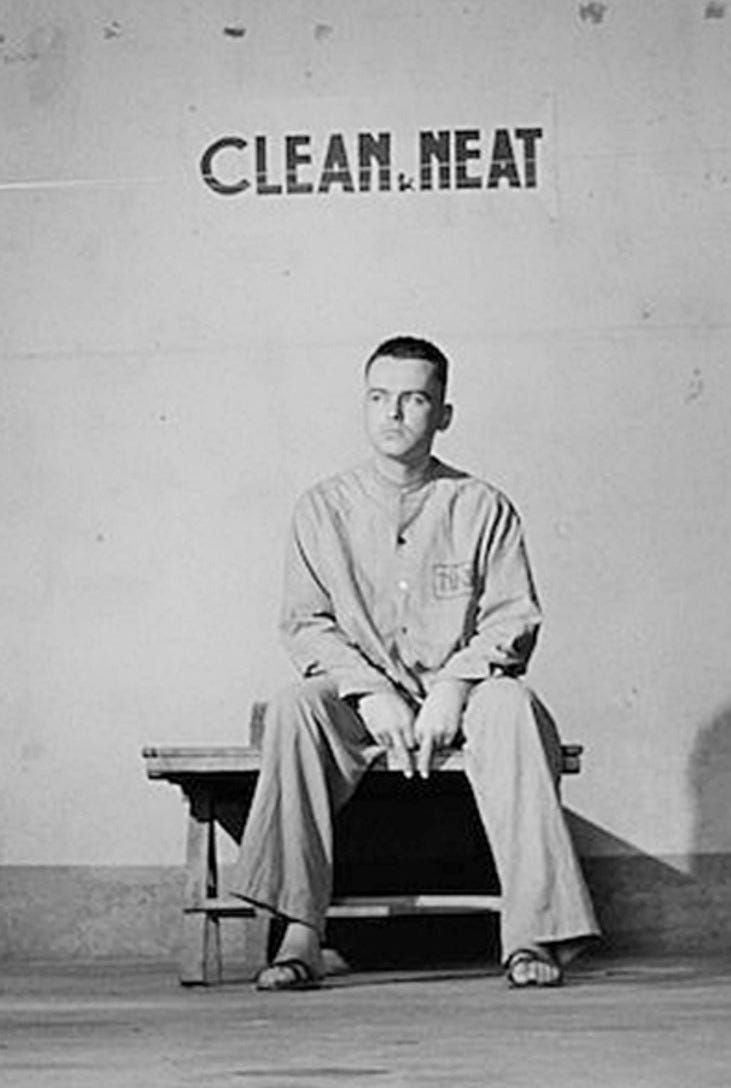
As you can see, Paul was respectfully honoring his guards and the East Germans with the traditional one-finger salute. To ensure that his captors and the East Germans understood what he thought of them, he even saluted with both hands.
Paul’s North Vietnamese captors didn’t have a clue. Proud of their propaganda coup, they released the photo to the world. And then, as Lord Tennyson said in his paean to the courage of the Light Brigade, “All the world wondered.”
The photo even made the cover of LIFE magazine, albeit in a modified form.
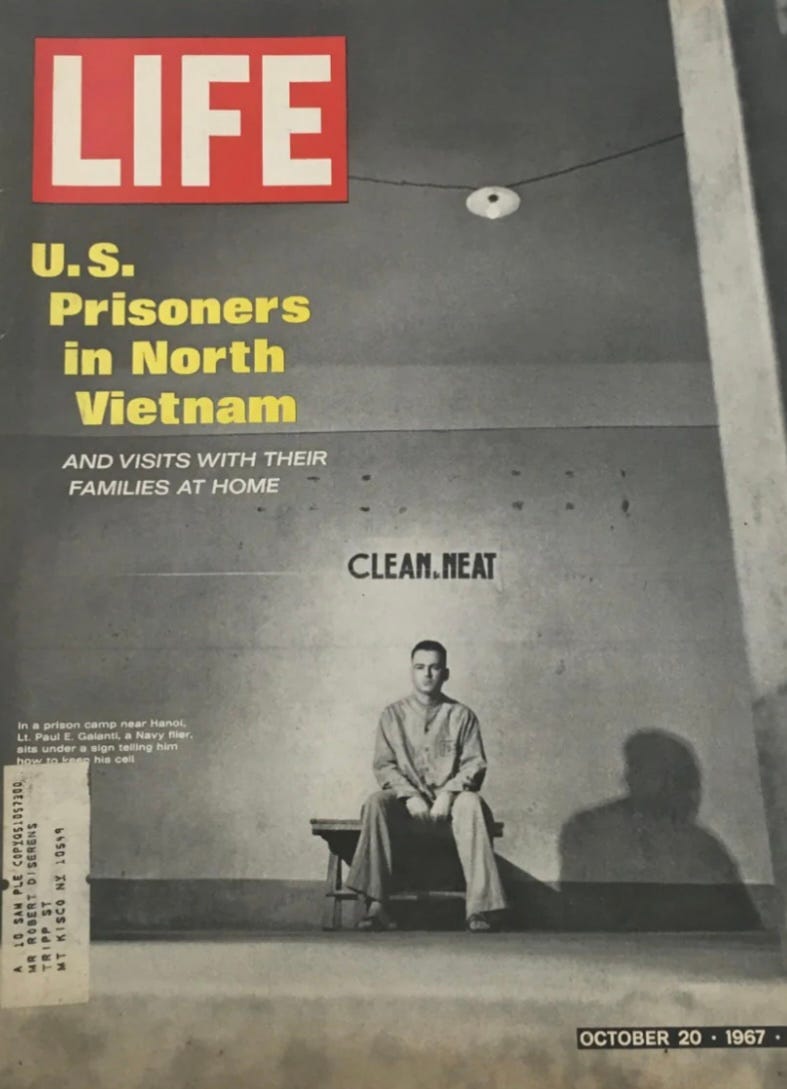
As you can see, the delicate flowers at LIFE were aghast at Lieutenant Galanti’s somewhat cheeky affront to his captors, and airbrushed out his salute. LIFE’s accompanying article, however, did describe some of the conditions to which the POWs were subjected. Despite that airbrushing, other copies were circulated, and the cat was out of the bag, so to speak. And, of course, Paul’s guards and interrogators finally figured out that he had been somewhat discourteous and brutally tortured him again in retaliation.
When he decided to strike his pose for the East German cameras, even though the North Vietnamese were blissfully unaware of the message he was conveying, Paul knew that when the photos were published, the truth would come out, and his captors would realize they had been deceived. He knew with certainty that they would once again subject him to inhuman tortures.
But he did it anyway. He did it because he wanted to send a message to the world. He did it because he was wedded to his sense of duty, honor, and country. Knowing of the tortures to come, he did it because he had Big Balls.
We honor Paul Galanti, Richard Stratton, Jeremiah Denton, and others like them every Veterans Day.
This author contributed earlier articles on this website. If you want to check them out, click on the links below:
https://cherrieswriter.com/2025/06/28/courage-and-coolness-in-a-pressure-cooker-a-vietnam-war-story/
Bravo Blue is a reader-supported publication. To receive new posts and support my work, consider becoming a free or paid subscriber: https://substack.com/@johnalucas6/posts
#####
If you wish to read more about Doug Heydahl (The Incredible Stupid One) or other POW articles, click on the magnifying glass at the top right of this screen and type POWs for a drop-down menu of a dozen articles.
*****
Thank you for taking the time to read this. If you have a question or comment about this article, scroll down to the comment section below to leave your response.
If you want to learn more about the Vietnam War and its Warriors, subscribe to this blog and get notified by email or your feed reader every time a new story, picture, video, or change occurs on this website—the button is located at the top right of this page.
I’ve also created a poll to help identify my website audience. Before leaving, please click HERE and choose the one item that best describes you. Thank you in advance!

 CherriesWriter - Vietnam War website
John, Thank you for posting the best summary I have ever read of how POWs suffered in VN. In particular, I must offer a Bravo Zulu for your coverage of Paul.
While Paul was in the Hanoi Hilton, I was off the coast, particularly I Corps, doing shore fire bombardment. However, I had the great privilege of getting to personally know Paul when I worked for him as the Commissioner of Virginia DVS. He was a great and inspirational leader..
Jim Thur, Capt. USNR (Ret.)
LikeLike
Thanks for your note, Jim. Just being able to know people like Paul is something that most people don’t get to do.
Sounds like you live in VA. Where are you. I am in Goochland County.
Here are two more of my articles (not on this site) that you may like.
The Incredibly Stupid One – An American Hero
“Our hearts were touched with fire.” – by John A. Lucas
Let me know if you get these. I hope you like them.
John
LikeLike
I still have my copy of Life with the salute airbrushed out. Phylis Galanti, Paul’s wife, emerged as a spokesperson for the families. She became known as Fearless Phylis.
LikeLike
She was a real heroine. After the State Department told all the wives to keep quiet but got no results, she became an outspoken woman exposing what the No. Viets were doing to the prisoners.
LikeLike