
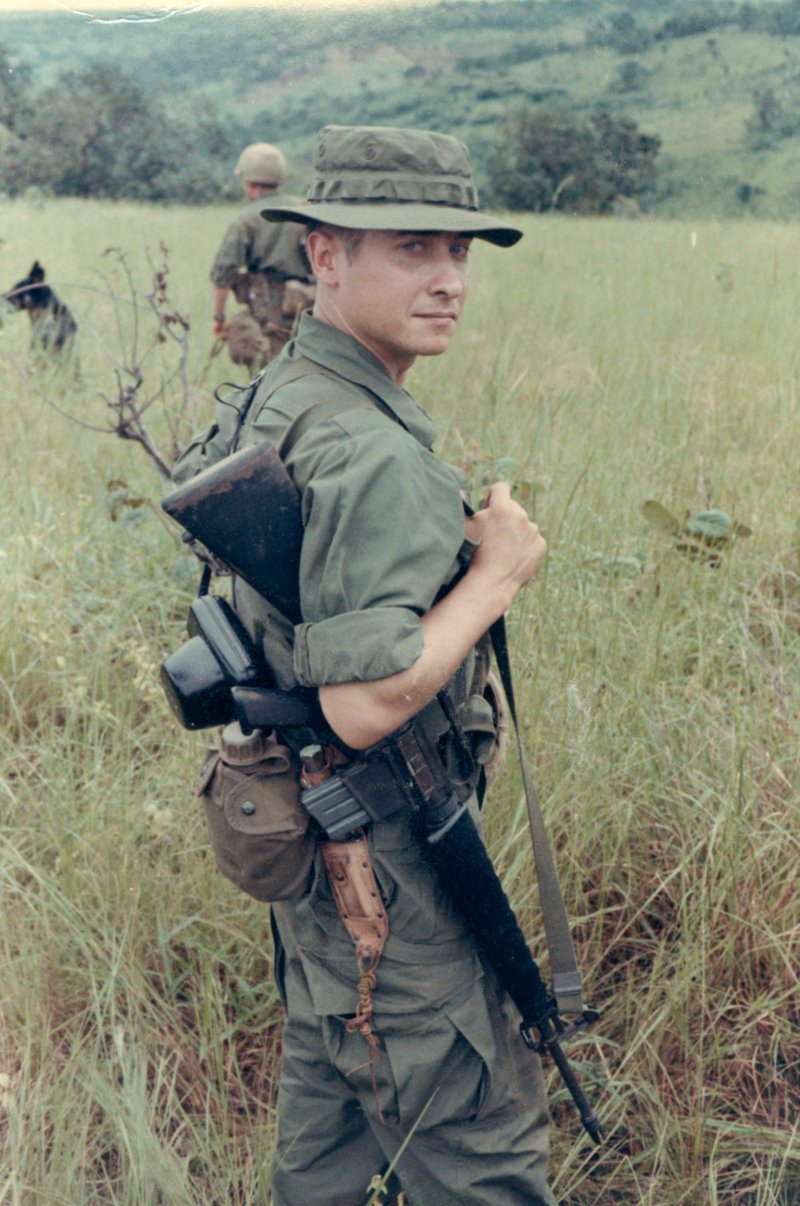
Jere Meacham on patrol in Vietnam with other members of the U.S. Army’s Fourth Infantry Division. He sent the images to his son in 1999
In 1999, one former combat soldier from the Army’s Fourth Infantry Division in Vietnam sent a package to his son comprised of words and photos regarding his time during the war. Check out the photos and read what his son had to say about the package.
BY JON MEACHAM
Thirty years after everything happened–and 31 years since he had first set foot in Southeast Asia–my father, a soldier of the Fourth Infantry Division, wrote me a letter. It was 1999, and the note came with a set of recently rediscovered photographs he and his friends had taken with an old 35-mm Minolta in the Central Highlands of Vietnam. There were images of impossibly young men, their helmets heavy on their heads, carrying M-16s, smoking cigarettes, and trying to look happy–itself a form of bravery. There were pictures of the lush landscape and of villagers going about their business, drawing water and sitting, watching, some blankly, all warily.
My father’s words, though, were the most poignant part of the package. “I thought you might like to have these,” he wrote me. “You are the historian, and I know you will preserve them. I remember the brutal heat, the more brutal humidity, the chop-chop-chop of the helicopter blades, and elephant grass that could cut men up like a knife. And I remember many things that I have never told you or anyone. Those are the demons that I will always bear. South Vietnam, for me, is a place I’ve never really left.”
Neither, truth be told, has America. As I watched Ken Burns and Lynn Novick’s illuminating 10-part documentary The Vietnam War, I thought often of my father and, inescapably, of his “demons.” He hinted from time to time about harrowing firefights with enemy soldiers but offered no details. The numbers tell a grim story: from 1966 to ’70, 2,500 fellow members of what’s known as the “Ivy Division” died; 15,000 were wounded. For my father and so many other veterans, the battles never genuinely ended. Over the decades, casualties of this perpetual war included emotional stability, peace of mind, marriages, and, more broadly, America’s sense of virtue and of self-confidence.
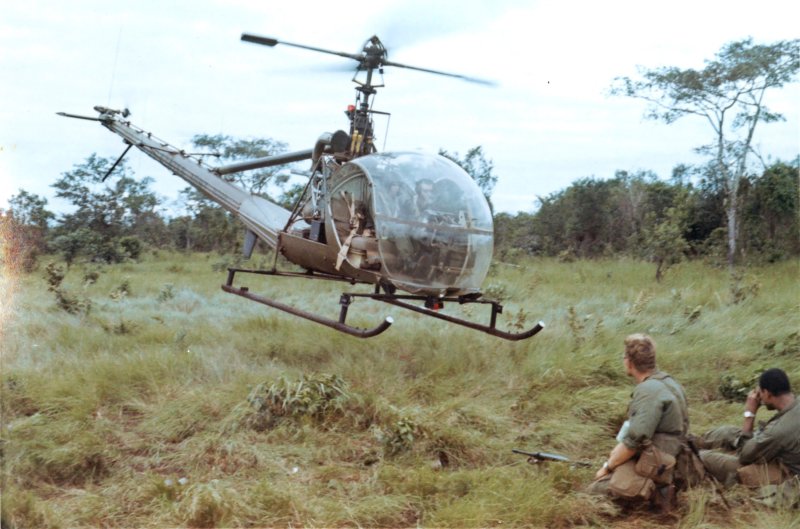
Jere Meacham on patrol in Vietnam with other members of the U.S. Army’s Fourth Infantry Division. He sent the images to his son in 1999 Courtesy Jon Meacham
The power of Burns and Novick’s documentary lies in its remarkable capacity to tell the story of the struggle in terms both particular and universal. This is part historical narrative, part cultural exploration, and part therapy–the last made even more effective by its subtlety. Burns and Novick take us from the corridors of power in Washington, Hanoi, and Saigon (now Ho Chi Minh City) to rice paddies and jungles and POW prisons. Driven by Burns’ characteristic devices–curated music, limited but effective interviews, and powerful still and moving imagery–The Vietnam War may have an even larger cultural impact than his landmark Civil War project of 1990. (Colin Powell, then Chairman of the Joint Chiefs of Staff, gave President George H. W. Bush videotapes of that documentary to watch in the run-up to the Gulf War. In his audiotape diary, the President recounted how the moving accounts of the travails of ordinary soldiers helped reinforce his determination to avoid a long land war in the Middle East.) I’ve always thought about what it would have been like for veterans of the cataclysm of 1861–65 to experience Burns’ treatment of their war. With the new documentary, we don’t have to wonder, for the warriors of the Vietnam era, many now in their 70s, will relive those momentous, disorienting days.
Vietnam and Watergate were decisive events in the erosion of trust in the government with which we still live, and both Lyndon Johnson and Richard Nixon admitted in private what they would not say in public. “The great trouble I’m under–a man can fight if he can see daylight down the road somewhere,” Johnson told Senator Richard Russell in a tape-recorded conversation in March 1965, early in the journey. “But there ain’t no daylight in Vietnam.” During the ’68 campaign, Nixon was more honest with his aides than with voters–and soldiers: “I’ve concluded that there’s no way to win the war,” Nixon said. “But we can’t say that, of course. In fact, we have to seem to say the opposite, just to keep some degree of bargaining leverage.” The war would last another seven years.
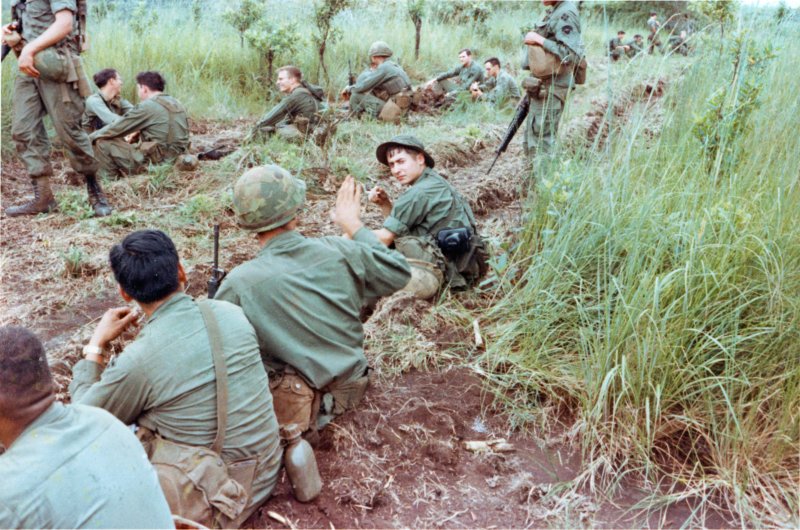
Jere Meacham on patrol in Vietnam with other members of the U.S. Army’s Fourth Infantry Division. He sent the images to his son in 1999. Courtesy Jon Meacham
Hal Kushner, a medic, held in captivity for five years by the Viet Cong, is among the film’s memorably affecting figures. His voice catching, tears coming, Kushner describes his 1973 release: “There was an Air Force brigadier general in Class A uniform. He looked magnificent. I looked at him, and he had breadth; he had a thickness that we didn’t have. He had on a garrison cap, and his hair was plump and moist, and our hair was like straw. It was dry, and we were skinny. And I went out and I saluted him, which was a courtesy that had been denied us for so many years. And he saluted me, and I shook hands with him, and he hugged me–he actually hugged me. And he said, ‘Welcome home, Major. We’re glad to see you, Doctor.’ The tears were streaming down his cheeks.”
In the film, Kushner tells this story with Ray Charles’ “America the Beautiful” playing softly in the background. To write about it risks making the presentation of Kushner’s release seem hokey, but it is not. Far from it. To me, the Kushner sequence is perhaps the most powerful moment in the entire series, not least because of the newly freed POW’s sense of dimension and size. The magnificence of the officer who greeted him, the “breadth” and “thickness” and the “plump” and “moist” hair: it’s as though the scraggly and sapped Kushner saw the general as the embodiment of the old America, invincible America, victorious America–an America that didn’t really exist anymore, or at least not in Southeast Asia.
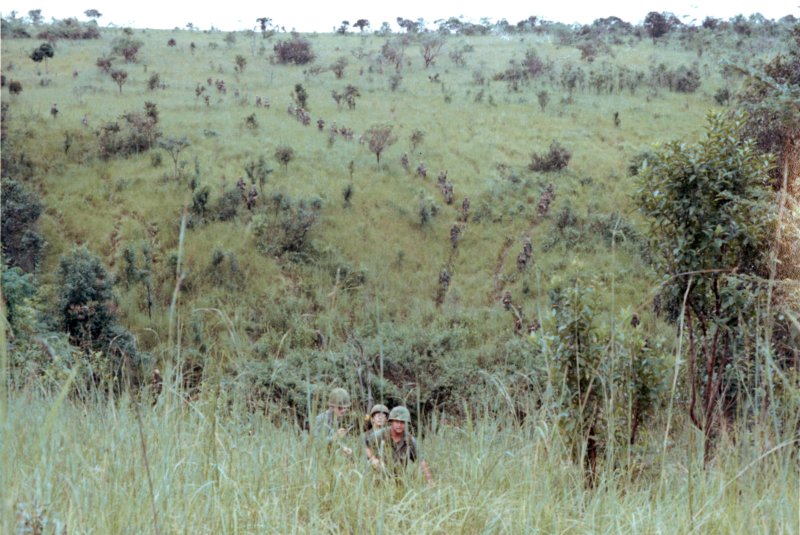
Picture taken in the Central Highlands in South Vietnam 1968-69. Courtesy Jon Meacham
One cold winter morning after Christmas 1984–I was 15, the same age my son is now–my father and I took a trip to Washington. Like a lot of other veterans, he had been skeptical of the plans for the Vietnam Veterans Memorial, thinking the unusual design in a gently sloping hill in the shadow of the monuments to Lincoln and Washington suggested a lack of respect. Seeing it changed his mind. He said nothing as we walked along the wall of the dead. Coming to the years of his service, he stopped, searching for a familiar name. He found it, and it was within reach. He ran a finger over the letters, turned, stepped back, and we moved on.
In his letter to me with the photographs of Vietnam 15 years later, my father was relatively terse about his thoughts in-country. “I wanted,” he wrote, “to get back to life.” My father is dead now, but for the warriors who remain among us, Ken Burns has at last charted a path back toward life, and toward home.
Meacham is the author of Destiny and Power: The American Odyssey of George Herbert Walker Bush.
This appeared in the September 25, 2017, issue of TIME.
*****
Thank you for taking the time to read this. Should you have a question or comment about this article, then scroll down to the comment section below to leave your response.
If you want to learn more about the Vietnam War and its Warriors, then subscribe to this blog and get notified by email or your feed reader every time a new story, picture, video and changes occur on this website – the button is located at the top right of this page.
I’ve also created a poll to help identify my website audience – before leaving, can you please click HERE and choose the one item that best describes you. Thank you in advance!

 CherriesWriter - Vietnam War website
Hello,
I was born March 6, 1971. My junior year of high school and the week when we studied the Vietnam War, our teacher took a week long leave. When he returned, I asked him why he wasn’t there to talk about Vietnam.I had so many questions although he said nothing and walked away. I read everything and watched everything I could find on the Vietnam War. Besides the textbook, I read “Mike Force” which I would eventually buy along with “We Were Soldiers…” including buying the movie. I had 2 uncles who served over there also although they did not want to talk about it. My father was in the Navy although my parents divorced when I was 6 and my mom has told me very little about my dad. I do know he was stationed in Japan before the Vietnam War. I also have an older sister who was born in 1969. That still leaves some years that he may have been stationed offshore at Vietnam, it being just southwest of Japan. I don’t know when he was stationed there though. I only saw Japanese currency that my aunt gave to my brother.
Thank you for sharing all of these stories.
Sincerely, Stephanie I. Smith
LikeLike
A wonderful read. But I think the nation as a whole is far too pessimistic about the war. First of all, even if we did not win in the traditional sense, what we did to help the South Vietnamese cause likely ended up influencing the youth of our time, especially those drafted in the North for the NVA. They must have been impressed by what we did for the South, how we improved the performance of their soldiers, developed infrastructure, and even their economy. This may explain why modern Vietnam is more friendly toward us than toward China and has integrated free enterprise within their nominally Communist system. Also, one has to wonder whether or not cutting off our support for the South, promised in the peace treaty with the NVA and VC in order to counter-balance support from the Communist world might have made a vast difference at least in how long the South may have survived and put off the fall of Saigon. I will always suspect that if at the point where we built up the war in ’66 or so with troops ships to carry sufficient troops over we had exercised more restraint, and not seen Vietnam like any conventional war we might have induced the South to draft more of its young men, even the privileged, and perform more effectively. In a guerilla war, a willingness to sacrifice for your own country and more knowledge of the terrain, plus a much larger sense of desperation, might have helped the South to prevail. I know this is 20.20 hindsight, but still I just don’t agree with all the desperation about how our involvement was a total waste, did no good, and had no chance of ever succeeding. If we learn from this that we should have started more Vietnamization much earlier, it could be a great lesson. As JFK said, “In the final analysis, it is their war.”
LikeLike
Well put, as usual. I plan to tell my 5 sons and seven grandsons my story to a camera soon. My memoir, in the style of a Spenserian epic poem, is half-finished at wimgrundy.wordpress.com
LikeLike
As the son of a WWII 3 1/2 year survivor against all odds (1:7) flying bombers in North Africa, Italy, and over much of Europe who rarely spoke of “the War” until I came back from infantry combat in Somalia in 1993, I fully empathize with the author. We love our fathers and respect them for their honorable service and humanity during a terrible war. Although fully trained and prepared to fight in VN, I missed that war by a few months. All of my mentors while on active duty for 31 years were Vietnam veterans – officers and NCOs. Two distinguished military historians and combat veterans among them who I greatly respected told me there were huge flaws in the Ken Burns video. Lewis Sorely, Deputy CIA Director and aides of and biogragher of both Abrams and Westmoreland was interviewed for 2.5 hours by Novak and his comments were cherry-picked for all of less than 2 minutes. Three Silver Star recipients and one MOH friends of mine pointed out there was more in the film about the political devisiveness and anti-war movement in the US than the war itself. There was almost nothing about the military strategies, battles (which we almost always won), our brave S.Korean, Australian, NZ allies, or the combat fought by Americans. For God’s sake we fought there for 12 years with millions of young (and older) men risking their lives daily, more than 70% of whom volunteered to be there. Highly anticipated by millions of Americans, the Burns and Novak film seemed to be more communist propoganda than a balanced documentary, disappointing tens of thousands of VN veterans. I heard criticsms from everyone I knew who had been in that war. It did not heal their wounds. By now most of those veterans are in their graves or late 70s-90s. They, like me with Somalia, will never stop being there in our dreams and unexpected thoughts or flashbacks. All warriors are alike.
LikeLike
Very interesting. I know of Jon, but never knew his dad was a Vietnam Veteran. Thanks for posting.
Bob
When I was 5 years old, my mother always told me that happiness was the key to life. When I went to school, they asked me what I wanted to be when I grew up. I wrote down ‘happy’. They told me I didn’t understand the assignment, and I told them they didn’t understand life. — John Lennon
LikeLike
Very good article. The only thing I saw that made me re-read it was in the first paragraph. I agree with all that was written except for the comment “trying to look happy”. What always amazes me, remembering back to 1970, was how the smallest, trivial things could make me smile. I, much later, decided it was because we were always hot, hungry, thirsty, tired and constantly on edge as no place was “safe”. Because of the nature of where we were and what our jobs were as 11Bs, every small thing with a touch of humor made me smile. We needed to smile when we could, to offset the far too many deadly things happening daily that weighed us down. Welcome Home Brothers to all who made it….Rest in Peace to those who didn’t. C 1/6 198th LIB Americal 1970
LikeLike
The problem with the history of the Viet Nam War is the lack of perspective of the huge change in perception of the purpose of the War. It started for America with Kennedy who was assassinated two weeks after the CIA overthrew the VN government by assassinating President Diem. Kennedy had decided that it was an impossible War for the US to involve itself. The Democrats (who are now all Republicans) escalated from 16,000 “advisors” in 64 to 500,000 troops in 68. Not including the men manning the 7th Fleet in the Gulf of Tonkin and the men who manned 5 Air Force Bases in Thailand supporting the bombing of North Viet Nam. At least Ken Burns mentioned Nixon’s traitorous communications with the North Vietnamese to help him win the election in 68 after Johnson attempted to end the war and gave up running for President to prove his intentions. Nixon killed another 25,000 soldiers. He was supported by the “Military/Industrial complex” that Isenhower warned of when leaving office. And the Republicans party suddenly became the party of War and Corporate greed. That is the lost story of the Viet Nam War. The evidence of the greed and governmental mismanagement is the fact that the US carried out the War in the South, when the enemy lived in the North. Shameful loss of life that even those of us who “attended” after 1968 knew was a losing effort only benefiting the greedy Corporations that are now draining the lifeblood of our Nation. jmho (USAF Forward Air Controller 69/70 attached to SF B-41 on the Cambodian Border in the Mekong. )
LikeLike
Such a great discussion of Veteran fathers and sons. What great writing.
LikeLike
Coming home was tough. We recently had the 40th and last reunion of Vietnam War Veterans here. I wrote this article about that experience. https://www.chronicleonline.com/lifestyle/veterans/emotional-speech-honors-vietnam-war-veterans/article_f6d41212-f9ab-538b-92fe-b588f7488cbf.html
LikeLike
Likewise but I wrote a 288 pg book on my Reserve Unit called up in 1968.
‘Mekong Delta Yacht Club’ about Army Boat Company from Tampa Bay that got called for this bullshit non declaired war that was taking thousands of lives of our young Ameriacn Men. Check it out at https://MDYClub.com
on Amazon Books and E-Books
LikeLike